


Page 68 - JSOM Winter 2025
P. 68
•  Commercial (210) 916-2876 or (210) 222-2876        o All patients with a burn size >20% TBSA will typically
            •  Email to usarmy.jbsa.medcom-aisr.list.armyburncenter@   need burn resuscitation. Some patients with 10%–19%
               health.mil                                         TBSA will need resuscitation.
          6.  Evacuating the patient to definitive care.          o Best: Calculate burn resuscitation needs using the rule
                                                                  of tens:
                                14
          Burn Severity Calculation  considerations include the      – For adults weighing >40kg and <80kg, initial rate =
          following:                                                10×TBSA.
          •  Best: After wounds are cleaned and debrided, recalculate     – If >80kg, add 100mL/h for every 10kg >80kg.
            TBSA using the Lund Browder chart available through the     – Administer Lactated Ringer’s (LR) at a calculated
            Burn  Wound Management Under Prolonged Field Care       rate: in this patient’s case, 32%×10=320mL/h. As the
            CPG. 14                                                 patient weighs 90kg, the total IV fluid rate should be
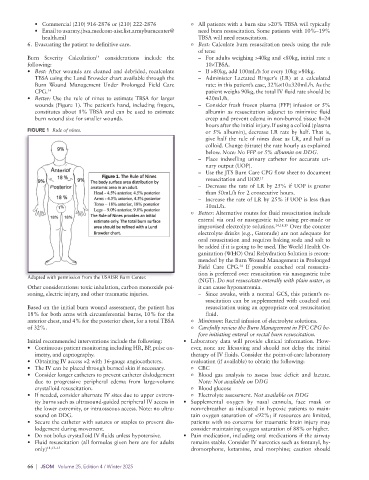
          •  Better: Use the rule of nines to estimate TBSA for larger   420mL/h.
            wounds (Figure 1). The patient’s hand, including fingers,     – Consider fresh frozen plasma (FFP) infusion or 5%
            constitutes about 1% TBSA and can be used to estimate   albumin as resuscitation adjunct to minimize fluid
            burn wound size for smaller wounds.                     creep and prevent edema in non-burned tissue 8–24
                                                                    hours after the initial injury. If using a colloid (plasma
          FIGURE 1  Rule of nines.                                  or 5% albumin), decrease LR rate by half. That is,
                                                                    give half the rule of nines dose as LR, and half as
                                                                    colloid. Change (titrate) the rate hourly as explained
                                                                    below. Note: No FFP or 5% albumin on DDG.
                                                                     – Place indwelling urinary catheter for accurate uri-
                                                                    nary output (UOP).
                                                                     – Use the JTS Burn Care CPG flow sheet to document
                                                                    resuscitation and UOP. 15
                                                                     – Decrease the rate of LR by 25% if UOP is greater
                                                                    than 50mL/h for 2 consecutive hours.
                                                                     – Increase the rate of LR by 25% if UOP is less than
                                                                    30mL/h.
                                                                  o Better: Alternative routes for fluid resuscitation include
                                                                  enteral via oral or nasogastric tube using pre-made or
                                                                  improvised electrolyte solutions. 14,18,19  Over the counter
                                                                  electrolyte drinks (e.g., Gatorade) are not adequate for
                                                                  oral resuscitation and requires baking soda and salt to
                                                                  be added if it is going to be used. The World Health Or-
                                                                  ganization (WHO) Oral Rehydration Solution is recom-
                                                                  mended by the Burn Wound Management in Prolonged
                                                                  Field Care CPG.  If possible coached oral resuscita-
                                                                               14
                                                                  tion is preferred over resuscitation via nasogastric tube
          Adapted with permission from the USAISR Burn Center.
                                                                  (NGT). Do not resuscitate enterally with plain water, as
          Other considerations: toxic inhalation, carbon monoxide poi-  it can cause hyponatremia.
          soning, electric injury, and other traumatic injuries.     – Since awake, with a normal GCS, this patient’s re-
                                                                    suscitation can be supplemented with coached oral
          Based on the initial burn wound assessment, the patient has   resuscitation using an appropriate oral resuscitation
          18% for both arms with circumferential burns, 10% for the   fluid.
          anterior chest, and 4% for the posterior chest, for a total TBSA     o Minimum: Rectal infusion of electrolyte solutions.
          of 32%.                                                 o Carefully review the Burn Management in PFC CPG be-
                                                                  fore initiating enteral or rectal burn resuscitation.
          Initial recommended interventions include the following:  •  Laboratory data will provide clinical information. How-
          •  Continuous patient monitoring including HR, BP, pulse ox-  ever,  none  are  lifesaving  and  should  not  delay  the  initial
            imetry, and capnography.                           therapy of IV fluids. Consider the point-of-care laboratory
          •  Obtaining IV access ×2 with 16-gauge angiocatheters.  evaluation (if available) to obtain the following:
          •  The IV can be placed through burned skin if necessary.    o CBC
          •  Consider longer catheters to prevent catheter dislodgement     o Blood gas analysis to assess base deficit and lactate.
            due to progressive peripheral edema from large-volume   Note: Not available on DDG
            crystalloid resuscitation.                            o Blood glucose
          •  If needed, consider alternate IV sites due to upper extrem-    o Electrolyte assessment. Not available on DDG
            ity burns such as ultrasound-guided peripheral IV access in   •  Supplemental oxygen by nasal cannula, face mask or
            the lower extremity, or intraosseous access. Note: no ultra-  non-rebreather as indicated in hypoxic patients to main-
            sound on DDG.                                      tain oxygen saturation of <92%; if resources are limited,
          •  Secure the catheter with sutures or staples to prevent dis-  patients with no concerns for traumatic brain injury may
            lodgement during movement.                         consider maintaining oxygen saturation of 88% or higher.
          •  Do not bolus crystalloid IV fluids unless hypotensive.  •  Pain medication, including oral medications if the airway
          •  Fluid resuscitation (all formulas given here are for adults   remains stable. Consider IV narcotics such as fentanyl, hy-
            only) 11,13–15                                     dromorphone, ketamine, and morphine; caution should

          66  |  JSOM   Volume 25, Edition 4 / Winter 2025

