


Page 73 - JSOM Winter 2025
P. 73
the USS Stark (FFG-31) and the 2000 improvised explosive   only options for IDCs on these platforms. Managing one pa-
              device attack on the USS Cole (DDG-687) resulted in signifi-  tient requiring airway and respiratory support with a BVM is
              cant damage to each ship, killing nearly 10% of the combined   time- and labor-intensive for one patient, let alone multiple
              crews. Of the 58 injured survivors from both ships, burn or in-  patients. Depending on the operational situation and whether
              halation injuries occurred in 22.4%. Modern openly available   or not the ship is under threat, maritime caregivers can uti-
              casualty estimates of an attack and loss of an aircraft carrier   lize non-medical crew to assist with this critical task. Other
              crewed by 5,500 personnel suggest that nearly 50% will be   equipment and medication shortfalls identified that would
              killed immediately from blunt force trauma, burns, inhalation   help in managing this patient include ultrasound, three-lead
              injury, or drowning. Of the survivors, 1,030 will have major   cardiac monitoring, nasogastric tubes, subcutaneous heparin,
              injuries including an estimated 309 survivors with some type   and the supplies, training, and protocols required to establish a
              of burn or inhalation injury. Therefore, to prepare for both   walking blood bank. While ten 30mg doses of enoxaparin are
              current DMOs, and a potential future large-scale war at sea,   available on destroyers, heparin is not. Subcutaneous heparin
              all maritime caregivers need both training and clinical expe-  may be a more versatile drug for chemical VTE prophylaxis in
              rience in the acute and prolonged management of severely   austere environments, in which renal function (beyond UOP)
              burned casualties.                                 cannot be monitored.
                                                                 BOX 2  Potential Procedures Required to Manage Burn Injury
              Maritime Burn Care Training and Supply Gaps
              The burn injury clinical experience and training gap for na-  • Endotracheal Intubation
              val caregivers has been well documented. 8,22  Individual units   • Cricothyroidotomy
                                                                 • Burn wound care (including cleaning/debridement and burn
              and medical departments are taking steps to close this gap,   dressings)
              but widespread curricular and doctrinal changes are needed.   • Escharotomy
              Box 1 lists common readily available resources to maritime   • Tube thoracostomy
              caregivers, used in this scenario, to help prepare them to man-  • Nasogastric tube placement
                                                                 • Walking blood blank
              age burn-injured and critically ill casualties in austere environ-
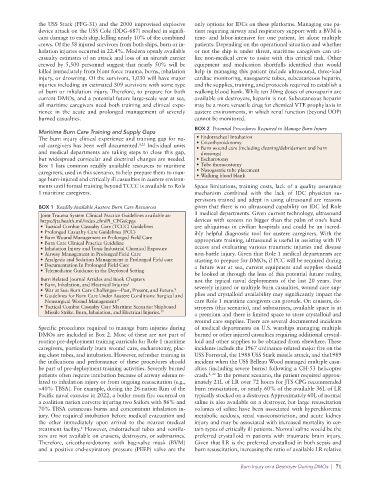
              ments until formal training beyond TCCC is available to Role   Space limitations, training costs, lack of a quality assurance
              1 maritime caregivers.                             mechanism combined with the lack of IDC physician su-
                                                                 pervisors trained and adept in using ultrasound are reasons
              BOX 1  Readily Available Austere Burn Care Resources  given that there is no ultrasound capability on IDC led Role
              Joint Trauma System Clinical Practice Guidelines available at:   1 medical departments. Given current technology, ultrasound
              https://jts.health.mil/index.cfm/PI_CPGs/cpgs      devices with screens no bigger than the palm of one’s hand
              • Tactical Combat Casualty Care (TCCC) Guidelines  are ubiquitous in civilian hospitals and could be an incred-
              • Prolonged Casualty Care Guidelines (PCC)         ibly helpful diagnostic tool for austere  caregivers. With the
              • Burn Wound Management in Prolonged Field Care    appropriate training, ultrasound is useful in assisting with IV
              • Burn Care Clinical Practice Guideline
              • Inhalation Injury and Toxic Industrial Chemical Exposure  access and evaluating various traumatic injuries and disease
              • Airway Management in Prolonged Field Care        non-battle injury. Given that Role 1 medical departments are
              • Analgesia and Sedation Management in Prolonged Field care  starting to prepare for DMOs, if PCC will be required during
              • Documentation In Prolonged Field Care            a future war at sea, current equipment and supplies should
              • Telemedicine Guidance in the Deployed Setting
                                                                 be looked at through the lens of this potential future reality,
              Burn Related Journal Articles and Book Chapters    not the typical naval deployments of the last 20 years. For
              • Burn, Inhalation, and Electrical Injuries 1      severely injured or multiple burn casualties, wound care sup-
              • War at Sea: Burn Care Challenges—Past, Present, and Future. 8
              • Guidelines for Burn Care Under Austere Conditions: Surgical and   plies and crystalloid availability may significantly impact the
                Nonsurgical Wound Management 17                  care Role 1 maritime caregivers can provide. On cruisers, de-
              • Tactical Combat Casualty Care Maritime Scenario: Shipboard   stroyers (this scenario), and submarines, available space is at
                Missile Strike. Burn, Inhalation, and Electrical Injuries.    a premium and there is limited space to store crystalloid and
                                                     19
                                                                 wound care supplies. There are several documented incidents
              Specific procedures required to manage burn injuries during   of medical departments on U.S. warships managing multiple
              DMOs are included in Box 2. Most of these are not part of   burned or other injured casualties requiring additional crystal-
              routine pre-deployment training curricula for Role 1 maritime   loid and other supplies to be obtained from elsewhere. These
              caregivers, particularly burn wound care, escharotomy, plac-  incidents include the 1967 ordinance-related major fire on the
              ing chest tubes, and intubation. However, refresher training in   USS Forrestal, the 1988 USS Stark missile attack, and the1989
              the indications and performance of these procedures should   incident when the USS Belleau Wood managed multiple casu-
              be part of pre-deployment training activities. Severely burned   alties (including severe burns) following a CH-53 helicopter
              patients often require intubation because of airway edema re-  crash. 8, 22  In the present scenario, the patient required approx-
              lated to inhalation injury or from ongoing resuscitation (e.g.,   imately 21L of LR over 72 hours for JTS CPG recommended
              >40% TBSA). For example, during the 26-nation Rim of the   burn resuscitation, or nearly 60% of the available 36L of LR
              Pacific naval exercise in 2022, a boiler room fire occurred on   typically stocked on a destroyer. Approximately 60L of normal
              a coalition nation corvette injuring two Sailors with 86% and   saline is also available on a destroyer, but large resuscitation
              70% TBSA cutaneous burns and concomitant inhalation in-  volumes of saline have been associated with hyperchloremic
              jury. One required intubation before medical evacuation and   metabolic  acidosis,  renal  vasoconstriction,  and  acute  kidney
              the other immediately upon arrival to the nearest medical   injury and may be associated with increased mortality in cer-
              treatment facility.  However, endotracheal tubes and ventila-  tain types of critically ill patients. Normal saline would be the
                           8
              tors are not available on cruisers, destroyers, or submarines.   preferred crystalloid in patients with traumatic brain injury.
              Therefore, cricothyroidotomy with bag-valve mask (BVM)   Given that LR is the preferred crystalloid in both sepsis and
              and a positive end-expiratory pressure (PEEP) valve are the   burn resuscitation, increasing the ratio of available LR relative

                                                                                Burn Injury on a Destroyer During DMOs  |  71

