


Page 77 - JSOM Winter 2025
P. 77
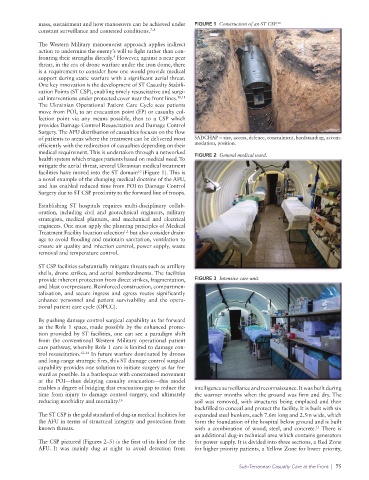
mass, sustainment and how manoeuvre can be achieved under   FIGURE 1  Construction of an ST CSP. 10
              constant surveillance and contested conditions. 7–8
              The Western Military manoeuvrist approach applies indirect
              action to undermine the enemy’s will to fight rather than con-
                                      9
              fronting their strengths directly.  However, against a near peer
              threat, in the era of drone warfare under the iron dome, there
              is a requirement to consider how one would provide medical
              support during static warfare with a significant aerial threat.
              One key innovation is the development of ST Casualty Stabili-
              zation Points (ST CSP), enabling timely resuscitative and surgi-
              cal interventions under protected cover near the front lines. 10,11
              The Ukrainian Operational Patient Care Cycle sees patients
              move from POI, to an evacuation point (EP) or casualty col-
              lection point via any means possible, then to a CSP which
              provides Damage Control Resuscitation and Damage Control
              Surgery. The AFU distribution of casualties focuses on the flow
              of patients to areas where the treatment can be delivered most   SADCHAP = size, access, defence, concealment, hardstanding, accom-
              efficiently with the redirection of casualties depending on their   modation, position.
              medical requirement. This is undertaken through a networked   FIGURE 2  General medical ward.
              health system which triages patients based on medical need. To
              mitigate the aerial threat, several Ukrainian medical treatment
                                              10
              facilities have moved into the ST domain (Figure 1). This is
              a novel example of the changing medical doctrine of the AFU,
              and has enabled reduced time from POI to Damage Control
              Surgery due to ST CSP proximity to the forward line of troops.
              Establishing ST hospitals requires multi-disciplinary collab-
              oration, including civil and geotechnical engineers, military
              strategists, medical planners, and mechanical and electrical
              engineers. One must apply the planning principles of Medical
              Treatment Facility location selection  but also consider drain-
                                          1,2
              age to avoid flooding and maintain sanitation, ventilation to
              ensure air quality and infection control, power supply, waste
              removal and temperature control.

              ST CSP facilities substantially mitigate threats such as artillery
              shells, drone strikes, and aerial bombardments. The facilities
              provide inherent protection from direct strikes, fragmentation,   FIGURE 3  Intensive care unit.
              and blast overpressure. Reinforced construction, compartmen-
              talization, and secure ingress and egress routes significantly
              enhance  personnel  and patient  survivability  and the  opera-
              tional patient care cycle (OPCC).

              By pushing damage control surgical capability as far forward
              as the Role 1 space, made possible by the enhanced protec-
              tion provided by ST facilities, one can see a paradigm shift
              from  the  conventional Western  Military  operational  patient
              care pathway, whereby Role 1 care is limited to damage con-
              trol resuscitation. 12–14  In future warfare dominated by drones
              and long-range strategic fires, this ST damage control surgical
              capability provides one solution to initiate surgery as far for-
              ward as possible. In a battlespace with constrained movement
              at the POI—thus delaying casualty evacuation—this model
              enables a degree of bridging that evacuation gap to reduce the   intelligence surveillance and reconnaissance. It was built during
              time from injury to damage control surgery, and ultimately   the warmer months when the ground was firm and dry. The
              reducing morbidity and mortality. 16               soil was removed, with structures being emplaced and then
                                                                 backfilled to conceal and protect the facility. It is built with six
              The ST CSP is the gold standard of dug-in medical facilities for   expanded steel bunkers, each 7.6m long and 2.5m wide, which
              the AFU in terms of structural integrity and protection from   form the foundation of the hospital below ground and is built
              known threats.                                     with a combination of wood, steel, and concrete.  There is
                                                                                                        11
                                                                 an additional dug-in technical area which contains generators
              The CSP pictured (Figures 2–5) is the first of its kind for the   for power supply. It is divided into three sections, a Red Zone
              AFU. It was mainly dug at night to avoid detection from   for higher priority patients, a Yellow Zone for lower priority,

                                                                               Sub-Terranean Casualty Care at the Front  |  75

