


Page 78 - JSOM Winter 2025
P. 78
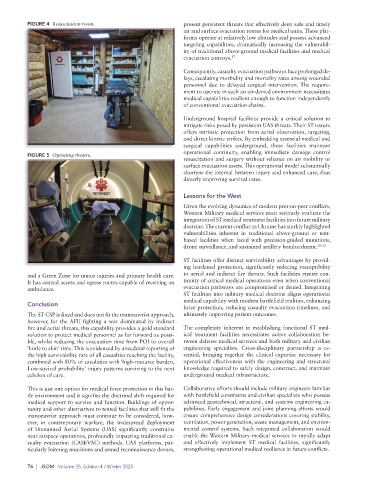
FIGURE 4  Resuscitation room.                      present persistent threats that effectively deny safe and timely
                                                             air and surface evacuation routes for medical units. These plat-
                                                             forms operate at relatively low altitudes and possess advanced
                                                             targeting capabilities, dramatically increasing the vulnerabil-
                                                             ity of traditional above-ground medical facilities and medical
                                                             evacuation convoys. 17

                                                             Consequently, casualty evacuation pathways face prolonged de-
                                                             lays, escalating morbidity and mortality rates among wounded
                                                             personnel due to delayed surgical intervention. The require-
                                                             ment to operate in such an air-denied environment necessitates
                                                             medical capabilities resilient enough to function independently
                                                             of conventional evacuation chains.

                                                             Underground hospital facilities provide a critical solution to
                                                             mitigate risks posed by persistent UAS threats. Their ST nature
                                                             offers intrinsic protection from aerial observation, targeting,
                                                             and direct kinetic strikes. By embedding essential medical and
                                                             surgical capabilities underground, these facilities maintain
                                                             operational  continuity, enabling  immediate damage  control
          FIGURE 5  Operating theatre.
                                                             resuscitation and surgery without reliance on air mobility or
                                                             surface evacuation assets. This operational model substantially
                                                             shortens the interval between injury and enhanced care, thus
                                                             directly improving survival rates.

                                                             Lessons for the West
                                                             Given the evolving dynamics of modern peer-on-peer conflicts,
                                                             Western Military medical services must seriously evaluate the
                                                             integration of ST medical treatment facilities into future military
                                                             doctrine. The current conflict in Ukraine has starkly highlighted
                                                             vulnerabilities inherent in traditional above-ground or tent-
                                                             based facilities when faced with precision-guided munitions,
                                                             drone surveillance, and sustained artillery bombardment. 18–19
                                                             ST facilities offer distinct survivability advantages by provid-
                                                             ing hardened protection, significantly reducing susceptibility
          and a Green Zone for minor injuries and primary health care.   to aerial and indirect fire threats. Such facilities ensure con-
          It has central access and egress routes capable of receiving an   tinuity of critical medical operations even when conventional
          ambulance.                                         evacuation pathways are compromised or denied. Integrating
                                                             ST facilities into military medical doctrine aligns operational
                                                             medical capability with modern battlefield realities, enhancing
          Conclusion                                         force protection, reducing casualty evacuation timelines, and
          The ST CSP is fixed and does not fit the manoeuvrist approach,   ultimately improving patient outcomes.
          however, for the AFU fighting a war dominated by indirect
          fire and aerial threats, this capability provides a gold standard   The  complexity inherent  in  establishing  functional ST  med-
          solution to protect medical personnel as far forward as possi-  ical treatment facilities necessitates active collaboration be-
          ble, whilst reducing the evacuation time from POI to overall   tween defense medical services and both military and civilian
          ‘knife to skin’ time. This is evidenced by anecdotal reporting of   engineering specialists. Cross-disciplinary partnership is es-
          the high survivability rate of all casualties reaching the facility,   sential, bringing together the clinical expertise necessary for
          combined with 80% of casulaties with ‘high-resource burden,   operational effectiveness with the engineering and structural
          Low-suvival probability’ injury patterns surviving to the next   knowledge required to safely design, construct, and maintain
          echelon of care.                                   underground medical infrastructure.

          This is just one option for medical force protection in this bat-  Collaborative efforts should include military engineers familiar
          tle environment and it signifies the doctrinal shift required for   with battlefield constraints and civilian specialists who possess
          medical support to survive and function. Buildings of oppor-  advanced geotechnical, structural, and systems engineering ca-
          tunity and other alternatives to tented facilities that still fit the   pabilities. Early engagement and joint planning efforts would
          manoeuvrist approach must continue to be considered, how-  ensure comprehensive design considerations covering stability,
          ever, in contemporary warfare, the widespread deployment   ventilation, power generation, waste management, and environ-
          of Unmanned  Aerial Systems (UAS) significantly constrains   mental control systems. Such integrated collaboration would
          near-airspace operations, profoundly impacting traditional ca-  enable the Western Military medical services to rapidly adapt
          sualty evacuation (CASEVAC) methods. UAS platforms, par-  and effectively implement ST medical facilities, significantly
          ticularly loitering munitions and armed reconnaissance drones,   strengthening operational medical resilience in future conflicts.

          76  |  JSOM   Volume 25, Edition 4 / Winter 2025

