


Page 70 - JSOM Winter 2025
P. 70
The IV fluid rate is LR at 525mL/h, with total estimated IV   •  Encouraging coughing and deep breathing hourly and reas-
          fluids at 6,142.5mL (~6.1L). Cumulative total UOP is 426mL   sess thoracic burns.
          (dark), approximately 55mL/h.                      •  Assisting the patient with oral/dental care.

          A single episode of vomiting controlled with ondansetron.   Time +24 Hours
          Now, with increasing pain in upper extremities, the patient is   The patient has been maintained on IV fluid resuscitation with
          not responding to previous medications. Radial pulses are ab-  good urine output. At 14 hours post-burn, IV fluids decreased
          sent in right upper extremity and diminished in the left upper   to 400mL. However, over the last 90 minutes, HR and RR
          extremity.                                         have increased, UOP and BP have started to decrease, and the
                                                             patient is complaining of chest wall pain on the right side.
          Recommended interventions include the following:
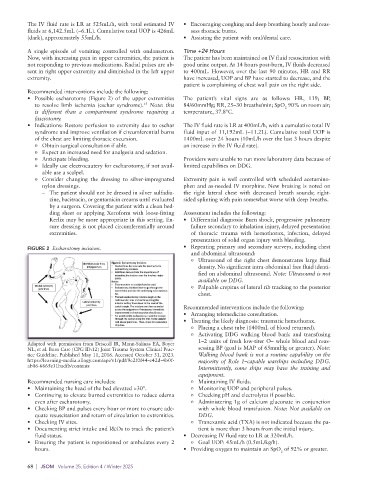
          •  Possible  escharotomy  (Figure  2)  of  the  upper  extremities   The patient’s vital signs are as follows: HR, 119; BP,
                                                15
            to resolve limb ischemia (eschar syndrome).   Note: this   84/60mmHg; RR, 25–30 breaths/min; SpO  90% on room air;
                                                                                              2
            is different than a compartment syndrome requiring a   temperature, 37.8°C.
            fasciotomy.
          •  Indications: Restore perfusion to extremity due to eschar   The IV fluid rate is LR at 400mL/h, with a cumulative total IV
            syndrome and improve ventilation if circumferential burns   fluid input of 11,192mL (~11.2L). Cumulative total UOP is
            of the chest are limiting thoracic excursion.    1400mL over 24 hours (10mL/h over the last 3 hours despite
               o Obtain surgical consultation if able.       an increase in the IV fluid rate).
               o Expect an increased need for analgesia and sedation.
               o Anticipate bleeding.                        Providers were unable to run more laboratory data because of
               o Ideally use electrocautery for escharotomy, if not avail-  limited capabilities on DDG.
               able use a scalpel.
               o Consider changing the dressing to silver-impregnated   Extremity pain is well controlled with scheduled acetamino-
               nylon dressings.                              phen and as-needed IV morphine. New bruising is noted on
                  – The patient should not be dressed in silver sulfadia-  the right lateral chest with decreased breath sounds; right-
                 zine, bacitracin, or gentamicin creams until evaluated   sided splinting with pain somewhat worse with deep breaths.
                 by a surgeon. Covering the patient with a clean bed-
                 ding sheet or applying Xeroform with loose-fitting   Assessment includes the following:
                 Kerlix may be more appropriate in this setting. En-  •  Differential diagnosis: Burn shock, progressive pulmonary
                 sure dressing is not placed circumferentially around   failure secondary to inhalation injury, delayed presentation
                 extremities.                                  of thoracic trauma with hemothorax, infection, delayed
                                                               presentation of solid organ injury with bleeding.
          FIGURE 2  Escharotomy incisions.                   •  Repeating primary and secondary surveys, including chest
                                                               and abdominal ultrasound:
                                                                  o Ultrasound of the right chest demonstrates large fluid
                                                                  density. No significant intra-abdominal free fluid identi-
                                                                  fied on abdominal ultrasound. Note: Ultrasound is not
                                                                  available on DDG.
                                                                  o Palpable crepitus of lateral rib tracking to the posterior
                                                                  chest.

                                                             Recommended interventions include the following:
                                                             •  Arranging telemedicine consultation.
                                                             •  Treating the likely diagnosis: traumatic hemothorax.
                                                                  o Placing a chest tube (1400mL of blood returned).
                                                                  o Activating DDG walking blood bank and transfusing
                                                                  1–2 units of fresh low-titer O– whole blood and reas-
          Adapted with permission from Driscoll IR, Mann-Salinas EA, Boyer
          NL, et al. Burn Care (CPG ID:12) Joint Trauma System Clinical Prac-  sessing BP (goal is MAP of 65mmHg or greater). Note:
          tice Guideline. Published May 11, 2016. Accessed October 31, 2023.   Walking blood bank is not a routine capability on the
          https://learning-media.allogy.com/api/v1/pdf/9e2f0f44-e42d-4b0f-   majority of Role 1–capable warships including DDG.
          ab06-6665e31badfb/contents                              Intermittently, some ships may have the training and
                                                                  equipment.
          Recommended nursing care includes:                      o Maintaining IV fluids.
          •  Maintaining the head of the bed elevated >30°.       o Monitoring UOP and peripheral pulses.
          •  Continuing to elevate burned extremities to reduce edema     o Checking pH and electrolytes if possible.
            even after escharotomy.                               o Administering 1g of calcium gluconate in conjunction
          •  Checking BP and pulses every hour or more to ensure ade-  with whole blood transfusion. Note: Not available on
            quate resuscitation and return of circulation to extremities.  DDG.
          •  Checking IV sites.                                   o Tranexamic acid (TXA) is not indicated because the pa-
          •  Documenting strict intake and I&Os to track the patient’s   tient is more than 3 hours from the initial injury.
            fluid status.                                    •  Decreasing IV fluid rate to LR at 320mL/h.
          •  Ensuring the patient is repositioned or ambulates every 2     o Goal UOP: 45mL/h (0.5mL/kg/h).
            hours.                                           •  Providing oxygen to maintain an SpO  of 92% or greater.
                                                                                             2
          68  |  JSOM   Volume 25, Edition 4 / Winter 2025

