


Page 57 - JSOM Winter 2025
P. 57
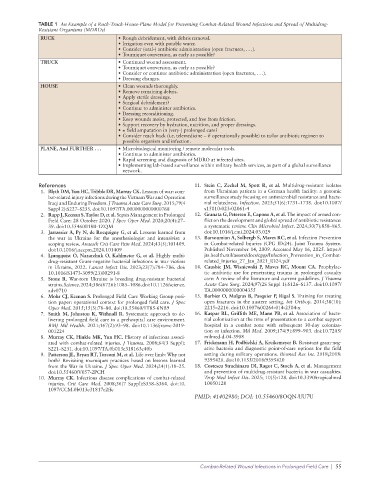
TABLE 1  An Example of a Ruck-Truck-House-Plane Model for Preventing Combat-Related Wound Infections and Spread of Multidrug-
              Resistant Organisms (MDROs)
              RUCK                      • Rough debridement, with debris removal.
                                        • Irrigation even with potable water.
                                        • Consider (oral-) antibiotic administration (open fractures, . . .).
                                        • Tourniquet conversion, as early as possible?
              TRUCK                     • Continued wound assessment.
                                        • Tourniquet conversion, as early as possible?
                                        • Consider or continue antibiotic administration (open fractures, . . .).
                                        • Dressing changes.
              HOUSE                     • Clean wounds thoroughly.
                                        • Remove remaining debris.
                                        • Apply sterile dressings.
                                        • Surgical debridement?
                                        • Continue to administer antibiotics.
                                        • Dressing reconditioning.
                                        • Keep wounds moist, protected, and free from friction.
                                        • Support recovery by hydration, nutrition, and proper dressings.
                                        • ± field amputation in (very-) prolonged care?
                                        • Consider reach back (i.e. telemedicine – if operationally possible) to tailor antibiotic regimen to
                                         possible organism and infection.
              PLANE, And FURTHER . . .  • Microbiological monitoring / remote molecular tools.
                                        • Continue to administer antibiotics.
                                        • Rapid screening and diagnosis of MDRO at infected sites.
                                        • Implementing lab-based surveillance within military health services, as part of a global surveillance
                                         network.

              References                                         11.  Stein C, Zechel M, Spott R, et al. Multidrug-resistant isolates
              1.  Blyth DM, Yun HC, Tribble DR, Murray CK. Lessons of war: com-  from Ukrainian patients in a German health facility: a genomic
                 bat-related injury infections during the Vietnam War and Operation   surveillance study focusing on antimicrobial resistance and bacte-
                 Iraqi and Enduring Freedom. J Trauma Acute Care Surg. 2015;79(4   rial relatedness. Infection. 2023;51(6):1731–1738. doi:10.1007/
                 Suppl 2):S227–S235. doi:10.1097/TA.0000000000000768  s15010-023-02061-4
              2.  Rapp J, Keenan S, Taylor D, et al. Sepsis Management in Prolonged   12.  Granata G, Petersen E, Capone A, et al. The impact of armed con-
                 Field Care: 28 October 2020. J Spec Oper Med. 2020;20(4):27–  flict on the development and global spread of antibiotic resistance:
                 39. doi:10.55460/I18B-1ZQM                         a systematic review. Clin Microbiol Infect. 2024;30(7):858–865.
              3.  Jarrassier A, Py N, de Rocquigny G, et al. Lessons learned from   doi:10.1016/j.cmi.2024.03.029
                 the war in Ukraine for the anesthesiologist and intensivist: a   13.  Barsoumian A, Solbergb S, Maves RC, et al. Infection Prevention
                 scoping review. Anaesth Crit Care Pain Med. 2024;43(5):101409.   in Combat-related Injuries (CPG ID:24). Joint Trauma System.
                 doi:10.1016/j.accpm.2024.101409                    Published November 14, 2009. Accessed May 16, 2025. https://
              4.  Ljungquist O, Nazarchuk O, Kahlmeter G, et al. Highly multi-  jts.health.mil/assets/docs/cpgs/Infection_Prevention_in_Combat-
                 drug-resistant Gram-negative bacterial infections in war victims   related_Injuries_27_Jan_2021_ID24.pdf
                 in Ukraine, 2022. Lancet Infect Dis. 2023;23(7):784–786. doi:   14.  Causbie  JM, Wisniewski  P,  Maves  RC,  Mount CA.  Prophylac-
                 10.1016/S1473-3099(23)00291-8                      tic antibiotic use for penetrating trauma in prolonged casualty
              5.  Stone R. War-torn Ukraine  is breeding drug-resistant  bacterial   care: A review of the literature and current guidelines. J Trauma
                 strains. Science. 2024;386(6726):1085–1086. doi:10.1126/science.   Acute Care Surg. 2024;97(2S Suppl 1):S126–S137. doi:10.1097/
                 adv0710                                            TA.0000000000004355
              6.  Mohr CJ, Keenan S. Prolonged Field Care Working Group posi-  15.  Barbier O, Malgras B, Pasquier P, Rigal S. Training for treating
                 tion paper: operational context for prolonged field care. J Spec   open fractures in the austere setting. Int Orthop. 2014;38(10):
                 Oper Med. 2015;15(3):78–80. doi:10.55460/1T85-6NB9  2215–2216. doi:10.1007/s00264-014-2504-x
              7.  Smith  M,  Johnston  K, Withnall  R.  Systematic  approach  to  de-  16.  Kaspar RL, Griffith ME, Mann PB, et al. Association of bacte-
                 livering prolonged field care in a prehospital care environment.   rial colonization at the time of presentation to a combat support
                 BMJ Mil Health. 2021;167(2):93–98. doi:10.1136/jramc-2019-   hospital in a combat zone with subsequent 30-day coloniza-
                 001224                                             tion or infection. Mil Med. 2009;174(9):899–903. doi:10.7205/
              8.  Murray CK, Hinkle MK, Yun HC. History of infections associ-  milmed-d-04-3908
                 ated with combat-related injuries. J Trauma. 2008;64(3 Suppl):   17.  Frickmann H, Podbielski A, Kreikemeyer B. Resistant gram-neg-
                 S221–S231. doi:10.1097/TA.0b013e318163c40b         ative bacteria and diagnostic point-of-care options for the field
              9.  Patterson JL, Bryan RT, Turconi M, et al. Life over limb: Why not   setting during military operations. Biomed Res Int. 2018;2018:
                 both? Revisiting tourniquet practices based on lessons learned   9395420. doi:10.1155/2018/9395420
                 from the War in Ukraine. J Spec Oper Med. 2024;24(1):18–25.   18.  Costescu Strachinaru DI, Ragot C, Stoefs A, et al. Management
                 doi:10.55460/V057-2PCH                             and prevention of multidrug-resistant bacteria in war casualties.
              10.  Murray CK. Infectious disease complications of combat-related   Trop Med Infect Dis. 2025; 10(5):128. doi:10.3390/tropicalmed
                 injuries.  Crit Care Med. 2008;36(7 Suppl):S358–S364. doi:10.   10050128
                 1097/CCM.0b013e31817e2ffc
                                                                 PMID: 41402980; DOI: 10.55460/8OQN-UU7U


                                                                  Combat-Related Wound Infections in Prolonged Field Care  |  55

