


Page 52 - JSOM Winter 2025
P. 52
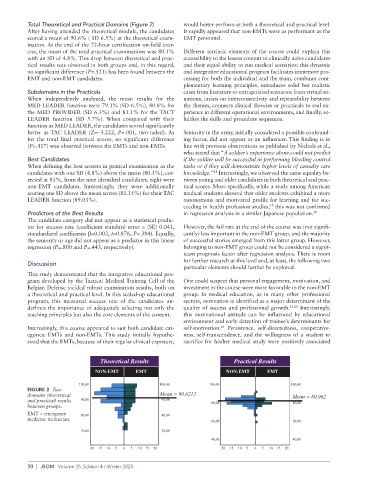
Total Theoretical and Practical Domains (Figure 2)  would better perform at both a theoretical and practical level.
          After having attended the theoretical module, the candidates   It rapidly appeared that non-EMTs were as performant as the
          scored a mean of 90.6% ( SD 6.5%) at the theoretical exam-  EMT personnel.
          ination. At the end of the 72-hour certification on-field exer-
          cise, the mean of the total practical examinations was 80.1%   Different  intrinsic  elements  of  the  course  could  explain  this
          with an SD of 4.8%. This drop between theoretical and prac-  accessibility to the lesson content to clinically naïve candidates
          tical results was observed in both groups and, in this regard,   and their equal ability to run medical scenarios: this dynamic
          no significant difference (P=.521) has been found between the   and integrative educational program facilitates immersive pro-
          EMT and non-EMT candidates.                        cessing for both the individual and the team, combines com-
                                                             plementary  learning  principles,  introduces  solid  but  realistic
          Subdomains in the Practicals                       cases from literature or extrapolated scenarios from virtual sit-
          When  independently  analyzed, the  mean  results  for  the   uations, insists on interconnectivity and repeatability between
          MED LEADER function were 79.1% (SD 6.5%), 80.8% for   the themes, connects clinical theories or practicals to real ex-
          the MED PROVIDER (SD 6.3%) and 81.1% for the TACT   perience in different operational environments, and finally, so-
          LEADER function (SD 5.7%).  When compared with their   lidifies the skills and procedure sequences.
          function as MED LEADER, the candidates scored significantly
          better as TAC LEADER (Z=–3.222,  P=.001,  two-tailed). As   Seniority in the army, initially considered a possible confound-
          for the total final practical scores, no significant difference   ing factor, did not appear as an influencer. This finding is in
          (P=.417) was observed between the EMTs and non-EMTs.  line with previous observations as published by Nichols et al.,
                                                             who stated that “A soldier’s experience alone could not predict
          Best Candidates                                    if the soldier will be successful in performing bleeding control
          When defining the best scorers in pratical examination as the   tasks or if they will demonstrate higher levels of casualty care
          candidates with one SD (4.8%) above the mean (80.1%), cor-  knowledge.”  Interestingly, we observed the same equality be-
                                                                       18
          rected at 85%, from the nine identified candidates, eight were   tween young and older candidates in both theoretical and prac-
          non-EMT candidates. Interestingly, they were additionally   tical scores. More specifically, while a study among American
          scoring one SD above the mean scores (81.15%) for their TAC   medical students showed that older students exhibited a more
          LEADER function (89.03%).                          autonomous and motivated profile for learning and for suc-
                                                             ceeding in health profession studies,  this was not confirmed
                                                                                         19
          Predictors of the Best Results                     in regression analysis in a similar Japanese population. 20
          The candidate category did not appear as a statistical predic-
          tor for success rate (coefficient standard error = (SE) 0.041,   However, the fail rate at the end of the course was (not signifi-
          standardized coefficients β=0.003, t=0.876, P=.384). Equally,   cantly) less important in the non-EMT group, and the majority
          the seniority or age did not appear as a predictor in this linear   of successful stories emerged from this latter group. However,
          regression (P=.800 and P=.443, respectively).      belonging to non-EMT group could not be considered a signif-
                                                             icant prognosis factor after regression analysis. There is room
                                                             for further research at this level and, at least, the following two
          Discussion
                                                             particular elements should further be explored.
          This study demonstrated that the integrative educational pro-
          gram developed by the Tactical Medical Training Cell of the   One could suspect that personal engagement, motivation, and
          Belgian Defense yielded robust examination results, both on   investment in the course were more favorable in the non-EMT
          a theoretical and practical level. In this scaled-up educational   group.  In  medical  education,  as  in  many  other  professional
          program, this measured success rate of the candidates un-  sectors, motivation is identified as a major determinant of the
          derlines the importance of adequately selecting not only the   quality of success and professional growth. 21,22  Interestingly,
          teaching principles but also the core elements of the content.  this motivational attitude can be influenced by educational
                                                             environment and early detection of trainee’s determinants for
          Interestingly, this course appeared to suit both candidate cat-  self-motivation.  Persistence, self-directedness, cooperative-
                                                                         23
          egories: EMTs and non-EMTs. This study initially hypothe-  ness, self-transcendence, and the willingness of a student to
          sized that the EMTs, because of their regular clinical exposure,   sacrifice for his/her medical study were positively associated


                                  Theoretical Results                        Practical Results
                                NON-EMT      EMT                           NON-EMT      EMT

                           100,00                    100,00          100,00                     100,00
          FIGURE 2  Two
          domains (theoretical                       Mean = 90,6212                              Mean = 80,062
          and practical) results   90,00              90,00           80,00                      80,00
          between groups.
          EMT = emergency   80,00                     80,00
          medicine technician.                                        60,00                      60,00
                           70,00                      70,00
                                                                      40,00                      40,00
                               20     15     10     5       0      5      10    15     20  20     15     10     5       0      5      10    15     20

          50  |  JSOM   Volume 25, Edition 4 / Winter 2025

