


Page 47 - JSOM Winter 2025
P. 47
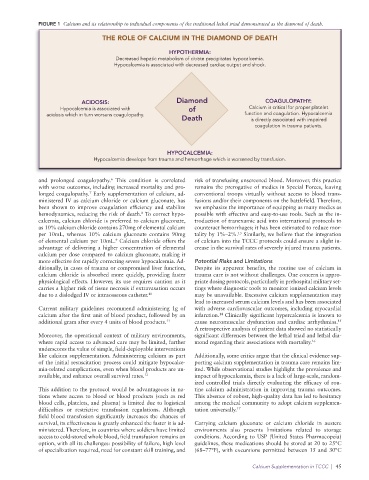
FIGURE 1  Calcium and its relationship to individual components of the traditional lethal triad demonstrated as the diamond of death.

                                  THE ROLE OF CALCIUM IN THE DIAMOND OF DEATH

                                                        HYPOTHERMIA:
                                       Decreased hepatic metabolism of citrate precipitates hypocalcemia.
                                      Hypocalcemia is associated with decreased cardiac output and shock.


                            ACIDOSIS:                      Diamond                      COAGULOPATHY:
                     Hypocalcemia is associated with           of                 Calcium is critical for proper platelet
                acidosis which in turn worsens coagulopathy.                     function and coagulation. Hypocalcemia
                                                            Death                  is directly associated with impaired
                                                                                    coagulation in trauma patients.


                                                        HYPOCALCEMIA:
                                Hypocalcemia develops from trauma and hemorrhage which is worsened by transfusion.


              and prolonged coagulopathy.   This condition is correlated   risk of transfusing unscreened blood. Moreover, this practice
                                     6
              with worse outcomes, including increased mortality and pro-  remains the prerogative of medics in Special Forces, leaving
              longed coagulopathy.  Early supplementation of calcium, ad-  conventional troops virtually without access to blood trans-
                              7
              ministered IV as calcium chloride or calcium gluconate, has   fusions and/or their components on the battlefield. Therefore,
              been shown to improve coagulation efficiency and stabilize   we emphasize the importance of equipping as many medics as
              hemodynamics, reducing the risk of death.  To correct hypo-  possible with effective and easy-to-use tools. Such as the in-
                                               8
              calcemia, calcium chloride is preferred to calcium gluconate,   troduction of tranexamic acid into international protocols to
              as 10% calcium chloride contains 270mg of elemental calcium   counteract hemorrhages; it has been estimated to reduce mor-
              per  10mL, whereas  10%  calcium  gluconate contains  90mg   tality by 1%–2%.  Similarly, we believe that the integration
                                                                               13
              of elemental calcium per 10mL.  Calcium chloride offers the   of calcium into the TCCC protocols could ensure a slight in-
                                       9
              advantage  of delivering  a higher concentration  of  elemental   crease in the survival rates of severely injured trauma patients.
              calcium per dose compared to calcium gluconate, making it
              more effective for rapidly correcting severe hypocalcemia. Ad-  Potential Risks and Limitations
              ditionally, in cases of trauma or compromised liver function,   Despite its apparent benefits, the routine use of calcium in
              calcium  chloride  is  absorbed more  quickly,  providing faster   trauma care is not without challenges. One concern is appro-
              physiological effects. However, its use requires caution as it   priate dosing protocols, particularly in prehospital military set-
              carries a higher risk of tissue necrosis if extravasation occurs   tings where diagnostic tools to monitor ionized calcium levels
              due to a dislodged IV or intraosseous catheter. 10  may be unavailable. Excessive calcium supplementation may
                                                                 lead to increased serum calcium levels and has been associated
              Current military guidelines recommend administering 1g of   with adverse cardiovascular outcomes, including myocardial
              calcium after the first unit of blood product, followed by an   infarction.  Clinically significant hypercalcemia is known to
                                                                         14
              additional gram after every 4 units of blood products. 11  cause neuromuscular dysfunction and cardiac arrhythmias.
                                                                                                               15
                                                                 A retrospective analysis of patient data showed no statistically
              Moreover, the operational context of military environments,   significant differences between the lethal triad and lethal dia-
              where rapid access to advanced care may be limited, further   mond regarding their associations with mortality. 16
              underscores the value of simple, field-deployable interventions
              like calcium supplementation. Administering calcium as part   Additionally, some critics argue that the clinical evidence sup-
              of the initial resuscitation process could mitigate hypocalce-  porting calcium supplementation in trauma care remains lim-
              mia-related complications, even when blood products are un-  ited. While observational studies highlight the prevalence and
              available, and enhance overall survival rates. 12  impact of hypocalcemia, there is a lack of large-scale, random-
                                                                 ized controlled trials directly evaluating the efficacy of rou-
              This addition to the protocol would be advantageous in na-  tine calcium administration in improving trauma outcomes.
              tions where access to blood or blood products (such as red   This absence of robust, high-quality data has led to hesitancy
              blood cells, platelets, and plasma) is limited due to logistical   among the medical community to adopt calcium supplemen-
              difficulties or restrictive transfusion regulations.  Although   tation universally. 17
              field blood transfusion significantly increases the chances of
              survival, its effectiveness is greatly enhanced the faster it is ad-  Carrying calcium gluconate or calcium chloride in austere
              ministered. Therefore, in countries where soldiers have limited   environments also presents limitations related to storage
              access to cold-stored whole blood, field transfusion remains an   conditions. According  to  USP  (United  States  Pharmacopeia)
              option, with all its challenges: possibility of failure, high level   guidelines, these medications should be stored at 20 to 25°C
              of specialization required, need for constant skill training, and   (68–77°F), with excursions permitted between 15 and 30°C

                                                                                   Calcium Supplementation in TCCC  |  45

