


Page 43 - JSOM Winter 2025
P. 43
or fuel and are not viable in a resource-limited environment.
              Additionally, with the current capabilities of thermal imaging,
              these methods are often not preferable and can contribute to
              enemy detection.


              Methods
              Medication and intravenous (IV) fluids were placed inside a
              Dometic  CoolFreeze  CFX-65 professional  cooling container
              at room temperature just before the start of Nordic Response   FIGURE 2  Inside
              2024, a 10-day deep-ops arctic field exercise in northern Nor-  and outside
              way’s Finnmark region.                             temperatures for
                                                                 the entire period.
              This cooling container is normally intended to keep medica-
              tion within a controlled temperature when operating in warm
              conditions. The cooling container was not attached to a power
              source, and only the isolating capabilities of the container
              were used to maintain the temperature. Within the container
                                 ®
              we placed three Nalgene  1L wide mouth sustain water bot-
              tles, filled with boiling water.
              The cooling container was placed inside one of the Hägglunds
                         ®
              Bandvagn 206  (BV 206) vehicles, used by the medical team
              (Figure 1). The bottles were reheated one by one every morn-  Inside the cooling container, a controlled temperature was
              ing by the service members.                        measured for 67.8% of the time (178.3 hours). The tempera-
                                                                 ture inside the cooling container was above 25°C (77°F) for
              Two TempTale  4 temperature loggers were used to measure   11.9% of the time (a total of 31.3 hours), and under 15°C
                         ®
              the temperature. One was placed alongside the cooling con-  (59°F) for 20.3% of the time (53.5 hours). Inside the cool-
              tainer to measure the ambient temperature, and one was placed   ing container we measured a minimum temperature of 6.2°C
              inside the container next to the medication and IV fluids. The   (43.2°F) and a maximum temperature of 36.7°C (98.1°F)
              TempTale 4s measured datapoints every 5 minutes for 10 days.
              After the exercise, the data were collected and analyzed to de-  On average the temperature difference between the inside and
              termine how long the temperature was within the 15°C (59°F)   outside of the cooling container was 16.6°C (62°F) with a
              to 25°C (77°F) parameters prescribed by the DFD.   17.9°C (64.2°F) median (6.6°C SD).

              Results                                            Discussion
              The two TempTale 4s collected 5,280 data points, consisting of   Temperatures inside and outside the storage container were
              time and temperature, with 5-minute intervals, and spanning   measured for 264 hours. Our results show that, for almost
              264 hours (Figure 2). The ambient temperature was within the   the entire measured timeframe, the ambient temperature was
              controlled temperature for 5.5% (13.8 hours) of the measured   outside the parameters of controlled temperature. The tem-
              time interval. It was outside the acceptable controlled tem-  peratures measured inside the cooling container were within
              perature for 94.5% of the time (248.5 hours).The temperature   those parameters for almost 70% of the time. Storage tem-
              outside of the cooling container was above 25°C (77 °F) for   peratures dropped bellow a controlled temperature of 15°C
              a total of 15 minutes (0.1%) and under 15°C (59°F) for a   (59°F) for one-fifth of the time. This happened almost every
              total of 249 hours (94.7%). Outside the cooling container we   night just before first light at the end of a 24-hour cycle. The
              measured a minimum temperature of –12.5°C (9.5°F) and a   temperature was too high for nearly 12% of the time, likely
              maximum temperature of 27.3°C (81.1°F).            due to a combination of “freshly” rewarmed water bottles and


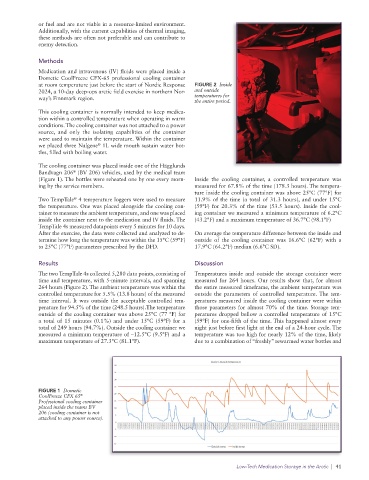
              FIGURE 1  Dometic
              CoolFreeze CFX 65
                           ®
              Professional cooling container
              placed inside the teams BV
              206 (cooling container is not
              attached to any power source).


                                                                              Low-Tech Medication Storage in the Arctic  |  41

