


Page 38 - JSOM Winter 2025
P. 38
No significant effects were found for needle size (P=.642), sex
          (P=.905), age (P=.320), years of experience (P=.603), or cre-
          dential level (P=.877). These findings suggest that driver type
          is the primary determinant of insertion speed, independent of
          provider characteristics or needle sizes.
          A natural log transformation was applied to the data to ho-
          mogenize and further evaluate the cohort to address the right-
          skewed distribution. A Levene’s Test was again conducted to
          assess the homogeneity of the transformed data. After nor-
          malizing the data, Levene’s test was non-significant,  P=.64,
          meeting the assumption of homogeneity of variances between
          groups. This transformation removed nine outliers with an SD
          greater than 3, leaving 106 advanced EMS clinicians (95 para-
          medics and 11 Advanced EMTs) remaining for further investi-
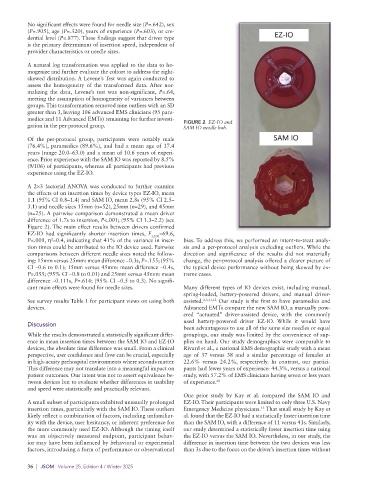
          gation in the per-protocol group.                  FIGURE 2  EZ-IO and
                                                             SAM IO needle hub.
          Of the per-protocol group, participants were notably male
          (76.4%), paramedics (89.6%), and had a mean age of 37.4
          years (range 20.0–63.0) and a mean of 10.6 years of experi-
          ence. Prior experience with the SAM IO was reported by 8.5%
          (9/106) of participants, whereas all participants had previous
          experience using the EZ-IO.

          A 2×3 factorial ANOVA was conducted to further examine
          the effects of on insertion times by device types EZ-IO, mean
          1.1 (95% CI 0.8–1.4) and SAM IO, mean 2.8s (95% CI 2.5–
          3.1) and needle sizes 15mm (n=52), 25mm (n=29), and 45mm
          (n=25). A pairwise comparison demonstrated a mean driver
          difference of 1.7s to insertion, P<.001; (95% CI 1.3–2.2) (see
          Figure 2). The main effect results between drivers confirmed
          EZ-IO had significantly shorter insertion times,  F 1,100 =69.6,
          P<.001, η =0.4, indicating that 41% of the variance in inser-  bias. To address this, we performed an intent-to-treat analy-
                  2
          tion times could be attributed to the IO device used. Pairwise   sis and a per-protocol analysis excluding outliers. While the
          comparisons between different needle sizes noted the follow-  direction and significance of the results did not materially
          ing: 15mm versus 25mm: mean difference −0.3s, P=.155; (95%   change, the per-protocol analysis offered a clearer picture of
          CI −0.6 to 0.1); 15mm versus 45mm: mean difference −0.4s,   the typical device performance without being skewed by ex-
          P=.055; (95% CI −0.8 to 0.01) and 25mm versus 45mm: mean   treme cases.
          difference −0.111s, P=.614; (95% CI −0.5 to 0.3). No signifi-
          cant main effects were found for needle sizes.     Many different types of IO devices exist, including manual,
                                                             spring-loaded, battery-powered drivers, and manual driver-
          See survey results Table 1 for participant views on using both   assisted. 2,3,11,12  Our study is the first to have paramedics and
          devices.                                           Advanced EMTs compare the new SAM IO, a manually pow-
                                                             ered  “actuated” driver-assisted device, with the commonly
                                                             used battery-powered driver EZ-IO.  While it would have
          Discussion
                                                             been advantageous to use all of the same size needles or equal
          While the results demonstrated a statistically significant differ-  groupings, our study was limited by the convenience of sup-
          ence in mean insertion times between the SAM IO and EZ-IO   plies on hand. Our study demographics were comparable to
          devices, the absolute time difference was small. From a clinical   Rivard et al., a national EMS demographic study with a mean
          perspective, user confidence and flow can be crucial, especially   age  of  37 versus  38  and  a similar  percentage  of females  at
          in high-acuity prehospital environments where seconds matter.   22.6% versus 24.2%, respectively. In contrast, our partici-
          This difference may not translate into a meaningful impact on   pants had fewer years of experience: 44.3%, versus a national
          patient outcomes. Our intent was not to assert equivalence be-  study, with 57.2% of EMS clinicians having seven or less years
          tween devices but to evaluate whether differences in usability   of experience. 20
          and speed were statistically and practically relevant.
                                                             One prior study by Kay et al. compared the SAM IO and
          A small subset of participants exhibited unusually prolonged   EZ-IO. Their participants were limited to only three U.S. Navy
          insertion times, particularly with the SAM IO. These outliers   Emergency Medicine physicians.  That small study by Kay et
                                                                                      11
          likely reflect a combination of factors, including unfamiliar-  al. found that the EZ-IO had a statistically faster insertion time
          ity with the device, user hesitancy, or inherent preference for   than the SAM IO, with a difference of 11 versus 41s. Similarly,
          the more commonly used EZ-IO. Although the timing itself   our study determined a statistically faster insertion time using
          was an objectively measured endpoint, participant behav-  the EZ-IO versus the SAM IO. Nevertheless, in our study, the
          ior may have been influenced by behavioral or experiential   difference in insertion time between the two devices was less
          factors, introducing a form of performance or observational   than 3s due to the focus on the driver’s insertion times without

          36  |  JSOM   Volume 25, Edition 4 / Winter 2025

