


Page 36 - JSOM Winter 2025
P. 36
A Prospective Comparison of SAM IO versus EZ-IO

                       Insertion Time and Usability During Simulated Vascular Access


                                                                                   2
                                                          1
                                 Rachel Stiglitz, BS, AEMT ; Roberto C. Portela, MD *;
                                                            3
                                      Stephen E. Taylor, PhD ; Juan A. March, MD 4


          ABSTRACT
          Background: Intraosseous (IO) access is a medical procedure   out-of-hospital access points being the proximal tibia and hu-
          primarily used in emergencies when peripheral venous access   meral head for adult patients. 8–10
          is unobtainable or delayed. The IO procedure is commonly
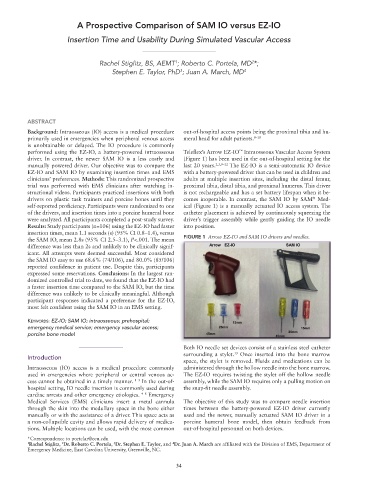
          performed using the EZ-IO, a battery-powered intraosseous   Teleflex’s Arrow EZ-IO  Intraosseous Vascular Access System
                                                                               ™
          driver. In contrast, the newer SAM IO is a less costly and   (Figure 1) has been used in the out-of-hospital setting for the
          manually powered driver. Our objective was to compare the   last 20 years. 2,3,9–12  The EZ-IO is a semi-automatic IO device
          EZ-IO and SAM IO by examining insertion times and EMS   with a battery-powered driver that can be used in children and
          clinicians’ preferences. Methods: This randomized prospective   adults at multiple insertion  sites, including the distal femur,
          trial was performed with EMS clinicians after watching in-  proximal tibia, distal tibia, and proximal humerus. This driver
          structional videos. Participants practiced insertions with both   is not rechargeable and has a set battery lifespan when it be-
          drivers on plastic task trainers and porcine bones until they   comes inoperable. In contrast, the SAM IO by SAM  Med-
                                                                                                       ®
          self-reported proficiency. Participants were randomized to one   ical (Figure 1) is a manually actuated IO access system. The
          of the drivers, and insertion times into a porcine humeral bone   catheter placement is achieved by continuously squeezing the
          were analyzed. All participants completed a post-study survey.   driver’s trigger assembly while gently guiding the IO needle
          Results: Study participants (n=106) using the EZ-IO had faster   into position.
          insertion times, mean 1.1 seconds (s) (95% CI 0.8–1.4), versus
          the SAM IO, mean 2.8s (95% CI 2.5–3.1), P<.001. The mean   FIGURE 1  Arrow EZ-IO and SAM IO drivers and needles.
          difference was less than 2s and unlikely to be clinically signif-
          icant. All attempts were deemed successful. Most considered
          the SAM IO easy to use 68.6% (74/106), and 80.0% (85/106)
          reported confidence in patient use. Despite this, participants
          expressed some reservations. Conclusions: In the largest ran-
          domized controlled trial to date, we found that the EZ-IO had
          a faster insertion time compared to the SAM IO, but the time
          difference was unlikely to be clinically meaningful. Although
          participant responses indicated a preference for the EZ-IO,
          most felt confident using the SAM IO in an EMS setting.

          Keywords: EZ-IO; SAM IO; intraosseous; prehospital;
          emergency medical service; emergency vascular access;
          porcine bone model
                                                             Both IO needle set devices consist of a stainless steel catheter
                                                             surrounding a stylet.  Once inserted into the bone marrow
                                                                              13
          Introduction
                                                             space, the stylet is removed. Fluids and medications can be
          Intraosseous (IO) access is a medical procedure commonly   administered through the hollow needle into the bone marrow.
          used  in  emergencies  where  peripheral  or  central  venous  ac-  The EZ-IO requires twisting the stylet off the hollow needle
          cess cannot be obtained in a timely manner.  1–3  In the out-of-   assembly, while the SAM IO requires only a pulling motion on
          hospital setting, IO needle insertion is commonly used during   the snap-fit needle assembly.
          cardiac arrests and other emergency etiologies.   Emergency
                                               4–8
          Medical Services (EMS) clinicians insert a metal cannula   The objective of this study was to compare needle insertion
          through the skin into the medullary space in the bone either   times between the battery-powered EZ-IO driver currently
          manually or with the assistance of a driver. This space acts as   used and the newer, manually actuated SAM IO driver in a
          a non- collapsible cavity and allows rapid delivery of medica-  porcine humeral bone model, then obtain feedback from
          tions. Multiple locations can be used, with the most common   out-of-hospital personnel on both devices.
          *Correspondence to portelar@ecu.edu
                     2
          1 Rachel Stiglitz,  Dr. Roberto C. Portela,  Dr. Stephen E. Taylor, and  Dr. Juan A. March are affiliated with the Division of EMS, Department of
                                      3
                                                         4
          Emergency Medicine, East Carolina University, Greenville, NC.
                                                           34

