


Page 39 - JSOM Winter 2025
P. 39
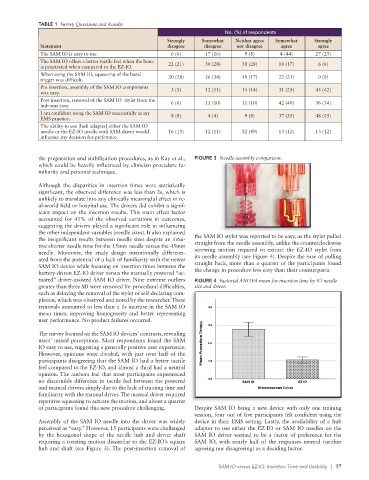
TABLE 1  Survey Questions and Results
                                                                          No. (%) of respondents
                                                        Strongly   Somewhat   Neither agree   Somewhat    Strongly
              Statement                                 disagree    disagree  nor disagree   agree       agree
              The SAM IO is easy to use.                 6 (6)      17 (16)      9 (8)       4 (44)     27 (25)
              The SAM IO offers a better tactile feel when the bone
              is penetrated when compared to the EZ-IO.  22 (21)    30 (28)     30 (28)     18 (17)      6 (6)
              When using the SAM IO, squeezing of the hand
              trigger was difficult.                    30 (28)     36 (34)     18 (17)     22 (21)      0 (0)
              Pre insertion, assembly of the SAM IO components
              was easy.                                  3 (3)      12 (11)     15 (14)     31 (29)     45 (42)
              Post insertion, removal of the SAM IO  stylet from the
              hub was easy.                              6 (6)      11 (10)     11 (10)     42 (40)     36 (34)
              I am confident using the SAM IO successfully in my   8 (8)  4 (4)  9 (8)      37 (35)     48 (45)
              EMS practice.
              The ability to use [hub adapter] either the SAM IO
              needle or the EZ-IO needle with SAM driver would   16 (15)  12 (11)  52 (49)  13 (12)     13 (12)
              influence my decision for preference.


              the preparation and stabilization procedures, as in Kay et al.,   FIGURE 3  Needle assembly comparison.
              which could be heavily influenced by clinician procedure fa-
              miliarity and personal technique.

              Although the disparities in insertion times were statistically
              significant, the observed difference was less than 2s, which is
              unlikely to translate into any clinically meaningful effect in re-
              al-world field or hospital use. The drivers did exhibit a signif-
              icant impact on the insertion results. This main effect factor
              accounted for 41% of the observed variations in outcomes,
              suggesting the drivers played a significant role in influencing
              the other independent variables (needle sizes). It also explained
              the insignificant results between needle sizes despite an intui-  the SAM IO stylet was reported to be easy, as the stylet pulled
              tive shorter needle time for the 15mm needle versus the 45mm   straight from the needle assembly, unlike the counterclockwise
              needle. Moreover, the study design intentionally differenti-  screwing motion required to extract the EZ-IO stylet from
              ated from the potential of a lack of familiarity with the newer   its needle assembly (see Figure 4). Despite the ease of pulling
              SAM IO device while focusing on insertion times between the   straight back, more than a quarter of the participants found
                battery-driven EZ-IO driver versus the manually powered “ac-  the change in procedure less easy than their counterparts.
              tuated” driver-assisted SAM IO driver. Nine extreme outliers   FIGURE 4  Factorial ANOVA mean for insertion time by IO needle
              greater than three SD were removed for procedural difficulties,   size and driver.
              such as delaying the removal of the stylet or self-declaring com-
              pletion, which was observed and noted by the researcher. These
              removals amounted to less than a 1s increase in the SAM IO
              mean  times,  improving  homogeneity  and  better  representing
              user performance. No product failures occurred.
              The survey focused on the SAM IO devices’ contrasts, revealing
              users’ mixed perceptions. Most respondents found the SAM
              IO easy to use, suggesting a generally positive user experience.
              However, opinions were divided, with just over half of the
              participants disagreeing that the SAM IO had a better tactile
              feel compared to the EZ-IO, and almost a third had a neutral
              opinion. The authors feel that most participants experienced
              no discernible difference in tactile feel between the powered
              and manual drivers simply due to the lack of training time and
              familiarity with the manual driver. The manual driver required
              repetitive squeezing to actuate the motion, and about a quarter
              of participants found this new procedure challenging.  Despite SAM IO being a new device with only one training
                                                                 session, four out of five participants felt confident using the
              Assembly of the SAM IO needle into the driver was widely   device in their EMS setting. Lastly, the availability of a hub
              perceived as “easy.” However, 15 participants were challenged   adapter to use either the EZ-IO or SAM IO needles on the
              by the hexagonal shape of the  needle hub and driver  shaft   SAM IO driver seemed  to be a factor of preference for the
              requiring a rotating motion dissimilar to the EZ-IO’s square   SAM IO, with nearly half of the responses neutral (neither
              hub and shaft (see Figure 3). The post-insertion removal of   agreeing nor disagreeing) as a deciding factor.

                                                                        SAM IO versus EZ-IO: Insertion Time and Usability   |  37

