


Page 50 - JSOM Winter 2025
P. 50
program in 2021, especially designed for emergency medical   of trauma patients. All of them were educated in Basic Life
          technicians  (EMT)  Advanced  Combat Medic  certification.   Support (BLS) and Prehospital Trauma Life Support (PHTLS).
          This model is currently systematically proposed to all Combat
          Medic candidates for the advanced course. After identifying   Considered  as  clinically  naïve,  the  second  group  was  com-
          the essential components for individual and collective medical   posed of non-EMT personnel from Para-Commando combat
                                                      11
          training, as recommended by the NATO SOF doctrine,  the   units or Special Operation Forces. Excluding their TC3 for-
          principles of the course profile shape theoretical and practical   mation and training, they had not been exposed to clinical
          skills to support individual professional development and, by   situations beforehand and had not participated in Real Life
          extension, leadership maturation. Different training principles   Support activities at the Belgian Defense. They applied on a
          such as LT and SIM training are combined; the course mainly   voluntary basis for the specific position of first-line respond-
          relies on the latter because of the abundance of peer-reviewed   ers in their unit.
          evidence from military studies that clearly demonstrates train-
          ing methods using human patient simulators for teaching   Course (Table 2)
          trauma care skills are as effective or better than LT, while also   After an initial entrance exam on general anatomy and physiol-
                              12
          being more cost-effective.  Finally, specific efforts are placed   ogy, candidates follow a three-week theoretical module cover-
          on hyper-realistic and immersive simulation training scenar-  ing TC3, PHTLS and Advanced Medical Life Support (AMLS)
                                                         14
          ios as stimulators of team performance.  As per Salas et al.    principles. Prehospital Trauma Life Support is a continuing ed-
                                         13
                      15
          and Kozlowski,  the course organizers conceived team perfor-  ucation program to promote excellence in trauma patient man-
          mance as a multilevel process that includes the interrelation   agement by all providers involved in the delivery of prehospital
          between individual-level and teamwork and team work pro-  care. Standard Operating Procedures (SOPs) are explained and
          cesses. Thus, optimal tasks, as well as team performance, de-  tested. The SOPs concerned TC3 phases, catastrophic Hemor-
          pend on the coordinated activities of a team of individuals. 16,17  rhage (c), Airway (A), Breathing (B), Circulation (C), Disability
                                                             (D), Exposure (E) protocol, with specific procedures for emer-
          The primary objective of the study was to compare final theo-  gency trauma or medical situations, and a large spectrum of
          retical and practical results between EMT and non-EMT can-  environmental situations. After successfully completing a the-
          didates for advanced Combat Medic certification. Considering   oretical exam in these domains, the candidate is enrolled in a
          that the non-EMT, mainly from SOF units, can rely on their   three-week practical module, consisting of dead tissue training,
          particular  agility  and  situational  awareness,  it  would  be  in-  trauma patient simulator (mannequin simulation), and clinical
          teresting to compare the groups to each other and to identify   scenarios individually or in a team, as well as a large spectrum
          their respective strengths or weaknesses. A secondary objective   of clinical practicals in CASEVAC, complex casualty extrica-
          was to explore how the candidate category could act as poten-  tion, MASCAL (mass casualty exercise or simulation for emer-
          tial key success factor for this course.           gency responders), or amphibious medical incidents. A 72-hour
                                                             final synthetizing on-field examination evaluates all candidates
                                                             based on three independent domains: their capability as a Med-
          Methods
                                                             ical Provider, as a Medical Leader and as a Tactical Leader.
          This longitudinal cohort-monocentric study was carried out
          with  Advanced Combat Medic candidates at the Centre of   Outcomes
          Medical Expertise, Belgian Defense, from January 2021 until   The study outcomes were subdivided into main domains (the-
          December 2022. All their theoretical and practical examina-  oretical and practical total scores at the final examination) and
          tion results were systematically collected by the instructors,   subdomains: “MED LEADER”, defined as reactivity in med-
          evaluators and Exercise Controllers.               ical decision-making, guidance of the medical activities, and
                                                             leadership of the medical team; “MED PROVIDER”, defined
          Populations (Table 1)                              as  technical medical skills (quality of material preparation,
          Each member of the Belgian military must fulfill a Tactical   completeness and safety in execution, quality of reporting to
          Combat Casualty Care (TC3) educational program and must   MED LEADER); “TACTICAL (TAC) LEADER”, defined as
          refresh their knowledge once a year. Two profiles of Advanced   responsible for team security, controller of Situational Aware-
          Combat Medic candidates were distinguished.        ness, coordinator of tactical actions of the medical team.
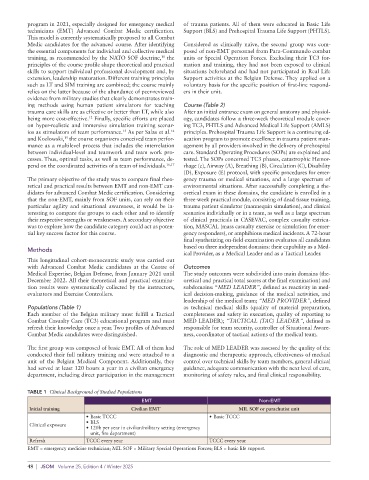
          The first group was composed of basic EMT. All of them had   The role of MED LEADER was assessed by the quality of the
          conducted their full military training and were attached to a   diagnostic and therapeutic approach, effectiveness of medical
          unit of the Belgian Medical Component.  Additionally, they   control over technical skills by team members, general clinical
          had served at least 120 hours a year in a civilian emergency   guidance, adequate communication with the next level of care,
          department, including direct participation in the management   monitoring of safety rules, and final clinical responsibility.

          TABLE 1  Clinical Background of Studied Populations
                                               EMT                                    Non-EMT
           Initial training                 Civilian EMT                       MIL SOF or parachutist unit
                             • Basic TCCC                            • Basic TCCC
                             • BLS
           Clinical exposure
                             • 120h per year in civilian/military setting (emergency
                               unit, fire department)
           Refresh           TCCC every year                         TCCC every year
          EMT = emergency medicine technician; MIL SOF = Military Special Operations Forces; BLS = basic life support.

          48  |  JSOM   Volume 25, Edition 4 / Winter 2025

