


Page 63 - 2023 SMOG Digital
P. 63
Environmental


                     Snake Envenomation
            Management: General Principles

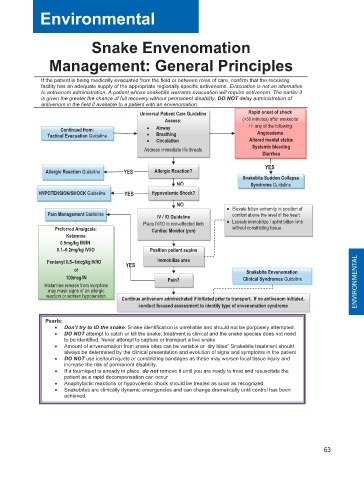
          If the patient is being medically evacuated from the field or between roles of care, confirm that the receiving
          facility has an adequate supply of the appropriate regionally specific antivenoms. Evacuation is not an alternative
          to antivenom administration. A patient whose snakebite warrants evacuation will require antivenom. The earlier it
          is given the greater the chance of full recovery without permanent disability. DO NOT delay administration of

          antivenom in the field if available to a patient with an envenomation.   Rapid onset of shock
                               Universal Patient Care Guideline
                                     Assess:          (<30 minutes) after snakebite
              Continued from:    •  Airway              +/- any of the following:
                                                         Angioedema
           Tactical Evacuation Guideline   •  Breathing
                                 •  Circulation        Altered mental status
                                Address immediate life threats  Systemic bleeding
                                                          Diarrhea

                                                           YES
           Allergic Reaction Guideline   YES   Allergic Reaction?
                                                      Snakebite Sudden Collapse
                                       NO               Syndrome Guideline
         HYPOTENSION/SHOCK Guideline   YES   Hypovolemic Shock?
                                       NO         • Elevate bitten extremity in position of
           Pain Management Guideline   IV / IO Guideline   comfort above the level of the heart
                                Place IV/IO in non-effected limb   • Loosely immobilize / splint bitten limb
             Preferred Analgesia:   Cardiac Monitor (prn)   without constricting tissue
               Ketamine
              0.5mg/kg IM/IN
             0.1– –0.2mg/kg IV/IO   Position patient supine
           Fentanyl 0 0.5–1mcg/kg IV/IO  YES   Immobilize area
                 –
                5
                  m
                 1
                  c
                   g
                    k
                    g

                .
                   /
                 o or r                                Snakebite Envenomation
                  g

                0
               1 100mcg IN            Pain?            Clinical Syndromes Guideline
                0
                  c
                 m
           Histamine release from morphine                                     ENVIRONMENTAL
           may mask signs of an allergic
           reaction or worsen hypotension.   Continue antivenom administrated if initiated prior to transport.  If no antivenom initiated,
                               conduct focused assessment to identify type of envenomation syndrome
           Pearls:
             •  Don’t try to ID the snake. Snake identification is unreliable and should not be purposely attempted.
             •  DO NOT attempt to catch or kill the snake; treatment is clinical and the snake species does not need
               to be identified. Never attempt to capture or transport a live snake
             •  Amount of envenomation from snake bites can be variable or  dry bites” Snakebite treatment should
               always be determined by the clinical presentation and evolution of signs and symptoms in the patient
             •  DO NOT use ice/tourniquets or constricting bandages as these may worsen local tissue injury and
               increase the risk of permanent disability.
             •  If a tourniquet is already in place, do not remove it until you are ready to treat and resuscitate the
               patient as a rapid decompensation can occur
             •  Anaphylactic reactions or hypovolemic shock should be treated as soon as recognized.
             •  Snakebites are clinically dynamic emergencies and can change dramatically until control has been
               achieved.
                                                                        63

