


Page 64 - 2023 SMOG Digital
P. 64
Environmental


                     Snakebite Envenomation
                          Clinical Syndromes

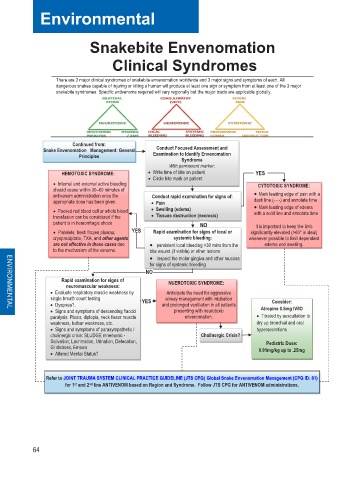
             There are 3 major clinical syndromes of snakebite envenomation worldwide and 3 major signs and symptoms of each. All
             dangerous snakes capable of injuring or killing a human will produce at least one sign or symptom from at least one of the 3 major
             snakebite syndromes. Specific antivenoms required will vary regionally but the major triads are applicable globally.


                 Continued from:
                  Principles
                                   Conduct Focused Assessment and
          Snake Envenomation Management: General   Examination to Identify Envenomation
                                         Syndrome
                                      With permanent marker:
              HEMOTOXIC SYNDROME:   • Write time of bite on patient  YES
                                 • Circle bite mark on patient
             • Internal and external active bleeding     CYTOTOXIC SYNDROME:
             should cease within 30–60 minutes of
             antivenom administration once the   Conduct rapid examination for signs of:   • Mark leading edge of pain with a
             appropriate dose has been given.  • Pain   dash line (- - -) and annotate time
             • Packed red blood cell or whole blood   • Swelling (edema)  • Mark leading edge of edema
                                                        with a solid line and annotate time
             transfusion can be considered if the   • Tissues destruction (necrosis)
             patient is in hemorrhagic shock  NO         It is important to keep the limb
             • Platelets, fresh frozen plasma,  YES   Rapid examination for signs of local or   significantly elevated (>60º is ideal)
             cryoprecipitate, TXA, and other agents   systemic bleeding:   whenever possible to limit dependent
             are not effective in these cases due   • persistent local bleeding >30 mins from the   edema and swelling.
             to the mechanism of the venoms.   bite wound (if visible) or other lesions
                                  • Inspect the molar gingiva and other mucosa
                                  for signs of systemic bleeding
                                 NO
              Rapid examination for signs of   NUEROTOXIC SYNDROME:
               neuromuscular weakness:
            • Evaluate respiratory muscle weakness by  Anticipate the need for aggressive
            single breath count testing  airway management with intubation
            • Dyspnea?.         YES   and prolonged ventilation in all patients   Consider:
            • Signs and symptoms of descending flaccid  presenting with neurotoxic   Atropine 0.5mg IV/IO
   ENVIRONMENTAL
            paralysis: Ptosis, diplopia, neck flexor muscle  envenomation.   • Titrated by auscultation to

            weakness, bulbar weakness, etc.              dry up bronchial and oral
            • Signs and symptoms of parasympathetic /    hypersecretions
            cholinergic crisis: SLUDGE mnemonic -  Cholinergic Crisis?
            Salivation, Lacrimation, Urination, Defecation,  Pediatric Dose:
            GI distress, Emesis                          0.01mg/kg up to .25mg
            • Altered Mental Status?
           Refer to JOINT TRAUMA SYSTEM CLINICAL PRACTICE GUIDELINE (JTS CPG) Global Snake Envenomation Management (CPG ID: 81)
               for 1 st  and 2 nd  line ANTIVENOM based on Region and Syndrome.  Follow JTS CPG for ANTIVENOM administrations.
        64

