


Page 66 - 2023 SMOG Digital
P. 66
Environmental


                          Global Spider and Scorpion Envenomation
         Background:
              Spider and scorpion envenomations can occur in many environments in which the military
              operates. Many arthropods possess a significant venom but lack a sufficient apparatus (fangs or
              talon) to inject it into humans. Most bites and stings involve more danger from anaphylaxis, but
              several species of spiders and scorpions have significant neurotoxic, cytotoxic, or hemotoxic
              venoms. While most spider and scorpion envenomations result in mild symptoms, severe
              toxicity and death can occur. Anaphylaxis is the most concerning initial effect. Recognize and
              treat it immediately using standard acute allergic reaction therapies. Anaphylaxis from an
              arthropod envenomation is not an indication for antivenom.

         SPIDERS:
              While many spider species produce venom, the vast majority lack sufficiently large or strong
              enough fangs to penetrate human skin and cause clinically significant effects. However, spiders
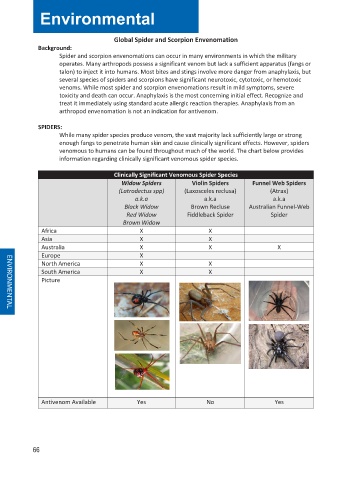
              venomous to humans can be found throughout much of the world. The chart below provides
              information regarding clinically significant venomous spider species.
                          Clinically Significant Venomous Spider Species
                           Widow Spiders   Violin Spiders   Funnel Web Spiders
                           (Latrodectus spp)   (Laxosceles reclusa)   (Atrax)
                              a.k.a          a.k.a          a.k.a
                            Black Widow    Brown Recluse   Australian Funnel-Web
                             Red Widow    Fiddleback Spider   Spider
                            Brown Widow
          Africa               X              X
          Asia                 X              X
          Australia            X              X              X
          Europe               X
          North America        X              X
          South America        X              X
          Picture


   ENVIRONMENTAL


          Antivenom Available   Yes           No             Yes


        66

