


Page 70 - 2023 SMOG Digital
P. 70
Environmental


                    Scorpion Envenomation

          Pearls:
           • Anaphylactic reactions should be treated as soon as recognized.

           • For clinically significant envenomation, management is sup   portive and focused on the patient’s symptoms and graded 1-4.
           • Patients graded 3&4 will require antivenom, evacuate to    a MTF able to administer antivenom.
           • Administer Benzodiazepines aggressively to ensure sympt  om control.
           • For significant neuromuscular spasm, oral secretions, sed   ation, or other threats to the patent airway, perform endotracheal

             intubation to prevent aspiration and ensure adequate ventilation.

           • Pulmonary edema should be managed with noninvasive or  invasive ventilation in combination with optimization of cardiac
             output
           • Direct acting vasopressors(epinephrine and norepinephrin   e) are recommended to treat bradycardia and hypotension
           • Elevate effected limb to reduce swelling.
           • DO NOT apply constricting bandages or tourniquets as  these may worsen local tissue injury and increase the risk of
             permanent disability.

           • DO NOT cut, suck, electrocute, burn, or use chemicals on the envenomation site.
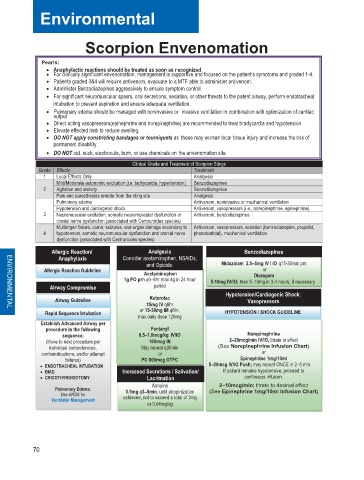
                              Clinical Grade and Treatment of Scorpion Stings
         Grade  Effects                    Treatment
          1   Local Effects Only           Analgesia
             Mild/Moderate autonomic excitation (i.e. tachycardia, hypertension)   Benzodiazepines
          2   Agitation and anxiety        Benzodiazepines
             Pain and paresthesias remote from the sting site   Analgesia
             Pulmonary edema               Antivenom, noninvasive or mechanical ventilation
             Hypotension and cardiogenic shock   Antivenom, vasopressors (i.e., norepinephrine, epinephrine)
          3   Neuromuscular excitation, somatic neuromuscular dysfunction or   Antivenom, benzodiazepines
             cranial nerve dysfunction (associated with Centruroides species)
             Multiorgan failure, coma, seizures, end-organ damage secondary to   Antivenom, vasopressors, sedation (benzodiazepine, propofol,
          4   hypotension, somatic neuromuscular dysfunction and cranial nerve   phenobarbital), mechanical ventilation
             dysfunction (associated with Centruroides species)
              Allergic Reaction/   Analgesia          Benzodiazepines
              Anaphylaxis   Consider acetaminophen, NSAIDs,
                                 and Opioids:    Midazolam  2.5––5mg IV / IO q15-30min prn
                                                          or
           Allergic Reaction Guideline    Acetaminophen    Diazepam
                            1g PO prn q6–8hr max 4g in 24 hour   5-10mg IV/IO; then 5–10mg in 3-4 hours, if necessary
            Airway Compromise     period
             Airway Guideline     Ketorolac       Hypotension/Cardiogenic Shock:
                                                       Vasopressors
                                 15mg IV q6hr
                               or 15-30mg IM q6hr,
           Rapid Sequence Intubation   max daily dose 120mg   HYPOTENSION / SHOCK GUIDELINE
   ENVIRONMENTAL
          Establish Advanced Airway per
           procedure in the following   Fentanyl
               sequence:       0.5–1.0mcg/kg    IV/IO  Norepinephrine
           (Move to next procedure per   100mcg IN   2– –20mcg/min IV/IO, titrate to effect
            individual competencies,   May repeat q30min   (See Norepinephrine Infusion Chart)
          contraindications, and/or attempt    or         or
               failures)        PO 800mcg OTFC       Epinephrine 1mg/10ml
                                               –
          • ENDOTRACHEAL INTUBATION           5–20mcg IV/IO Push; may repeat ONCE in 2–5 min.
          • BIAD            Increased Secretions / Salivation/   If patient remains hypotensive, proceed to
          • CRICOTHYROIDOTOMY    Lacrimation          continuous infusion.
                                  Atropine       2–10mcg/min; titrate to desired effect
             Pulmonary Edema:   0.5mg q q3––5min, until atropinization   (See Epinephrine 1mg/10ml Infusion Chart)
              Use ARDS for
            Ventilator Management   achieved, not to exceed a total of 3mg
                                 or 0.04mg/kg
        70

