


Page 71 - 2023 SMOG Digital
P. 71
Environmental


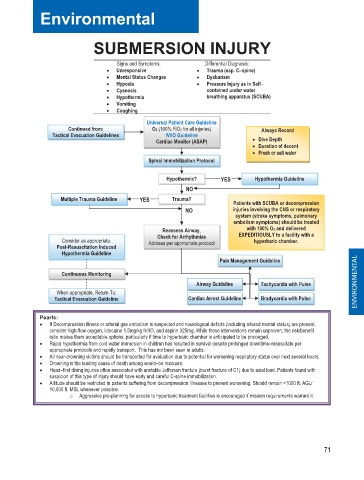
                     SUBMERSION INJURY

                          Signs and Symptoms:   Differential Diagnosis:
                        •  Unresponsive     •  Trauma (esp. C––spine)
                        •  Mental Status Changes  •  Dysbarism
                        •  Hypoxia          •  Pressure Injury as in Self– –
                        •  Cyanosis           contained under water
                        •  Hypothermia        breathing apparatus   (SCUBA)
                        •  Vomiting
                        •  Coughing
                                 Universal Patient Care Guideline
                Continued from:    O2 (100% FiO2 for all injuries)   Always Record
            Tactical Evacuation Guidelines   IV/IO Guideline
                                   Cardiac Monitor (ASAP)   • Dive Depth
                                                        • Duration of decent

                                                          e
                                                          r
                                                        • F Fresh or salt water e r
                                                              t
                                                              l
                                                              a

                                                                t
                                                                a
                                                               w

                                                           h
                                                           s
                                                            o
                                                             s

                                                             r
                                 Spinal Immobilization Protocol
                                     Hypothermic?   YES   Hypothermia Guideline
                                         NO
              Multiple Trauma Guideline   YES   Trauma?   Patients with SCUBA or decompression
                                         NO         injuries involving the CNS or respiratory
                                                    system (stroke symptoms, pulmonary
                                                    embolism symptoms) should be treated
                                    Reassess Airway,    with 100% O2 and delivered
                                   Check for Arrhythmias   EXPEDITIOUSLY to a facility with a
              Consider as appropriate:   Address per appropriate protocol   hyperbaric chamber.
             Post-Resuscitation Induced
              Hypothermia Guideline
                                                 Pain Management Guideline
              Continuous Monitoring
                                            Airway Guideline   Tachycardia with Pulse   ENVIRONMENTAL
             When appropriate, Return To:
             Tactical Evacuation Guideline   Cardiac Arrest Guideline   Bradycardia with Pulse
          Pearls:
          •  If Decompression Illness or arterial gas embolism is suspected and neurological deficits (including altered mental status) are present,
            consider high-flow oxygen, lidocaine 1.5mg/kg IV/IO, and aspirin 325mg. While these interventions remain unproven, the risk/benefit
            ratio makes them acceptable options, particularly if time to hyperbaric chamber is anticipated to be prolonged.
          •  Rapid hypothermia from cold water immersion in children has resulted in survival despite prolonged downtime–resuscitate per
            appropriate protocols and rapidly transport.  This has not been seen in adults.
          •  All near-drowning victims should be transported for evaluation due to potential for worsening respiratory status over next several hours.
          •  Drowning is the leading cause of death among would–be rescuers.
          •  Head–first diving injuries often associated with unstable Jefferson fracture (burst fracture of C1) due to axial load. Patients found with
            suspicion of this type of injury should have early and careful C-spine immobilization.
          •  Altitude should be restricted in patients suffering from decompression illnesses to prevent worsening. Should remain <1000 ft. AGL/
            10,000 ft. MSL whenever possible.
                o  Aggressive pre-planning for access to hyperbaric treatment facilities is encouraged if mission requirements warrant it.
                                                                        71

