


Page 76 - 2023 SMOG Digital
P. 76
CBRN


                                                2
                                MARCHE

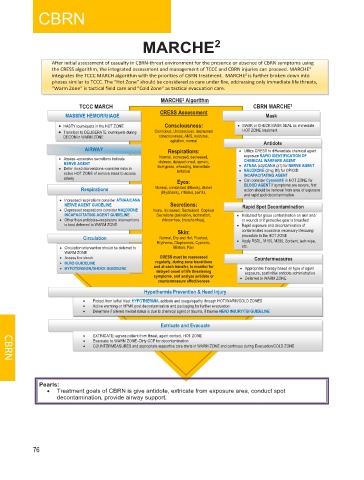
            After initial assessment of casualty in CBRN-threat environment for the presence or absence of CBRN symptoms using
            the CRESS algorithm, the integrated assessment and management of TCCC and CBRN injuries can proceed. MARCHE 2
            integrates the TCCC MARCH algorithm with the priorities of CBRN treatment.  MARCHE 2  is further broken down into
            phases similar to TCCC. The “Hot Zone” should be considered as care under fire, addressing only immediate life threats,
            “Warm Zone” is tactical field care and “Cold Zone” as tactical evacuation care.
                                    MARCHE 2  Algorithm
                  TCCC MARCH                            CBRN MARCHE 2
               MASSIVE HEMORRHAGE   CRESS Assessment       Mask
                        H
                        R
              • HASTY tourniquets in the HOT ZONE  Consciousness:   • MASK or CHECK MASK SEAL as immediate
              • Transition to DELIBERATE tourniquets during  Conscious, Unconscious, depressed   HOT ZONE treatment
               DECON in WARM ZONE   consciousness, AMS, seizures,
                                      agitation, normal     Antidote
                   AIRWAY             Respirations:   • Utilize CRESS to differentiate chemical agent
              • Assess–excessive secretions indicate   Normal, increased, decreased,   exposure RAPID IDENTIFICATION OF
                                                      CHEMICAL WARFARE AGENT
               NERVE AGENT          distress, delayed onset, apneic,   • ATNAA (x3)/CANA (x1) for NERVE AGENT
              • Defer most interventions–consider risks in   tachypnea, wheezing, immediate   • NALOXONE (2mg IM) for OPIOID
                                                        O
                                                        X
                                                         O
                                                       L
                                                         N
               active HOT ZONE of remove mask to access  irritation   INCAPACITATING AGENT
               airway
                                        Eyes:        • Can consider Cyanokit® in HOT ZONE for
                                                      BLOOD AGENT if symptoms are severe, first
                   Respirations    Normal, constricted (Miosis), dilated   action should be removal from area of exposure
                                    (Mydriasis), irritated, painful,     and rapid spot decontamination
              • Increased respirations consider ATNAA/CANA
               NERVE AGENT GUIDELINE  Secretions:
                            L
              • Depressed respirations consider NALOXONE   None, Increased, Decreased  Copious   Rapid Spot Decontamination
                             X
               INCAPACITATING AGENT GUIDELINE  Secretions (salivation, lacrimation,   • Indicated for gross contamination on skin and/
              • Other than antidotes–respiratory interventions  rhinorrrhea, bronchorrhea),    or wounds or if protective gear is breached
               is best deferred to WARM ZONE         • Rapid exposure and decontamination of
                                        Skin:         contaminated wounds is necessary lifesaving
                   Circulation      Normal, Dry and Hot, Flushed,   procedure in the HOT ZONE
                                   Erythema, Diaphoresis, Cyanotic,   • Apply RSDL, M100, M295, Sorbent, tech wipe,
              • Circulation intervention should be deferred to   Blisters, Pain   etc.
               WARM ZONE
              • Assess for shock    CRESS must be reassessed   Countermeasures
                                   regularly, during zone transitions
              • IV/IO GUIDELINE   and at each transfer, to monitor for
              • HYPOTENSION/SHOCK GUIDELINE          • Appropriate therapy based on type of agent
                                   delayed onset of life threatening   exposure, post initial antidote administration
                                  symptoms, and analyze antidote or   • Deferred to WARM ZONE
                                   countermeasure effectiveness

                                Hypothermia Prevention & Head Injury
                               O
                                T
                               P
                   •  Protect from lethal triad: HYPOTHERMIA, acidosis and coagulopathy through HOT/WARM/COLD ZONES
                              H
                              Y
                                 E
                                  R
                                  M
                                H
                                   I
                                   A
                   •  Active warming or HPMK post decontamination and packaging for further evacuation
                                                       B

                                                       I
                                                     Y
                                                      /
                                                      T
                                                          L
                                                         E
                                                           N
                                                          I
                                                        U
                                                       G
                                                         D
                                                         I
                                                 E
                                                  A
                                                  D
                   •  Determine if altered mental status is due to chemical agent or trauma, if trauma HEAD INJURY/TBI GUIDELINE E

                                                 H
                                                    J
                                                    U
                                                     R
                                                   N
                                                   I

                                    Extricate and Evacuate
                   •  EXTRICATE: egress patient from threat, agent contact, HOT ZONE
                   •  Evacuate: to WARM ZONE–Dirty CCP for decontamination
                   •  COUNTERMEASURES and appropriate supportive care starts in WARM ZONE and continues during Evacuation/COLD ZONE
  CBRN
          Pearls:
           •  Treatment goals of CBRN is give antidote, extricate from exposure area, conduct spot
             decontamination, provide airway support.
        76

