


Page 78 - 2023 SMOG Digital
P. 78
CBRN


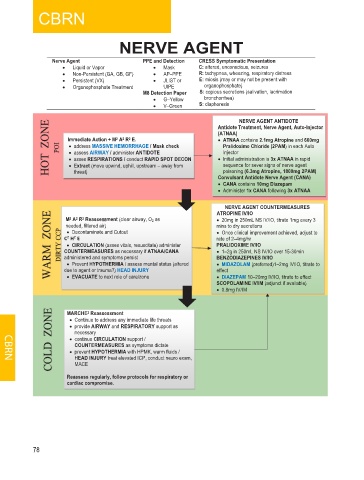
                           NERVE AGENT

            Nerve Agent         PPE and Detection   CRESS Symptomatic Presentation
               •  Liquid or Vapor  •  Mask  C: altered, unconscious, seizures
               •  Non-Persistent (GA, GB, GF)  •  AP–PPE  R: tachypnea, wheezing, respiratory distress
               •  Persistent (VX)  •  JLIST or  E: miosis (may or may not be present with
               •  Organophosphate Treatment  UIPE  organophosphate)
                                M8 Detection Paper   S: copious secretions (salivation, lacrimation
                                  •  G–Yellow  bronchorrhea)
                                  •  V–Green  S: diaphoresis   NERVE AGENT ANTIDOTE
            HOT  ZONE   POI   Immediate Action + M 2  A 2  R 2  E.   Antidote Treatment, Nerve Agent, Auto-Injector
                                                (ATNAA)
                                                • ATNAA contains 2.1mg Atropine and 600mg
                • address MASSIVE HEMORRHAGE / Mask check
                                                  Pralidoxime Chloride (2PAM) in each Auto
                                                         l
                                                         o
                • assess AIRWAY / administer ANTIDOTE
                                                  Injector
                                                • Initial administration is 3x ATNAA in rapid
                • asses RESPIRATIONS / conduct RAPID SPOT DECON
                                                  sequence for sever signs of nerve agent
                • Extract (move upwind, uphill, upstream – away from
                                                  poisoning (6.3mg Atropine, 1800mg 2PAM)
                 threat)
                                                Convulsant Antidote Nerve Agent (CANA)
                                                • CANA contains 10mg Diazepam
                                                • Administer 1x CANA following 3x ATNAA
                                                  NERVE AGENT COUNTERMEASURES
            WARM  ZONE   DIRTY CCP  needed, filtered air)   mins to dry secretions
                                                ATROPINE IV/IO
                        s
                       s
               M 2  A 2  R 2  Reassessment (clear airway, O 2 as
                                                • 20mg in 250mL NS IV/IO, titrate 1mg every 3
                • Decontaminate and Cutout
                                                • Once clinical improvement achieved, adjust to
                2
               C  H  E
                                                rate of 2–4mg/hr
                 2
                • CIRCULATION (asses vitals, resuscitate) administer
                                                PRALIDOXIME IV/IO
                                                • 1–2g in 250mL NS IV/IO over 15-30min
               COUNTERMEASURES as necessary if ATNAA/CANA
               administered and symptoms persist
                                                BENZODIAZEPINES IV/IO
                                                • MIDAZOLAM (preferred)1–2mg IV/IO, titrate to
                • Prevent HYPOTHERMIA / assess mental status (altered
               due to agent or trauma?) HEAD INJURY
                                                effect
                                                • DIAZEPAM 10–20mg IV/IO, titrate to effect
                • EVACUATE to next role of care/zone
                                                SCOPOLAMINE IV/IM (adjunct if available)
                                                • 0.8mg IV/IM
            COLD  ZONE  • Continue to address any immediate life threats
                MARCHE 2  Reassessment
                • provide AIRWAY and RESPIRATORY support as
                 necessary
                • continue CIRCULATION support /
                 COUNTERMEASURES as symptoms dictate
                • prevent HYPOTHERMIA with HPMK, warm fluids /
                 HEAD INJURY treat elevated ICP, conduct neuro exam,
  CBRN
                 MACE
                Reassess regularly, follow protocols for respiratory or
                cardiac compromise.
        78

