


Page 81 - 2023 SMOG Digital
P. 81
CBRN


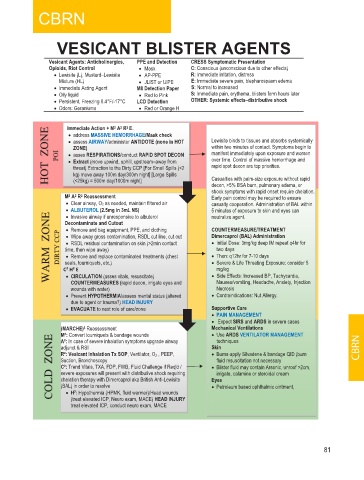
             VESICANT BLISTER AGENTS

            Vesicant Agents: Anticholinergics,   PPE and Detection   CRESS Symptomatic Presentation
            Opioids, Riot Control   • Mask  C: Conscious (unconscious due to other effects)
             • Lewisite (L), Mustard–Lewisite  • AP-PPE  R: Immediate irritation, distress
              Mixture (HL)     • JLIST or UIPE  E: Immediate severe pain, blepharospasm edema
             • Immediate Acting Agent  M8 Detection Paper  S: Normal to increased
             • Oily liquid     • Red to Pink  S: Immediate pain, erythema, blisters form hours later
             • Persistent, Freezing 0.4°F/-17°C  LCD Detection  OTHER: Systemic effects–distributive shock
             • Odors: Geraniums  • Red or Orange H
                Immediate Action + M 2  A 2  R 2  E.
           HOT  ZONE   POI   • address MASSIVE HEMORRHAGE/Mask check  Lewisite binds to tissues and absorbs systemically
                • assess AIRWAY/administer ANTIDOTE (none in HOT
                                               within two minutes of contact. Symptoms begin to
                 ZONE)
                                               manifest immediately upon exposure and worsen
                • asses RESPIRATIONS/conduct RAPID SPOT DECON
                                               over time. Control of massive hemorrhage and
                • Extract (move upwind, uphill, upstream–away from
                                               rapid spot decon are top priorities.
                 threat) Extraction to the Dirty CCP [For Small Spills (<2
                 kg) move away 100m day/300m night] [Large Spills
                                               Casualties with palm-size exposure without rapid
                 (<25kg) = 500m day/1000m night]
                                               decon, >5% BSA burn, pulmonary edema, or
                                               shock symptoms with rapid onset require chelation.
               M 2  A 2  R 2  Reassessment     Early pain control may be required to ensure
               • Clear airway, O2 as needed, maintain filtered air  casualty cooperation. Administration of BAL within
               • ALBUTEROL (2.5mg in 3mL L NS)
                                               5 minutes of exposure to skin and eyes can
            WARM  ZONE   DIRTY CCP   time, then wipe away)  COUNTERMEASURE/TREATMENT
                                               neutralize agent.
               • Invasive airway if unresponsive to albuterol
               Decontaminate and Cutout
               • Remove and bag equipment, PPE, and clothing
                                               Dimercaprol (BAL) Administration
               • Wipe away gross contamination, RSDL cut line, cut out
                                               • Initial Dose: 3mg/kg deep IM repeat q4hr for
               • RSDL residual contamination on skin (>2min contact
                                                two days
                                               • Then: q12hr for 7-10 days
               • Remove and replace contaminated treatments (chest
               seals, tourniquets, etc.)
                                               • Severe & Life Threating Exposure: consider 5
                                                mg/kg
                 2
               2
               C  H  E
               • CIRCULATION (asses vitals, resuscitate)
                                                Nausea/vomiting, Headache, Anxiety, Injection
                COUNTERMEASURES (rapid decon, irrigate eyes and
                                                Necrosis
                wounds with water)             • Side Effects: Increased BP, Tachycardia,
               • Prevent HYPOTHERMIA/assess mental status (altered  • Contraindications: Nut Allergy.
                due to agent or trauma?) HEAD INJURY
               • EVACUATE to next role of care/zone  Supportive Care
                                               • PAIN MANAGEMENT
                                               • Expect SIRS and ARDS in severe cases
              (MARCHE)² Reassessment           Mechanical Ventilations
                                               • Use ARDS VENTILATOR MANAGEMENT
              M²: Convert tourniquets & bandage wounds
            COLD  ZONE  R²: Vesicant Inhalation Tx SOP, Ventilator, O 2  , PEEP,   • Burns-apply Silvadene & bandage QID (burn  CBRN
                                                techniques
              A²: In case of severe inhalation symptoms upgrade airway
                                               Skin
              adjunct & RSI
              Suction, Bronchoscopy
                                                fluid resuscitation not necessary
              C²: Trend Vitals, TXA, FDP, FWB, Fluid Challenge if Req'd /
                                               • Blister fluid may contain Arsenic, unroof >2cm,
              severe exposures will present with distributive shock requiring
                                                irrigate, calamine or steroidal cream
              chelation therapy with Dimercaprol aka British Anti-Lewisite
                                               Eyes
              (BAL) in order to resolve
               • H 2 : Hypothermia (HPMK, fluid warmer)/Head wounds
                (treat elevated ICP, Neuro exam, MACE) HEAD INJURY
                treat elevated ICP, conduct neuro exam, MACE  • Petroleum based ophthalmic ointment,
                                                                        81

