


Page 107 - JSOM Winter 2021
P. 107
The time between an exposure to the bacteria that causes the   Patients with penicillin allergies should notify their doctor,
              disease and the emergence of symptoms is not clearly defined   who can prescribe an alternative treatment course.
              but may range from 1 day to many years; generally, symptoms
              appear 2 to 4 weeks after exposure.
                                                                 Prevention
              Although healthy people may get melioidosis, underlying med-  In areas where the disease is widespread, contact with con-
              ical conditions may increase the risk of diseases. The major   taminated soil or water can put people at risk for melioidosis.
              risk factors are diabetes, liver disease, renal disease, thalas-  However, in these areas, there are things that certain groups of
              semia, cancer or another immune-suppressing condition not   people can do to help minimize the risk of exposure:
              related to HIV infection, and chronic lung disease (e.g., cystic
              fibrosis, chronic obstructive pulmonary disease [COPD], and   •  Persons with open skin wounds and those with diabetes
              bronchiectasis).                                       or chronic renal disease are at increased risk for meli-
                                                                     oidosis and should avoid contact with soil and standing
                                                                     water.
              Risk of Exposure
                                                                   •  Those who perform agricultural work should wear
              While melioidosis infection has taken place all over the world,   boots, which can prevent infection through the feet and
              Southeast Asia and northern Australia are the areas in which   lower legs.
              it is primarily found. The only places the bacterium B. pseu-  •  Health care workers can use standard precautions
              domallei occurs naturally in the United States are Puerto Rico   when treating patients with melioidosis to help prevent
              and the US Virgin Islands.                             infection.

              Around a dozen cases are identified each year in the United
              States and have primarily occurred among travelers and
              immigrants coming from  places where the disease is wide-
              spread. However, we have seen melioidosis cases in the United
              States with no history of travel to areas where the disease is
              widespread.

              Moreover, it has been found among troops of all nationalities
              who have served in areas with widespread disease.

              The greatest numbers of melioidosis cases are reported in
              Thailand, Malaysia, Singapore, and northern Australia. Cases
              are also frequently reported in India and Sri Lanka, southern
              China, Hong Kong, Taiwan, Vietnam, Indonesia, Cambodia,
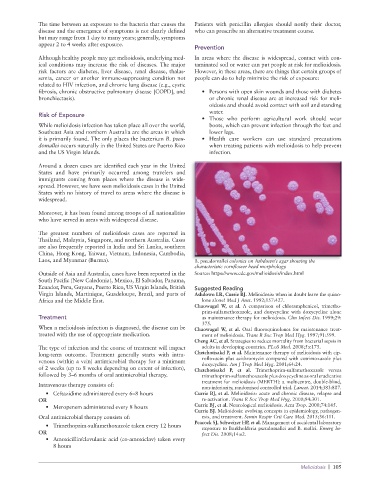
              Laos, and Myanmar (Burma).                         B. pseudomallei colonies on Ashdown’s agar showing the
                                                                 characteristic cornflower head morphology.
              Outside of Asia and Australia, cases have been reported in the   Source: https://www.cdc.gov/melioidosis/index.html
              South Pacific (New Caledonia), Mexico, El Salvador, Panama,
              Ecuador, Peru, Guyana, Puerto Rico, US Virgin Islands, British   Suggested Reading
              Virgin Islands, Martinique, Guadeloupe, Brazil, and parts of   Ashdown LR, Currie BJ. Melioidosis: when in doubt leave the quino-
              Africa and the Middle East.                          lone alone! Med J Aust. 1992;157:427.
                                                                 Chaowagul W, et al. A comparison of chloramphenicol, trimetho-
                                                                   prim-sulfamethoxazole, and doxycycline with doxycycline alone
              Treatment                                            as maintenance therapy for melioidosis. Clin Infect Dis. 1999;29:
                                                                   375.
              When a melioidosis infection is diagnosed, the disease can be   Chaowagul W, et al. Oral fluoroquinolones for maintenance treat-
              treated with the use of appropriate medication.      ment of melioidosis. Trans R Soc Trop Med Hyg. 1997;91:599.
                                                                 Cheng AC, et al. Strategies to reduce mortality from bacterial sepsis in
              The type of infection and the course of treatment will impact   adults in developing countries. PLoS Med. 2008;5:e175.
              long-term outcome. Treatment generally starts with intra-  Chetchotisakd P, et al. Maintenance therapy of melioidosis with cip-
              venous (within a vein) antimicrobial therapy for a minimum   rofloxacin plus azithromycin compared with cotrimoxazole plus
                                                                   doxycycline. Am J Trop Med Hyg. 2001;64:24.
              of 2 weeks (up to 8 weeks depending on extent of infection),   Chetchotisakd P, et al.  Trimethoprim-sulfamethoxazole versus
              followed by 3–6 months of oral antimicrobial therapy.    trimethoprim-sulfamethoxazole plus doxycycline as oral eradicative
                                                                   treatment for melioidosis (MERTH): a multicentre,  double-blind,
              Intravenous therapy consists of:                     non-inferiority, randomised controlled trial. Lancet. 2014;383:807.
                •  Ceftazidime administered every 6–8 hours      Currie BJ, et al. Melioidosis: acute and chronic disease, relapse and
              OR                                                   re-activation. Trans R Soc Trop Med Hyg. 2000;94:301.
                •  Meropenem administered every 8 hours          Currie BJ, et al. Neurological melioidosis. Acta Trop. 2000;74:145.
                                                                 Currie BJ. Melioidosis: evolving concepts in epidemiology, pathogen-
              Oral antimicrobial therapy consists of:              esis, and treatment. Semin Respir Crit Care Med. 2015;36:111.
                                                                 Peacock SJ, Schweizer HP, et al. Management of accidental laboratory
                •  Trimethoprim-sulfamethoxazole taken every 12 hours  exposure to Burkholderia pseudomallei and B. mallei. Emerg In-
              OR                                                   fect Dis. 2008;14:e2.
                •  Amoxicillin/clavulanic acid (co-amoxiclav) taken every
                  8 hours


                                                                                                   Melioidosis  |  105

