


Page 103 - JSOM Winter 2021
P. 103
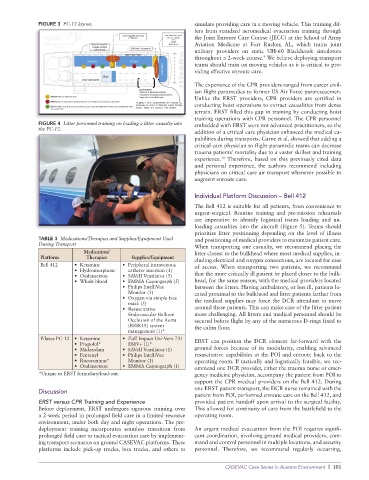
FIGURE 3  PC-12 layout.                            simulate providing care in a moving vehicle. This training dif-
                                                                 fers from standard aeromedical evacuation training through
                                                                 the Joint Enroute Care Course (JECC) at the School of Army
                                                                 Aviation Medicine at  Fort Rucker, AL, which trains  joint
                                                                 military providers on static UH-60 Blackhawk simulators
                                                                 throughout a 2-week course.  We believe deploying transport
                                                                                       9
                                                                 teams should train on moving vehicles as it is critical to pro-
                                                                 viding effective enroute care.

                                                                 The experience of the CPR providers ranged from career civil-
                                                                 ian flight paramedics to former US Air Force pararescuemen.
                                                                 Unlike the ERST providers, CPR providers are certified in
                                                                 conducting hoist operations to extract causalities from dense
                                                                 terrain. ERST filled this gap in training by conducting hoist
                                                                 training operations with CPR personnel. The CPR personnel
              FIGURE 4  Litter personnel training on loading a litter casualty into   embedded with ERST were not advanced practitioners, so the
              the PC-12.
                                                                 addition of a critical care physician enhanced the medical ca-
                                                                 pabilities during transports. Garne et al. showed that adding a
                                                                 critical care physician to flight paramedic teams can decrease
                                                                 trauma patients’ mortality due to a vaster skillset and training
                                                                         10
                                                                 experience.  Therefore, based on this previously cited data
                                                                 and personal experience, the authors recommend including
                                                                 physicians on critical care air transport whenever possible to
                                                                 augment enroute care.

                                                                 Individual Platform Discussion – Bell 412
                                                                 The Bell 412 is suitable for all patients, from convenience to
                                                                 urgent-surgical. Routine training and pre-mission rehearsals
                                                                 are imperative  to identify logistical issues  loading and un-
                                                                 loading casualties into the aircraft (Figure 5). Teams should
                                                                 prioritize litter positioning depending on the level of illness
              TABLE 3  Medications/Therapies and Supplies/Equipment Used   and positioning of medical providers to maximize patient care.
              During Transport                                   When transporting one casualty, we recommend placing the
                            Medication/                          litter closest to the bulkhead where most medical supplies, in-
              Platform       Therapies      Supplies/Equipment   cluding electrical and oxygen connections, are located for ease
              Bell 412   •  Ketamine     •  Peripheral intravenous   of access. When transporting two patients, we recommend
                         •  Hydromorphone   catheter insertion (1)
                         •  Ondansetron  •  SAVeII Ventilator (5)  that the more critically ill patient be placed closer to the bulk-
                         •  Whole blood  •  EMMA Capnograph (5)  head, for the same reason, with the medical providers located
                                         •  Philips IntelliVue    between the litters. Having ambulatory, or less ill, patients lo-
                                           Monitor (5)           cated proximal to the bulkhead and litter patients farther from
                                         •  Oxygen via simple face   the medical supplies may force the DCR attendant to move
                                           mask (5)
                                         •  Resuscitative        around these patients. This can make care of the litter patient
                                           Endovascular Balloon   more challenging. All litters and medical personnel should be
                                           Occlusion of the Aorta   secured before flight by any of the numerous D-rings fixed to
                                           (REBOA) system        the cabin floor.
                                           management (1)*
              Pilatus PC-12  •  Ketamine  •  Zoll Impact Uni-Vent 731   ERST can position the DCR element far-forward with the
                         •  Propofol*      EMV+ (1)*
                         •  Midazolam    •  SAVeII Ventilator (1)  ground forces because of its modularity, enabling advanced
                         •  Fentanyl     •  Philips IntelliVue    resuscitative capabilities at the POI and enroute back to the
                         •  Rocuronium*    Monitor (1)           operating room. If tactically and logistically feasible, we rec-
                         •  Ondansetron  •  EMMA Capnograph (1)  ommend one DCR provider, either the trauma nurse or emer-
              *Unique to ERST formulary/load-out.                gency medicine physician, accompany the patient from POI to
                                                                 support the CPR medical providers on the Bell 412. During
                                                                 one ERST patient transport, the DCR nurse remained with the
              Discussion
                                                                 patient from POI, performed enroute care on the Bell 412, and
              ERST versus CPR Training and Experience            provided patient handoff upon arrival to the surgical facility.
              Before deployment, ERST undergoes rigorous training over   This allowed for continuity of care from the battlefield to the
              a 2-week period in prolonged field care in a limited-resource   operating room.
              environment, under both day and night operations. The pre-
              deployment training incorporates seamless transition from   An urgent medical evacuation from the POI requires signifi-
              prolonged field care to tactical evacuation care by implement-  cant coordination, involving ground medical providers, com-
              ing transport scenarios on ground CASEVAC platforms. These   mand and control personnel in multiple locations, and security
              platforms include pick-up trucks, box trucks, and others to   personnel. Therefore,  we recommend  regularly occurring,

                                                                           CASEVAC Case Series in Austere Environment  |  101

