


Page 98 - JSOM Winter 2021
P. 98
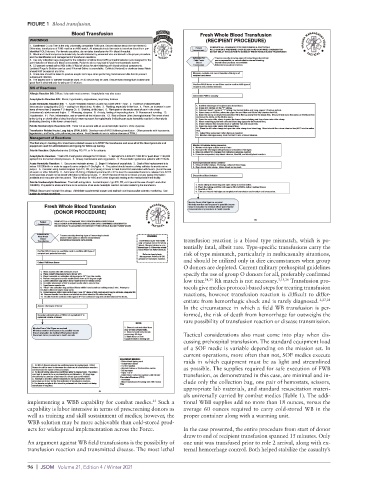
FIGURE 1  Blood transfusion.


                                                             transfusion reaction is a blood type mismatch, which is po-
                                                             tentially fatal, albeit rare. Type-specific transfusions carry the
                                                             risk of type mismatch, particularly in multicasualty situations,
                                                             and should be utilized only in dire circumstances when group
                                                             O donors are depleted. Current military prehospital guidelines
                                                             specify the use of group O donors for all, preferably confirmed
                                                             low titer. 24,25  Rh match is not necessary. 3,15,26  Transfusion pro-
                                                             tocols give medics protocol-based steps for treating transfusion
                                                             reactions, however transfusion reaction is difficult to differ-
                                                             entiate from hemorrhagic shock and is rarely diagnosed.  2,27,28
                                                             In the circumstance in which a field WB transfusion is per-
                                                             formed, the risk of death from hemorrhage far outweighs the
                                                             rare possibility of transfusion reaction or disease transmission.

                                                             Tactical considerations also must come into play when dis-
                                                             cussing prehospital transfusion. The standard equipment load
                                                             of a SOF medic is variable depending on the mission set. In
                                                             current operations, more often than not, SOF medics execute
                                                             raids in which equipment must be as light and streamlined
                                                             as possible. The supplies required for safe execution of FWB
                                                             transfusion, as demonstrated in this case, are minimal and in-
                                                             clude only the collection bag, one pair of hemostats, scissors,
                                                             appropriate lab materials, and standard resuscitation materi-
                                                             als universally carried by combat medics (Table 1). The addi-
          implementing a WBB capability for combat medics.  Such a   tional WBB supplies add no more than 18 ounces, versus the
                                                   23
          capability is labor intensive in terms of prescreening donors as   average 60 ounces required to carry cold-stored WB in the
          well as training and skill sustainment of medics; however, the   proper container along with a warming unit.
          WBB solution may be more achievable than cold-stored prod-
          ucts for widespread implementation across the Force.  In the case presented, the entire procedure from start of donor
                                                             draw to end of recipient transfusion spanned 15 minutes. Only
          An argument against WB field transfusions is the possibility of   one unit was transfused prior to role 2 arrival, along with ex-
          transfusion reaction and transmitted disease. The most lethal   ternal hemorrhage control. Both helped stabilize the casualty’s


          96  |  JSOM   Volume 21, Edition 4 / Winter 2021

