


Page 94 - JSOM Winter 2021
P. 94
Stratifying sites according to flow rate is useful when high-   There are substantial data that support using an IO line when
          volume resuscitation is required. As previously discussed,   peripheral IV access is not attainable for various reasons.
          sternal and humoral sites have distinct flow rate advantages.   However, in our opinion, there is no formal stratification to
          Consistent with Wolf’s law, iliac crest access would also have a   help determine preferential location for access placement. The
          theoretical advantage. Due to the iliac crest being non–weight   iliac crest has some unique advantages compared with other
          bearing, density and flow resistance are relatively low. This   sites, such as site availability, potentially better flow rate, ease
          suggests flow rates would be similar to sternal IO flow rates.   of insertion, and workspace utilization.
          More devoted studies would be required to confirm this. Cer-
          tainly, tibial access consistently lags regarding this metric.  Conclusion
                                                             This is the first report of a whole blood transfusion through an
          Anatomic differences among the possible sites are important to   iliac crest IO for hemorrhagic shock in a military prehospital
          consider. The iliac crest has a relatively wide medullary cavity   setting. Based on our experience, the possibility of needing to
          and is deep considering the trajectory of IO placement, mak-  care for triple and quadruple amputees, as well as the favor-
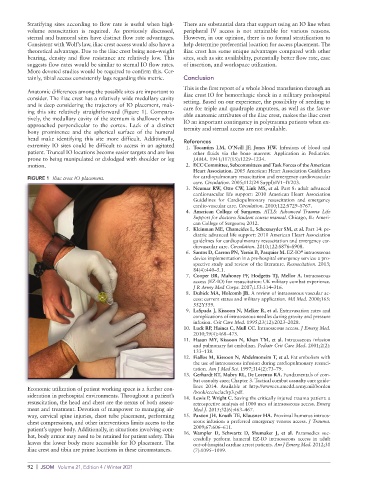
          ing this site relatively straightforward (Figure 1). Compara-  able anatomic attributes of the iliac crest, makes the iliac crest
          tively, the medullary cavity of the sternum is shallower when   IO an important contingency in polytrauma patients when ex-
          approached  perpendicular  to  the  cortex.  Lack  of  a  distinct   tremity and sternal access are not available.
          bony  prominence  and  the  spherical  surface  of  the  humeral
          head make identifying this site more difficult. Additionally,
          extremity IO sites could be difficult to access in an agitated   References
                                                              1.  Tocantins LM, O’Neill JF, Jones HW. Infusions of blood and
          patient. Truncal IO locations become easier targets and are less   other  fluids  via  the  bone  marrow.  Application  in  Pediatrics.
          prone to being manipulated or dislodged with shoulder or leg    JAMA. 1941;117(15):1229–1234.
          motion.                                             2.  ECC Committee, Subcommittees and Task Forces of the American
                                                                Heart Association. 2005 American Heart Association Guidelines
          FIGURE 1  Iliac crest IO placement.                   for cardiopulmonary resuscitation and emergency cardiovascular
                                                                care. Circulation. 2005;112(24 Suppl):IV1–IV203.
                                                              3.  Neumar RW, Otto CW, Link MS, et al. Part 8: adult advanced
                                                                cardiovascular life support: 2010 American Heart Association
                                                                Guidelines for Cardiopulmonary resuscitation and emergency
                                                                cardio-vascular care. Circulation. 2010;122:S729–S767.
                                                              4.  American  College  of  Surgeons.  ATLS:  Advanced  Trauma  Life
                                                                Support for doctors: Student course manual. Chicago, IL: Ameri-
                                                                can College of Surgeons; 2012.
                                                              5.  Kleinman ME, Chameides L, Schexnayder SM, et al. Part 14: pe-
                                                                diatric advanced life support: 2010 American Heart Association
                                                                guidelines for cardiopulmonary resuscitation and emergency car-
                                                                diovascular care. Circulation. 2010;122:S876–S908.
                                                              6.  Santos D, Carron PN, Yersin B, Pasquier M. EZ-IO  intraosseous
                                                                                                   ®
                                                                device implementation in a pre-hospital emergency service: a pro-
                                                                spective study and review of the literature. Resuscitation. 2013;
                                                                84(4):440–5.1.
                                                              7.  Cooper BR, Mahoney PF, Hodgetts TJ, Mellor A. Intraosseous
                                                                access (EZ-IO) for resuscitation: UK military combat experience.
                                                                J R Army Med Corps. 2007;153:314–316.
                                                              8.  Dubick MA, Holcomb JB. A review of intraosseous vascular ac-
                                                                cess: current status and military application. Mil Med. 2000;165:
                                                                552Y559.
                                                              9.  LaSpada J, Kissoon N, Melker R, et al. Extravasation rates and
                                                                complications of intraosseous needles during gravity and pressure
                                                                infusion. Crit Care Med. 1995;23(12):2023–2028.
                                                             10.  Luck RP, Haines C, Mull CC. Intraosseous access. J Emerg Med.
                                                                2010;39(4):468–475.
                                                             11.  Hasan MY, Kissoon N, Khan TM, et al. Intraosseous infusion
                                                                and pulmonary fat embolism. Pediatr Crit Care Med. 2001;2(2):
                                                                133–138.
                                                             12.  Fiallos M, Kissoon N, Abdelmoneim T, et al. Fat embolism with
                                                                the use of intraosseous infusion during cardiopulmonary resusci-
                                                                tation. Am J Med Sci. 1997;314(2):73–79.
                                                             13.  Gerhardt RT, Mabry RL, De Lorenzo RA. Fundamentals of com-
                                                                bat casualty care; Chapter 3. Tactical combat casualty care guide-
          Economic utilization of patient working space is a further con-  lines 2014. Available at  http://www.cs.amedd.army.mil/borden
                                                                /book/ccc/uclachp3.pdf.
          sideration in prehospital environments. Throughout a patient’s   14.  Lewis P, Wright C. Saving the critically injured trauma patient: a
          resuscitation, the head and chest are the nexus of both assess-  retrospective analysis of 1000 uses of intraosseous access. Emerg
          ment and treatment. Devotion of manpower to managing air-  Med J. 2015;32(6):463–467.
          way, cervical spine injuries, chest tube placement, performing   15.  Paxton JH, Knuth TE, Klausner HA. Proximal humerus intraos-
          chest compressions, and other interventions limits access to the   seous infusion: a preferred emergency venous access. J Trauma.
          patient’s upper body. Additionally, in situations involving com-  2009;67:606–611.
          bat, body armor may need to be retained for patient safety. This   16.  Wampler D, Schwartz D, Shumaker J, et al. Paramedics suc-
                                                                cessfully perform humeral EZ-IO intraosseous access in adult
          leaves the lower body more accessible for IO placement. The   out-of-hospital cardiac arrest patients. Am J Emerg Med. 2012;30
          iliac crest and tibia are prime locations in these circumstances.  (7):1095–1099.


          92  |  JSOM   Volume 21, Edition 4 / Winter 2021

