


Page 93 - JSOM Winter 2021
P. 93
artery. After hemorrhage was controlled in the chest, a celiot-  whereas first-time peripheral IV access was successful 43% of
              omy showed no violation of peritoneum. The iliac crest in-  the time. Tibial IO access times were also faster than establish-
              traosseous (IO) access was used as secondary access for the   ing a peripheral IV line. 16
              duration of the case and during transport to a higher level of
              care.                                              Once IO access is established, literature supports pharmaco-
                                                                 kinetic equivalence to IV with regard to fluids, iso-osmolar
                                                                 medications, blood products, and radiopaque contrast. 17–20
              Discussion
                                                                 These studies also demonstrate that time to central venous cir-
              IO access for administration of blood was described in the   culation is equivalent to that for peripheral IV.
                                       1
              1940s by Tocantins and O’Neil.  However, after the develop-
              ment of plastic-based intravenous (IV) catheters in the 1950s,   In 1922, Drinker described the marrow of a mammalian bone
              the use of IO access fell out of favor. In the 1980s, it reemerged   as a “non-collapsible vein.”  Marrow within the medullary
                                                                                       21
              as alternative access for children and took years before recom-  venous channel communicates to the central venous system via
                                      2–5
              mendations were implemented.  Despite being established as   nutrient and emissary veins, which may be occluded by tour-
              a functional and acceptable route, IO access has largely not   niquets. The density of compact bone and presence of spicules
              been adopted in civilian hospitals to the degree in which it has   in the medullary cavity create a noncollapsible system, even
              in the military prehospital setting. 6–8           in profound shock and hypovolemic states.  Although this
                                                                                                    22
                                                                 system maintains patency, it is also responsible for generating
              Slow adoption may have been due to concerns with possible   resistance to flow. This fact is consistent with flow rates from
              complications such as retained IO needle, infiltration, compart-  various bony sites. This is consistent with Wolf’s law, in which
              ment syndrome, fracture, fat embolism, and others. Complica-  bone density is related to the physiologic stress placed on it. 23,24
              tions associated with insertion are uncommon and, according
                                                        9
              to LaSpada et al., occur in less than 1% of insertions.  Other   Most studies comparing intraosseous flow rates assess tibial
              complications are related to duration of use and may be mit-  and humoral access sites, as these are the most common sites
              igated by early removal once alternative access is achieved. 10  used currently in civilian care. Due to significantly higher in-
                                                                 cidence of bilateral lower extremity injuries, sternal and hu-
              In an effort to quantify the incidence of embolization, Hasan   meral access sites are more common in military prehospital
              et al. studied tibial IO access in piglet lung specimens. Evi-  care. However, other access sites have been mentioned in the
              dence of fat emboli were witnessed in about 30% of lung spec-  medical literature, such as the medial malleolus, distal femur,
                   11
              imens.  However, there are no publications that suggest that   radius, clavicle, and iliac crest. 25–28
              fat emboli from IOs are clinically significant. Furthermore, Fi-
              allos et al. demonstrated that there was a similar distribution   Despite some variation between studies, as would be expected
              and magnitude of fat emboli at autopsy after 30 minutes of   from a mixture of animal models, age, and gender of human
              cardiopulmonary resuscitation with or without IO cannula-  patients  with  varying  bone  densities,  there  does  appear  to
              tion.   Despite theoretical validity, there is no evidence that fat   be a consistent theme as access sites are compared internally
                 12
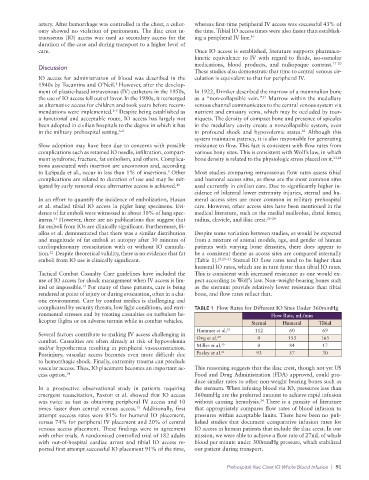
              emboli from IO use is clinically significant.      (Table 1). 23,29–31  Sternal IO flow rates tend to be higher than
                                                                 humeral IO rates, which are in turn faster than tibial IO rates.
              Tactical Combat Casualty Care guidelines have included the   This is consistent with increased resistance as one would ex-
              use of IO access for shock management when IV access is lim-  pect according to Wolf’s law. Non–weight-bearing bones such
                            13
              ited or impossible.  For many of these patients, care is being   as the sternum provide relatively lower resistance than tibial
              rendered at point of injury or during evacuation, often in a cha-  bone, and flow rates reflect that.
              otic environment. Care by combat medics is challenging and
              complicated by security threats, low light conditions, and envi-  TABLE 1  Flow Rates for Different IO Sites Under 360mmHg
              ronmental stresses and by treating casualties on turbulent he-              Flow Rate, mL/min
              licopter flights or on adverse terrain while in combat vehicles.     Sternal   Humeral     Tibial
                                                                 Hammer et al. 23   112         60        69
              Several factors contribute to making IV access challenging in   29
              combat. Casualties are often already at risk of hypovolemia   Ong et al.  0      153        165
              and/or hypothermia resulting in peripheral vasoconstriction.   Miller et al. 30  0  84      17
              Postinjury, vascular access becomes even more difficult due   Pasley et al. 31  93  57      30
              to hemorrhagic shock. Finally, extremity trauma can preclude
              vascular access. Thus, IO placement becomes an important ac-  This reasoning suggests that the iliac crest, though not yet US
              cess option. 14                                    Food and Drug Administration (FDA) approved, could pro-
                                                                 duce similar rates to other non-weight bearing bones such as
              In a prospective observational study in patients requiring   the sternum. When infusing blood via IO, pressures less than
              emergent resuscitation, Paxton et al. showed that IO access   360mmHg are the preferred amount to achieve rapid infusion
                                                                                      24
              was twice as fast as obtaining peripheral IV access and 10   without causing hemolysis.  There is a paucity of literature
                                              15
              times faster than central venous access.  Additionally, first   that appropriately compares flow rates of blood infusion to
              attempt success rates were 81% for humeral IO placement,   pressures within acceptable limits. There have been no pub-
              versus 74% for peripheral IV placement and 20% of central   lished studies that document comparative infusion rates for
              venous access placement. These findings were in agreement   IO access in human patients that include the iliac crest. In our
              with other trials. A randomized controlled trial of 182 adults   mission, we were able to achieve a flow rate of 27mL of whole
              with out-of-hospital cardiac arrest and tibial IO access re-  blood per minute under 300mmHg pressure, which stabilized
              ported first attempt successful IO placement 91% of the time,   our patient during transport.

                                                                           Prehospital Iliac Crest IO Whole Blood Infusion  |  91

