


Page 104 - JSOM Winter 2021
P. 104
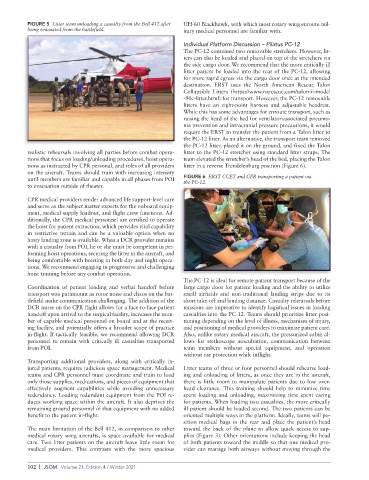
FIGURE 5  Litter team unloading a casualty from the Bell 412 after   UH-60 Blackhawk, with which most rotary wing enroute mil-
          being evacuated from the battlefield.              itary medical personnel are familiar with.

                                                             Individual Platform Discussion – Pilatus PC-12
                                                             The PC-12 contained two removable stretchers. However, lit-
                                                             ters can also be loaded and placed on top of the stretchers via
                                                             the side cargo door. We recommend that the more critically ill
                                                             litter patient be loaded into the rear of the PC-12, allowing
                                                             for more rapid egress via the cargo door once at the intended
                                                             destination.  ERST  uses  the North  American  Rescue  Talon
                                                             Collapsible Litters (https://www.narescue.com/talon-ii-model
                                                             -90c-litter.html) for transport. However, the PC-12 removable
                                                             litters have an eight-point harness and adjustable headrest.
                                                             While this has some advantages for enroute transport, such as
                                                             raising the head of the bed for ventilator-associated pneumo-
                                                             nia prevention and intracranial pressure precautions, it would
                                                             require the ERST to transfer the patient from a Talon litter to
                                                             the PC-12 litter. As an alternative, the transport team removed
                                                             the PC-12 litter, placed it on the ground, and fixed the Talon
          realistic rehearsals involving all parties before combat opera-  litter to the PC-12 stretcher using standard litter straps. The
          tions that focus on loading/unloading procedures, hoist opera-  team elevated the stretcher’s head of the bed, placing the Talon
          tions as instructed by CPR personal, and roles of all providers   litter in a reverse Trendelenburg position (Figure 6).
          on the aircraft. Teams should train with increasing intensity
          until members are familiar and capable in all phases from POI   FIGURE 6  ERST CCET and CPR transporting a patient via
                                                             the PC-12.
          to evacuation outside of theater.
          CPR medical providers render advanced life support-level care
          and serve as the subject matter experts for the onboard equip-
          ment, medical supply loadout, and flight crew functions. Ad-
          ditionally, the CPR medical personnel are certified to operate
          the hoist for patient extraction, which provides vital capability
          in restrictive terrain and can be a valuable option when no
          hasty landing zone is available. When a DCR provider remains
          with a casualty from POI, he or she must be competent in per-
          forming hoist operations, securing the litter in the aircraft, and
          being comfortable with hoisting in both day and night opera-
          tions. We recommend engaging in progressive and challenging
          hoist training before any combat operation.
                                                             The PC-12 is ideal for remote patient transport because of the
          Coordination of patient loading and verbal handoff before   large cargo door for patient loading and the ability to utilize
          transport was paramount as rotor noise and chaos on the bat-  small  airfields  and  non-traditional  landing  strips  due  to  its
          tlefield make communication challenging. The addition of the   short take-off and landing distance. Casualty rehearsals before
          DCR nurse on the CPR flight allows for a face-to-face patient   missions are imperative to identify logistical issues in loading
          handoff upon arrival to the surgical facility, increases the num-  casualties into the PC-12. Teams should prioritize litter posi-
          ber of capable medical personnel on board and at the receiv-  tioning depending on the level of illness, mechanism of injury,
          ing facility, and potentially offers a broader scope of practice   and positioning of medical providers to maximize patient care.
          in-flight. If tactically feasible, we recommend allowing DCR   Also, unlike rotary medical aircraft, the pressurized cabin al-
          personnel to remain with critically ill casualties transported   lows for stethoscope auscultation, communication between
          from POI.                                          team members without special equipment, and operation
                                                             without ear protection while inflight.
          Transporting additional providers, along with critically in-
          jured patients, requires judicious space management. Medical   Litter teams of three or four personnel should rehearse load-
          teams and CPR personnel must coordinate and train to load   ing and unloading of litters, as once they are in the aircraft,
          only those supplies, medications, and pieces of equipment that   there is little room to manipulate patients due to low over-
          effectively augment capabilities while avoiding unnecessary   head  clearance.  This  training  should  help  to  minimize  time
          redundancy. Loading redundant equipment from the POI re-  spent loading and unloading, maximizing time spent caring
          duces working space within the aircraft. It also deprives the   for patients. When loading two casualties, the more critically
          remaining ground personnel of that equipment with no added   ill patient should be loaded second. The two patients can be
          benefit to the patient in-flight.                  oriented multiple ways in the platform. Ideally, teams will po-
                                                             sition  medical  bags  in  the  rear  and  place  the  patient’s  head
          The main limitation of the Bell 412, in comparison to other   toward the back of the plane to allow quick access to sup-
          medical rotary wing aircrafts, is space available for medical   plies (Figure 3). Other orientations include keeping the head
          care. Two litter patients on the aircraft leave little room for   of both patients toward the middle so that one medical pro-
          medical providers. This contrasts with the more spacious   vider can manage both airways without moving through the


          102  |  JSOM   Volume 21, Edition 4 / Winter 2021

