


Page 108 - JSOM Winter 2021
P. 108
Centipede Bites


                                                                                 2
                                                           1
                                    Haley B. Randich, MSIV ; Mark W. Burnett, MD *


          ABSTRACT
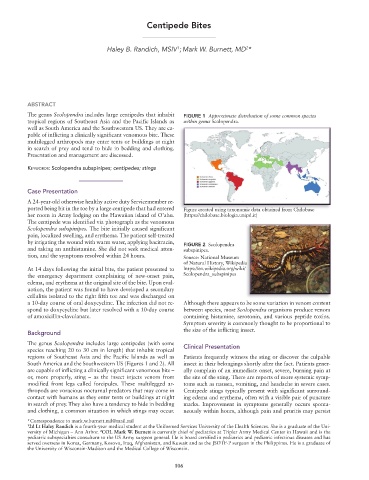
          The genus Scolopendra includes large centipedes that inhabit   FIGURE 1  Approximate distribution of some common species
          tropical regions of Southeast Asia and the Pacific Islands as   within genus Scolopendra.
          well as South America and the Southwestern US. They are ca-
          pable of inflicting a clinically significant venomous bite. These
          multilegged arthropods may enter tents or buildings at night
          in search of prey and tend to hide in bedding and clothing.
          Presentation and management are discussed.

          Keywords: Scolopendra subspinipes; centipedes; stings


          Case Presentation
          A 24-year-old otherwise healthy active duty Servicemember re-
          ported being bit in the toe by a large centipede that had entered   Figure created using taxonomic data obtained from Chilobase
          her room in Army lodging on the Hawaiian island of O’ahu.   (https://chilobase.biologia.unipd.it)
          The centipede was identified via photograph as the venomous
          Scolopendra subspinipes. The bite initially caused significant
          pain, localized swelling, and erythema. The patient self-treated
          by irrigating the wound with warm water, applying bacitracin,   FIGURE 2  Scolopendra
          and taking an antihistamine. She did not seek medical atten-  subspinipes.
          tion, and the symptoms resolved within 24 hours.   Source: National Museum
                                                             of Natural History, Wikipedia
          At 14 days following the initial bite, the patient presented to   https://en.wikipedia.org/wiki/
          the emergency department complaining of new-onset pain,   Scolopendra_subspinipes
          edema, and erythema at the original site of the bite. Upon eval-
          uation, the patient was found to have developed a secondary
          cellulitis isolated to the right fifth toe and was discharged on
          a 10-day course of oral doxycycline. The infection did not re-  Although there appears to be some variation in venom content
          spond to doxycycline but later resolved with a 10-day course   between species, most Scolopendra organisms produce venom
          of amoxicillin-clavulanate.                        containing histamine, serotonin, and various peptide toxins.
                                                             Symptom severity is commonly thought to be proportional to
                                                             the size of the inflicting insect.
          Background
          The genus Scolopendra includes large centipedes (with some
          species reaching 20 to 30 cm in length) that inhabit tropical   Clinical Presentation
          regions of Southeast Asia and the Pacific Islands as well as   Patients frequently witness the sting or discover the culpable
          South America and the Southwestern US (Figures 1 and 2). All   insect in their belongings shortly after the fact. Patients gener-
          are capable of inflicting a clinically significant venomous bite –    ally complain of an immediate onset, severe, burning pain at
          or, more properly, sting – as the insect injects venom from   the site of the sting. There are reports of more systemic symp-
          modified front legs called forcipules. These multilegged ar-  toms such as nausea, vomiting, and headache in severe cases.
          thropods are voracious nocturnal predators that may come in   Centipede stings typically present with significant surround-
          contact with humans as they enter tents or buildings at night   ing edema and erythema, often with a visible pair of puncture
          in search of prey.They also have a tendency to hide in bedding   marks. Improvement in symptoms generally occurs sponta-

          and clothing, a common situation in which stings may occur.   neously within hours, although pain and pruritis may persist
          *Correspondence to mark.w.burnett.mil@mail.mil
          1 2d Lt Haley Randich is a fourth-year medical student at the Uniformed Services University of the Health Sciences. She is a graduate of the Uni-
                                  2
          versity of Michigan – Ann Arbor.  COL Mark W. Burnett is currently chief of pediatrics at Tripler Army Medical Center in Hawaii and is the
          pediatric subspecialties consultant to the US Army surgeon general. He is board certified in pediatrics and pediatric infectious diseases and has
          served overseas in Korea, Germany, Kosovo, Iraq, Afghanistan, and Kuwait and as the JSOTF-P surgeon in the Philippines. He is a graduate of
          the University of Wisconsin-Madison and the Medical College of Wisconsin.
                                                          106
                                                          106

