


Page 110 - JSOM Winter 2021
P. 110
Latent TB Infection in USSOF

                                             A Refresher and Update


                                                         1
                                     Shawn H. Tang, 18D ; Joshua D. Evans, PA-C ;
                                                                                 2
                                                          3
                                    Alexander Vostal, MD ; Akira A. Shishido, MD *
                                                                                 4


          ABSTRACT
          Tuberculosis (TB) causes approximately 2 million deaths an-  clinically as fever and lymphadenopathy followed by the for-
          nually worldwide, with 2 billion persons estimated to be ac-  mation of cavitary lung lesions.  Patients with LTBI cannot
                                                                                       3
          tively infected with TB. While rates of active TB disease in the   transmit TB but have a 5–10% lifetime risk of reactivation of
          US military are low, military service in TB-endemic countries   infection (reactivation TB).  Clinically, reactivation TB mani-
                                                                                  2
          remains an uncommon, but important source of infection.   fests subtly as weeks to months of low-grade fever, weight loss,
          United States Special Operations Forces (USSOF) and enablers   and cough.  Both primary TB and reactivation TB are consid-
                                                                      3
          often operate in TB-endemic countries and, as an inherent risk   ered active infection with the possibility of transmission.
          of their mission sets, are more likely to have high-risk expo-
          sure to TB disease. Military medical authorities have provided
          excellent diagnostic guidance; the Centers for Disease Control   Context
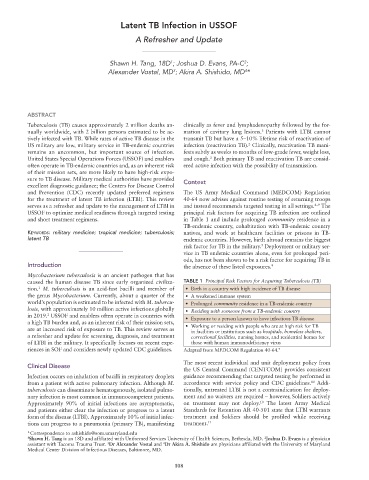
          and Prevention (CDC) recently updated preferred regimens   The US Army Medical Command (MEDCOM) Regulation
          for the treatment of latent TB infection (LTBI). This review   40-64 now advises against routine testing of returning troops
          serves as a refresher and update to the management of LTBI in   and instead recommends targeted testing in all settings.  The
                                                                                                        4–9
            USSOF to optimize medical readiness through targeted testing   principal risk factors for acquiring TB infection are outlined
          and short treatment regimens.                      in Table 1 and include prolonged community residence in a
                                                             TB-endemic country, cohabitation with TB-endemic country
          Keywords:  military medicine; tropical medicine; tuberculosis;   natives, and work at healthcare facilities or prisons in TB-
          latent TB                                          endemic countries. However, birth abroad remains the biggest
                                                             risk factor for TB in the military.  Deployment or military ser-
                                                                                      9
                                                             vice in TB endemic countries alone, even for prolonged peri-
                                                             ods, has not been shown to be a risk factor for acquiring TB in
          Introduction                                       the absence of these listed exposures. 9
          Mycobacterium tuberculosis is an ancient pathogen that has
          caused the human disease TB since early organized civiliza-  TABLE 1  Principal Risk Factors for Acquiring Tuberculosis (TB)
          tion.   M. tuberculosis is an acid-fast bacilli and member of   •  Birth in a country with high incidence of TB disease
              1
          the genus Mycobacterium. Currently, about a quarter of the   •  A weakened immune system
          world’s population is estimated to be infected with M. tubercu-  •  Prolonged community residence in a TB-endemic country
          losis, with approximately 10 million active infections globally   •  Residing with someone from a TB-endemic country
          in 2019.  USSOF and enablers often operate in countries with
                 2
          a high TB burden and, as an inherent risk of their mission sets,   •  Exposure to a person known to have infectious TB disease
          are at increased risk of exposure to TB. This review serves as   •  Working or residing with people who are at high risk for TB
                                                               in facilities or institutions such as hospitals, homeless shelters,
          a refresher and update for screening, diagnosis, and treatment   correctional facilities, nursing homes, and residential homes for
          of LTBI in the military. It specifically focuses on recent expe-  those with human immunodeficiency virus
          riences in SOF and considers newly updated CDC guidelines.  Adapted from MEDCOM Regulation 40-64. 9
                                                             The most recent individual and unit deployment policy from
          Clinical Disease
                                                             the US Central Command (CENTCOM) provides consistent
          Infection occurs on inhalation of bacilli in respiratory droplets   guidance recommending that targeted testing be performed in
                                                                                                       10
          from a patient with active pulmonary infection. Although M.   accordance with service policy and CDC guidelines.  Addi-
          tuberculosis can disseminate hematogenously, isolated pulmo-  tionally, untreated LTBI is not a contraindication for deploy-
          nary infection is most common in immunocompetent patients.   ment and no waivers are required – however, Soldiers actively
          Approximately  90%  of  initial  infections  are  asymptomatic,   on treatment may not deploy.  The latest Army Medical
                                                                                      10
          and patients either clear the infection or progress to a latent   Standards for Retention AR 40-501 state that LTBI warrants
          form of the disease (LTBI). Approximately 10% of initial infec-  treatment and Soldiers should be profiled while receiving
          tions can progress to a pneumonia (primary TB), manifesting   treatment. 11
          *Correspondence to ashishido@som.umaryland.edu
                                                                                       2
          1 Shawn H. Tang is an 18D and affiliated with Uniformed Services University of Health Sciences, Bethesda, MD.  Joshua D. Evans is a physician
                                    3
                                                      4
          assistant with Tacoma Trauma Trust.  Dr Alexander Vostal and  Dr Akira A. Shishido are physicians affiliated with the University of Maryland
          Medical Center Division of Infectious Diseases, Baltimore, MD.
                                                          108
                                                          108

