


Page 115 - JSOM Winter 2021
P. 115
of HIFT programs provided based on information from the   locations of injuries. All three reviews found that the shoulder,
                                   7
              Army Public Health Center.  In the 7 years since 2015, several   back, and knee were the most common sites of injury.
              systematic and narrative reviews have been published exam-
              ining injuries during HIFT. The purpose of this article was to   Analysis of Reviews
                                                                                      9
              evaluate these reviews with the goal of determining the safety   The review by Poston et al.  was of particular interest because
              of HIFT programs.                                  it was the only one to look specifically at military investiga-
                                                                 tions, largely ignored by the other reviews. This shortcoming
                                                                 in other reviews was likely to the result of the retrieval sys-
              Methods
                                                                 tems used by them. These retrieval systems (e.g., PubMed, CI-
              PubMed, Web of Science, and the Cumulative Index to Nurs-  NAHL) often do not include studies published in other than
              ing and Allied Health Literature (CINAHL) were searched to   peer-reviewed journal articles. Studies not in peer-reviewed
              find articles relating to injuries incurred during HIFT. Key-  journals are often called “grey literature” and might include
              words used in the search were “injury” AND “CrossFit,” OR   military technical reports and other self-published scientific
                                                                                                                9
              “High Intensity Functional Training” OR “Extreme Exercise   papers. In the five military studies reviewed by Poston et al.,
              Programs” OR “Gym Jones” OR “Insanity.” The reference   two studies reported no injuries, two studies reported that in-
              lists of the obtained articles were also reviewed for other ar-  juries were lower in in the HIFT group compared with other
              ticles that were missed by the formal search. Articles were   types of training, and one study reported that injuries were
              included when they were narrative or systematic reviews of   similar in groups performing HIFT versus traditional Army
              injuries incurred during HIFT of any type, as defined above.   physical training.
              The  quality  of  the  systematic  reviews  was  assessed  using
              the eight-item National Institutes of Health (NIH) Study     The reviews by Meyer et al.  and Klimek et al.  included only
                                                                                                     12
                                                                                      11
                                  8
              Quality Assessment Tools.  The review was completed in Au-  three studies each, with just one study overlapping. Klimek et
              gust 2021.                                         al.  specifically selected studies that compared CrossFit train-
                                                                  12
                                                                 ing to other types of training; the authors concluded that with
                                                                 the  limited  number  of  investigations  available  at  the  time,
              Results
                                                                 injuries were similar in CrossFit and other types of physical
                                                                                                               10
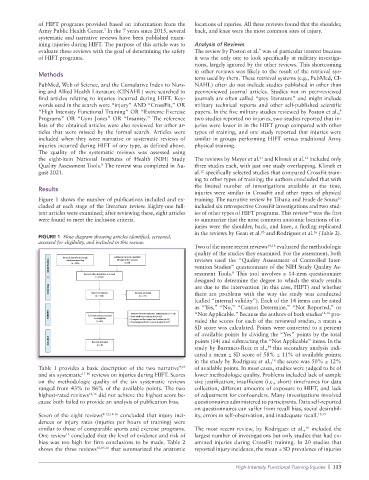
              Figure 1 shows the number of publications included and ex-  training. The narrative review by Tibana and Frade de Sousa
              cluded at each stage of the literature review. Eighty-one full-  included six retrospective CrossFit investigations and two stud-
              text articles were examined; after reviewing these, eight articles   ies of other types of HIFT programs. This review  was the first
                                                                                                      10
              were found to meet the inclusion criteria.         to summarize that the most common anatomic locations of in-
                                                                 juries were the shoulder, back, and knee, a finding replicated
                                                                                                        16
                                                                                      15
                                                                 in the reviews by Gean et al.  and Rodriguez et al.  (Table 2).
              FIGURE 1  Flow diagram showing articles identified, screened,
              assessed for eligibility, and included in this review.
                                                                 Two of the more recent reviews 14,16  evaluated the methodologic
                                                                 quality of the studies they examined. For the assessment, both
                                                                 reviews used the “Quality Assessment of Controlled Inter-
                                                                 vention Studies” questionnaire of the NIH Study Quality As-
                                                                             8
                                                                 sessment Tools.  This tool involves a 14-item questionnaire
                                                                 designed to determine the degree to which the study results
                                                                 are due to the intervention (in this case, HIFT) and whether
                                                                 there are problems with the way the study was conducted
                                                                 (called “internal validity”). Each of the 14 items can be rated
                                                                 as “Yes,” “No,” “Cannot Determine,” “Not Reported,” or
                                                                 “Not Applicable.” Because the authors of both studies 14,16  pro-
                                                                 vided the scores for each of the reviewed studies, a mean ±
                                                                 SD score was calculated. Points were converted to a percent
                                                                 of available points by dividing the “Yes” points by the total
                                                                 points (14) and subtracting the “Not Applicable” items. In the
                                                                 study by Barranco-Ruiz et al.,  this secondary analysis indi-
                                                                                        14
                                                                 cated a mean ± SD score of 58% ± 11% of available points;
                                                                 in the study by Rodriguez et al.,  the score was 50% ± 12%
                                                                                          16
              Table 1 provides a basic description of the two narrative 9,10    of available points. In most cases, studies were judged to be of
              and six systematic 11-16  reviews on injuries during HIFT. Scores   lower methodologic quality. Problems included lack of sample
              on the methodologic quality of the six systematic reviews   size justification, insufficient (i.e., short) timeframes for data
              ranged from 43% to 86% of the available points. The two   collection, different amounts of exposure to HIFT, and lack
              highest-rated reviews 14,16  did not achieve the highest score be-  of adjustment for confounders. Many investigations involved
              cause both failed to provide an analysis of publication bias.  questionnaires administered to participants. Data self-reported
                                                                 on questionnaires can suffer from recall bias, social desirabil-
              Seven of the eight reviews 9-12,14-16  concluded that injury inci-  ity, errors in self-observation, and inadequate recall. 18,19
              dences or injury rates (injuries per hours of training) were
                                                                                                     16
              similar to those of comparable sports and exercise programs.   The  most  recent  review,  by  Rodriguez  et  al.,   included  the
                       13
              One review  concluded that the level of evidence and risk of   largest number of investigations but only studies that had ex-
              bias was too high for firm conclusions to be made. Table 2   amined injuries during CrossFit training. In 20 studies that
              shows the three reviews 10,15,16  that summarized the anatomic   reported injury incidence, the mean ± SD prevalence of injuries
                                                                              High-Intensity Functional Training Injuries  |  113

