


Page 112 - JSOM Winter 2021
P. 112
Recommendations and Conclusion                     TABLE 3  Latent TB References as of 2021 for SOF Medics and
                                                             Medical Providers
          The most recent CDC guidelines recommend the IGRA as the
          preferred test in both low-risk and high-risk individuals.  We   Operational
                                                      19
          also prefer IGRA testing when available in favor of the TST   MEDCOM Reg 40-64: The Tuberculosis Surveillance and Control
                                                                        8
          because it (1) avoids practitioner-dependent variability in ad-  Program 2013
          ministration and interpretation, (2) requires only one visit by   USCENTCOM MOD Fourteen Individual Protection and
                                                              Individual Unit-Deployment Policy 2019
                                                                                          9
          the Soldier, (3) avoids (rare, but serious) hypersensitivity reac-                            10
          tions that can occur with TSTs, and (4) is a more specific test.   Army Regulation 40-501: Standards of Medical Fitness 2019
          Any Soldier exhibiting signs of active TB disease (e.g., chronic   Epidemiology
          cough, hemoptysis, weight loss, night sweats, fevers, abnormal   National Center for Medical Intelligence:
          chest imaging) should be immediately isolated and evaluated   https://www.intelink.gov/ncmi (DOD Only)  2
          by a physician experienced in the diagnosis and treatment of   World Health Organization Global Tuberculosis Report 2020
          active TB disease.                                  Unit- or branch-specific references depending on clearance level
                                                              Diagnosis
          In accordance with AR 40-501, we recommend treatment of   Diagnosis of Tuberculosis in Adults and Children IDSA/ATS
          all Soldiers in the USSOF community who test positive for   Guideline 2017 18
          LTBI because (1) all USSOF Soldiers are potential medical   Management
          providers and while risk of progression is low, active disease   Guidelines for the Treatment of Latent Tuberculosis Infection
          can be catastrophic, (2) USSOF Soldiers are often required to   (CDC) 2020 15
          cohabitate in enclosed, close-quartered housing for prolonged
          periods, and (3) documentation of LTBI treatment is often re-
          quired for credentialing and specialized schools.  Author Contributions
                                                             AS drafted the original manuscript. ST, JE, and AV contributed
                                                             additional sections and references. All authors reviewed and
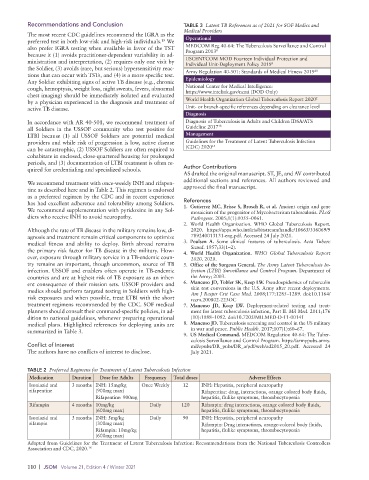
          We recommend treatment with once-weekly INH and rifapen-
          tine as described here and in Table 2. This regimen is endorsed   approved the final manuscript.
          as a preferred regimen by the CDC and in recent experience
          has had excellent adherence and tolerability among Soldiers.   References
          We recommend supplementation with pyridoxine in any Sol-  1.  Gutierrez MC, Brisse S, Brosch R, et al. Ancient origin and gene
                                                               mosaicism of the progenitor of Mycobacterium tuberculosis. PLoS
          diers who receive INH to avoid neuropathy.           Pathogens. 2005;1(1):0055–0061.
                                                             2.  World Health Organization. WHO Global Tuberculosis Report.
          Although the rate of TB disease in the military remains low, di-  2020.  https://apps.who.int/iris/bitstream/handle/10665/336069/9
          agnosis and treatment remain critical components to optimize   789240013131-eng.pdf. Accessed 24 July 2021.
          medical  fitness and ability  to deploy. Birth abroad remains   3.  Poulsen A. Some clinical features of tuberculosis.  Acta Tuberc
                                                               Scand. 1957;33(1–2).
          the primary risk factor for TB disease in the military. How-  4.  World  Health  Organization.  WHO  Global  Tuberculosis  Report
          ever, exposure through military service in a TB-endemic coun-  2020. 2020.
          try remains an important, though uncommon, source of TB   5.  Office of the Surgeon General. The Army Latent Tuberculosis In-
          infection. USSOF and enablers often operate in TB- endemic   fection (LTBI) Surveillance and Control Program. Department of
          countries and are at highest risk of TB exposure as an inher-  the Army; 2003.
          ent consequence of their mission sets. USSOF providers and   6.  Mancuso JD, Tobler SK, Keep LW. Pseudoepidemics of tuberculin
          medics should perform targeted testing in Soldiers with high-  skin test conversions in the U.S. Army after recent deployments.
                                                               Am J Respir Crit Care Med. 2008;177:1285–1289. doi:10.1164/
          risk exposures and when possible, treat LTBI with the short   rccm.200802-223OC
          treatment regimens recommended by the CDC. SOF medical   7.  Mancuso JD, Keep LW. Deployment-related testing and treat-
          planners should consult their command-specific policies, in ad-  ment for latent tuberculosis infection, Part II. Mil Med. 2011;176
          dition to national guidelines, whenever preparing operational   (10):1088–1092. doi:10.7205/MILMED-D-11-00141
          medical plans. Highlighted references for deploying units are   8.  Mancuso JD. Tuberculosis screening and control in the US military
          summarized in Table 3.                               in war and peace. Public Health. 2017;107(1):60–67.
                                                             9.  US Medical Command. MEDCOM Regulation 40-64: The Tuber-
                                                               culosis Surveillance and Control Program. https://armypubs.army.
          Conflict of Interest                                 mil/epubs/DR_pubs/DR_a/pdf/web/ad2015_20.pdf. Accessed  24
          The authors have no conflicts of interest to disclose.  July 2021.


          TABLE 2  Preferred Regimens for Treatment of Latent Tuberculosis Infection
           Medication    Duration  Dose for Adults  Frequency  Total doses        Adverse Effects
           Isoniazid and   3 months INH: 15mg/kg    Once Weekly  12  INH: Hepatitis, peripheral neuropathy
           rifapentine          (900mg max)                        Rifapentine: drug, interactions, orange colored body fluids,
                                Rifapentine: 900mg                 hepatitis, flulike symptoms, thrombocytopenia
           Rifampin      4 months 10mg/kg         Daily     120    Rifampin: drug interactions, orange colored body fluids,
                                (600mg max)                        hepatitis, flulike symptoms, thrombocytopenia
           Isoniazid and   3 months INH: 5mg/kg    Daily     90    INH: Hepatitis, peripheral neuropathy
           rifampin             (300mg max)                        Rifampin: Drug interactions, orange-colored body fluids,
                                Rifampin: 10mg/kg                  hepatitis, flulike symptoms, thrombocytopenia
                                (600mg max)
          Adapted from Guidelines for the Treatment of Latent Tuberculosis Infection: Recommendations from the National Tuberculosis Controllers
          Association and CDC, 2020. 16


          110  |  JSOM   Volume 21, Edition 4 / Winter 2021

