


Page 111 - JSOM Winter 2021
P. 111
Risk of TB in USSOF and Enablers                   must then be measured 48–72 hours after injection. A positive
                                                                 result depends on the pretest likelihood that the Soldier is in-
              USSOF and SOF enablers often operate in regions with a signif-  fected: 5 mm of induration for high risk, 10 mm for intermedi-
              icant TB burden. The CENTCOM area of operations (AOR)   ate risk, and 15 mm for low risk. A formal explanation on the
              has high rates of TB and has been the most kinetic AOR for   interpretation of TSTs is beyond the scope of this review, but
              the last two decades. For reference, the United States has an   in general, 10 mm of induration is used as the positive thresh-
              incidence of 3 cases of TB per 100,000 persons.  Afghanistan   old for active-duty Soldiers. A TST and IGRA interpretation
                                                   2
              has a rate of 189 cases per 100,000, whereas Iraq has a rate   tool is available from McGill University at http://www.tstin3d
              of 41 cases.  Additionally, near peer threats such as China, the   .com.  The IGRA measures T-cell release of interferon-γ stim-
                       2
                                                                     12
              Russian Federation, and North Korea have significantly high   ulated by  M. tuberculosis antigens. It is performed in vitro
              burdens of TB with estimated incidences of 58, 50, and 513   and requires a one-time blood sample from the Soldier being
              cases per 100,000 persons, respectively, in 2019.  The regions   tested. While the sensitivities of the tests are similar (approxi-
                                                   2
              currently estimated to have the highest overall burden of TB   mately 90% for both when performed correctly in a targeted
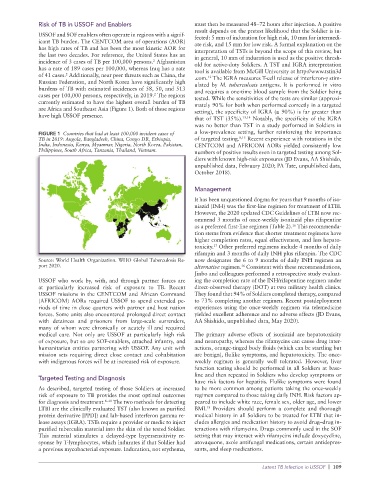
              are Africa and Southeast Asia (Figure 1). Both of these regions   setting), the specificity of IGRA (≥ 90%) is far greater than
              have high USSOF presence.                          that of TST (35%). 13,14  Notably, the specificity of the IGRA
                                                                 was no better than TST in a study performed in Soldiers in
              FIGURE 1  Countries that had at least 100,000 incident cases of   a low-prevalence setting, further reinforcing the importance
              TB in 2019: Angola, Bangladesh, China, Congo DR, Ethiopia,   of targeted testing. 8,15  Recent experience with rotations in the
              India, Indonesia, Kenya, Myanmar, Nigeria, North Korea, Pakistan,   CENTCOM and AFRICOM AORs yielded consistently low
              Philippines, South Africa, Tanzania, Thailand, Vietnam.  numbers of positive results even in targeted testing among Sol-
                                                                 diers with known high-risk exposures (JD Evans, AA Shishido,
                                                                 unpublished data, February 2020; PA Tate, unpublished data,
                                                                 October 2018).


                                                                 Management
                                                                 It has been unquestioned dogma for years that 9 months of iso-
                                                                 niazid (INH) was the first-line regimen for treatment of LTBI.
                                                                 However, the 2020 updated CDC Guidelines of LTBI now rec-
                                                                 ommend 3 months of once-weekly isoniazid plus rifapentine
                                                                                                 16
                                                                 as a preferred first-line regimen (Table 2).  This recommenda-
                                                                 tion stems from evidence that shorter treatment regimens have
                                                                 higher completion rates, equal effectiveness, and less hepato-
                                                                 toxicity.  Other preferred regimens include 4 months of daily
                                                                       17
                                                                 rifampin and 3 months of daily INH plus rifampin. The CDC
              Source: World Health Organization. WHO Global Tuberculosis Re-  now designates the 6 to 9 months of daily INH regimen an
              port 2020.                                         alternative regimen.  Consistent with these recommendations,
                                                                                16
                                                                 Jinbo and colleagues performed a retrospective study evaluat-
              USSOF who work by, with, and through partner forces are   ing the completion rate of the INH/rifapentine regimen under
              at particularly increased risk of exposure to TB. Recent   direct-observed therapy (DOT) at two military health clinics.
                USSOF missions in the CENTCOM and African Command   They found that 94% of Soldiers completed therapy, compared
              ( AFRICOM) AORs required USSOF to spend extended pe-  to 73% completing another regimen. Recent postdeployment
              riods of time in close quarters with partner and host nation   experiences using the once-weekly regimen via telemedicine
              forces. Some units also encountered prolonged direct contact   yielded excellent adherence and no adverse effects (JD Evans,
              with detainees and prisoners from large-scale surrenders,   AA Shishido, unpublished data, May 2020).
              many of whom were chronically or acutely ill and required
              medical care. Not only are USSOF at particularly high risk   The primary adverse effects of isoniazid are hepatotoxicity
              of exposure, but so are SOF-enablers, attached infantry, and   and neuropathy, whereas the rifamycins can cause drug inter-
              humanitarian entities partnering with USSOF. Any unit with   actions, orange-tinged body fluids (which can be startling but
              mission sets requiring direct close contact and cohabitation   are benign), flulike symptoms, and hepatotoxicity. The once-
              with indigenous forces will be at increased risk of exposure.  weekly regimen is generally well tolerated. However, liver
                                                                 function testing should be performed in all Soldiers at base-
                                                                 line and then repeated in Soldiers who develop symptoms or
              Targeted Testing and Diagnosis
                                                                 have risk factors for hepatitis. Flulike symptoms were found
              As described, targeted  testing of those Soldiers at increased   to be more common among patients taking the once-weekly
              risk of exposure to TB provides the most optimal outcomes   regimen compared to those taking daily INH. Risk factors ap-
              for diagnosis and treatment. 8–10  The two methods for detecting   peared to include white race, female sex, older age, and lower
                                                                     18
              LTBI are the clinically evaluated TST (also known as purified   BMI.   Providers  should  perform  a  complete  and  thorough
              protein derivative [PPD]) and lab-based interferon gamma re-  medical history in all Soldiers to be treated for LTBI that in-
              lease assays (IGRA). TSTs require a provider or medic to inject   cludes allergies and medication history to avoid drug–drug in-
              purified tuberculin material into the skin of the tested Soldier.   teractions with rifamycins. Drugs commonly used in the SOF
              This material stimulates a delayed-type hypersensitivity re-  setting that may interact with rifamycins include doxycycline,
              sponse by T-lymphocytes, which indurates if that Soldier had   atovaquone, azole antifungal medications, certain antidepres-
              a previous mycobacterial exposure. Induration, not erythema,   sants, and sleep medications.

                                                                                       Latent TB Infection in USSOF  |  109

