


Page 147 - JSOM Winter 2018
P. 147
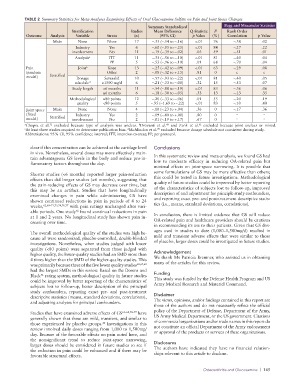
TABLE 2  Summary Statistics for Meta-Analyses Examining Effects of Oral Glucosamine Sulfate on Pain and Joint Space Changes
                                                              Summary Standardized            Begg and Mazumdar Statistics
                               Stratification          Studies   Mean Difference    Q-Statistic   I 2  Rank Order
            Outcome   Analysis  Variable     Strata     (n)        (95% CI)      p Value  (%)  Correlation  p Value
                       Main      None        None        17     –.35 (–.54 to –.16)  <.01  76    –.38        .02
                                Industry      Yes        6      –.60 (–.95 to –.25)  <.01  84    –.27        .22
                               involvement    No         11     –.19 (–.39 to –.02)  .03  59     –.51        .01
                                Analysis a    ITT        11     –.33 (–.56 to –.10)  <.01  81    –.40        .04
                                              PP         5      –.53 (–.96 to –.10)  .01  68     –.70        .04
            Pain                 Joint b      Knee       13     –.25 (–.42 to –.09)  <.01  63    –.29        .08
            (random                          Other       2      –.08 (–.32 to +.15)  .81  0        c          c
            model)    Stratified  Dosage    Several/d    10     –.57 (–.93 to –.22)  <.01  81    –.40        .05
                                schedule d  ≥1500 mg/d   6      –.21 (–.33 to –.08)  .32  15     –.53        .07
                               Study length  <6 months   11     –.54 (–.88 to –.19)  <.01  83    –.36        .06
                                            ≥6 months    6      –.18 (–.30 to –.05)  .33  13     –.13        .35
                              Methodological   ≥80 points  12   –.20 (–.33 to –.06)  .01  55     –.20        .19
                                 quality    <80 points   5     –.95 (–1.69 to –.22)  <.01  83    –.10        .40
            Joint space   Main   None        None        4      –.10 (–.23 to +.04)  .56  0      –.17        .36
            (fixed              Industry      Yes        2      –.19 (–.40 to +.00)  .80  0        c          c
            model)    Stratified  involvement  No        2      –.01 (–.19 to +.17)  .67  0        c          c
                                                                                   62
                      72
                                                          b
                                                                      68
           a Chopra  et  al.   excluded  because  type  of  analysis  was  unclear.  Drovanti  et  al.   and  Zenk  et  al.   excluded  because  joint  unclear  or  mixed.
           c At least three studies required to determine publication bias.  McAlindon et al.  excluded because dosage schedule not consistent during study.
                                                      d
                                                                  76
           Abbreviations: 95% CI, 95% confidence interval; ITT, intention-to-treat; PP, per protocol.
              clear if this concentration can be achieved at the cartilage level   Conclusions
              in vivo. Nonetheless, several doses may more effectively main-
              tain advantageous GS levels in the body and reduce pro-in-  In this systematic review and meta-analysis, we found GS had
              flammatory factors throughout the day.             low to moderate efficacy in reducing OA-related pain but
                                                                 minimal effects on joint-space narrowing. It is possible that
              Shorter studies (<6 months) reported larger pain-reduction   some formulations of GS may be more effective than others;
              effects than did longer studies (≥6 months), suggesting that   this could be tested in future investigations. Methodological
              the pain-reducing effects of GS may decrease over time, but   quality of future studies could be improved by better reporting
              this may be an artifact. Studies that have longitudinally   of the characteristics of subjects lost to follow-up, improved
              examined changes in pain while administering GS have   description of and adjustment for principle study confounders,
              shown continued reductions in pain in periods of 4 to 24   and reporting exact pre- and post-treatment descriptive statis-
              weeks, 62,68–71,73,74,76,77  with pain ratings unchanged after vari-  tics (i.e., means, standard deviations, correlations).
              able periods. One study  found continual reductions in pain
                                66
              at 1 and 2 years. No longitudinal study has shown pain in-  In conclusion, there is limited evidence that GS will reduce
              creasing over time.                                OA-related pain and healthcare providers should be cautious
                                                                 in recommending its use to their patients. Given that GS dos-
              The overall methodological quality of the studies was high be-  ages used in studies  to date (1,000–1,500mg/d) resulted  in
              cause all were randomized, placebo-controlled, double-blinded   mild and transient adverse effects that were similar to those
              investigations. Nonetheless, when studies judged with lower   of placebo, larger doses could be investigated in future studies.
              quality (<80 points) were separated from those judged with
              higher quality, the lower-quality studies had an SMD more than   Acknowledgement
              4 times higher than the SMD of the higher-quality studies. This   We thank Ms Patricia Bremner, who assisted us in obtaining
              was primarily because three of the five lower quality studies 62,67,68    many of the articles for this review.
              had the largest SMDs in this review. Based on the Downs and
              Black  rating system, methodological quality in future studies   Funding
                  52
              could be improved by better reporting of the characteristics of   This study was funded by the Defense Health Program and US
              subjects lost to follow-up, better description of the principal   Army Medical Research and Materiel Command.
              study confounders, reporting exact pre- and post-treatment
              descriptive statistics (means, standard deviations, correlations),   Disclaimer
              and adjusting analyses for principal confounders.  The views, opinions, and/or findings contained in this report are
                                                                 those of the authors and do not necessarily reflect the official
              Studies that have examined adverse effects of GS 63–68,70–77  have   policy of the Department of Defense, Department of the Army,
              generally shown that these are mild, transient, and similar to   US Army Medical Department, or the US government. Citations
              those experienced by placebo groups.  Investigations in this   of commercial organizations and/or trade names in this report do
                                           48
              review involved daily doses ranging from 1,000 to 1,500mg/  not constitute an official Department of the Army endorsement
              day. Because of the favorable effects on pain noted here, and   or approval of the products or services of these organizations.
              the nonsignificant trend to reduce joint-space narrowing,
              larger doses should be considered in future studies to see if   Disclosures
              the reduction in pain could be enhanced and if there may be   The authors have indicated they have no financial relation-
              favorable structural effects.                      ships relevant to this article to disclose.

                                                                                     Osteoarthritis and Glucosamine  |  145

