


Page 150 - JSOM Winter 2018
P. 150
An Ongoing Series


                                               Thrown for a Loop


                                 Mariusz K. Urbaniak ; Katarzyna (Kasia) Hampton, MD 2
                                                    1


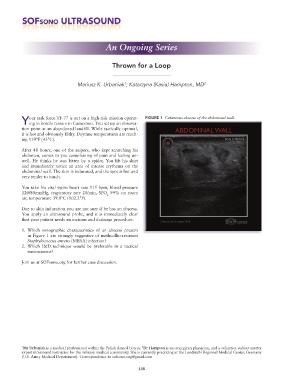
             our task force TF-77 is out on a high-risk mission operat-  FIGURE 1  Cutaneous abscess of the abdominal wall.
          Ying in hostile terrain in Cameroon. You set up an observa-
          tion point at an abandoned landfill. While tactically optimal,
          it is hot and obviously filthy. Daytime temperatures are reach-
          ing 110°F (43°C).

          After 48 hours, one of the snipers, who kept scratching his
          abdomen, comes to you complaining of pain and feeling un-
          well. He thinks he was bitten by a spider. You lift his shirt
          and immediately notice an area of intense erythema on the
          abdominal wall. The skin is indurated, and the spot is hot and
          very tender to touch.

          You take his vital signs: heart rate 115 bpm, blood pressure
          120/80mmHg, respiratory rate 20/min, SPO  99% on room
                                             2
          air, temperature 39.0°C (102.2°F).
          Due to skin induration you are not sure if he has an abscess.
          You apply an ultrasound probe, and it is immediately clear
          that your patient needs an incision and drainage procedure.

          1.  Which sonographic characteristics of an abscess present
            in Figure 1 are strongly suggestive of methicillin-resistant
            Staphylococcus aureus (MRSA) infection?
          2.  Which I&D technique would be preferable in a tactical
            environment?

          Join us at SOFsono.org for further case discussion.


                                                            2
          1 Mr Urbaniak is a medical professional within the Polish Armed Forces.  Dr Hampton is an emergency physician, and a volunteer subject matter
          expert ultrasound instructor for the military medical community. She is currently practicing at the Landstuhl Regional Medical Center, Germany
          (U.S. Army Medical Department). Correspondence to sofsono.org@gmail.com
                                                          148

