


Page 151 - JSOM Winter 2018
P. 151
An Ongoing Series


                                       The Emergence and Evolution of the
                                     Journal of Special Operations Medicine

                                    An Interview With Publisher Michelle Landers


                                        Interviewed by COL (Ret) Andre Pennardt, MD


              What is your background, and how did you become    to provide a commonality that has transcended the past six
              involved with Special Operations?                  decades of SOF medicine.
                              My nursing background is in critical care,
                              ER, flight nursing, and legal nurse con-  What were the biggest challenges in developing the
                              sulting. I started my military reserve ca-  JSOM (besides keeping everyone on deadline)?
                              reer in 1987 at an Army combat support   The biggest challenge was that I was a nurse, not an editor or
                              hospital. After 3 years of fun in the sum-  publisher! I took several classes and learned how to publish
                              mer heat at Camp Shelby, I changed ser-  a journal. The next biggest challenge was getting the JSOM
                              vices to the Air Force and went to Flight   indexed in the US National Library of Medicine’s PubMed. It
                              Physiology School and became a C-130   took several years of adjusting the layout and further develop-
                              flight nurse. In 1998, I started work-  ment to get it accepted in 2007.
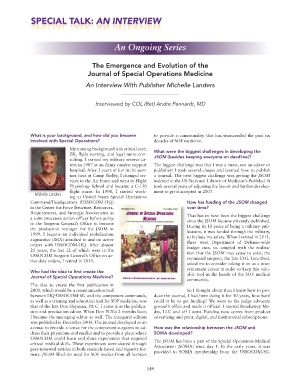
               Michelle Landers
                              ing at  United States  Special  Opera tions
              Command/Headquarters (USSOCOM-HQ)                               How has funding of the JSOM changed
              in the Center for Force Structure, Resources,                   over time?
              Requirements, and Strategic Assessments as
              a joint processes action officer before going                   That has to have been the biggest challenge
              to the Surgeon General’s Office to become                       since the JSOM became privately published.
              the production manager for the JSOM in                          During its 10 years of being a military pub-
              1999. I became an individual mobilization                       lication, it was funded through the military,
              augmentee (IMA) attached to and on active                       to include my salary. When I retired in 2011,
              orders with   USSOCOM-HQ. After almost                          there were Department of Defense–wide
              25 years, the last 12 of which were in the                      budget cuts, so, coupled with the realiza-
              USSOCOM Surgeon General’s Office on ac-                         tion that the JSOM may cease to exist, the
              tive duty orders, I retired in 2011.                            command surgeon, the late COL Tom Deal,
                                                                              asked me to consider taking it on as a post-
                                                                              retirement career in order to keep this valu-
              Who had the idea to first create the
                Journal of Special Operations Medicine?                       able tool in the hands of the SOF medical
                                                                              community.
              The idea to create the first publication in
              2000, which would be a communication tool                       So I thought about this; I knew how to pro-
              between HQ-USSOCOM-SG and the component commands,   duce the journal, I had been doing it for 10 years, how hard
              as well as a training and education tool for SOF medicine, was   could it be to get funding? We went to the judge advocate
              that of the late Don Shipman, PA-C. I came is as the publica-  general’s office and made it official. I started Breakaway Me-
              tion and production editor. When Don PCS’d 2 months later,   dia, LLC and off I went. Funding now comes from product
              I became the managing editor as well. The inaugural edition   advertising and print, digital, and institutional subscriptions.
              was published in December 2000. The journal developed as an
              avenue to provide a venue for the component surgeons to ad-  How was the relationship between the JSOM and
              dress their physicians and medics and to provide a place where   SOMA developed?
              USSOCOM could learn and share experiences that required
              critical medical skills. These experiences were shared through   The JSOM has been a part of the Special Operations Medical
              peer-reviewed articles in both research-based and vignette for-  Association  (SOMA) since  day 1. In the  early years,  it was
              mats. JSOM filled the need for SOF medics from all Services   provided  to  SOMA  membership  from  the  USSOCOM-SG.


                                                              149

