


Page 144 - JSOM Winter 2018
P. 144
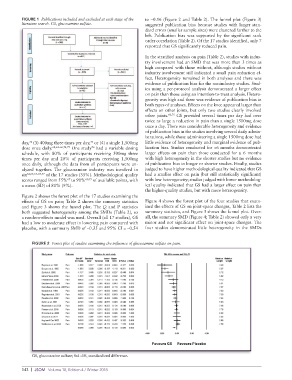
FIGURE 1  Publications included and excluded at each stage of the   to –0.16 (Figure 2 and Table 2). The funnel plot (Figure 3)
          literature search. GS, glucosamine sulfate.        suggested publication bias because studies with larger stan-
                                                             dard errors (smaller sample sizes) were clustered farther to the
                                                             left. Publication bias was supported by the significant rank
                                                             order correlation (Table 2). Of the 17 studies identified, only 7
                                                             reported that GS significantly reduced pain.

                                                             In the stratified analysis on pain (Table 2), studies with indus-
                                                             try involvement had an SMD that was more than 3 times as
                                                             high compared with those without, although studies without
                                                             industry involvement still indicated a small pain reduction ef-
                                                             fect. Heterogeneity remained in both analyses and there was
                                                             evidence of publication bias for the nonindustry studies. Stud-
                                                             ies using a per-protocol analysis demonstrated a larger effect
                                                             on pain than those using an intention-to-treat analysis. Hetero-
                                                             geneity was high and there was evidence of publication bias in
                                                             both types of analyses. Effects on the knee appeared larger than
                                                             effects on other joints, but only two studies clearly involved
                                                             other joints. 60,75  GS provided several times per day had over
                                                             twice as large a reduction in pain than a single 1500mg dose
                                                             once a day. There was considerable heterogeneity and evidence
                                                             of publication bias in the studies involving several daily admin-
                                                             istrations, while those administering a single 1500mg dose had
                                      75
          day,  (3) 400mg three times per day,  or (4) a single 1,500mg   little evidence of heterogeneity and marginal evidence of pub-
             72
          dose once daily. 60,64–66,74,77  One study  had a variable dosing   lication bias. Studies conducted for <6 months demonstrated
                                       76
          schedule,  with 80%  of participants  receiving  500mg  three   larger effects on pain than those conducted for  ≥ 6 months
          times per day and 20% of participants receiving 1,500mg   with high heterogeneity in the shorter studies but no evidence
          once daily, although the data from all participants were an-  of publication bias in longer or shorter studies. Finally, studies
          alyzed together. The glucosamine industry was involved in   judged to have higher methodological quality indicated that GS
          six 64,65,67–69,77  of the 17 studies (35%). Methodological quality   had a smaller effect on pain (but still statistically significant)
          scores ranged from 55%  to 90% 60,73  of available points, with   with low heterogeneity; studies judged with lower methodolog-
                             67
          a mean (SD) of 81% (9%).                           ical quality indicated that GS had a larger effect on pain than
                                                             the higher-quality studies, but with more heterogeneity.
          Figure 2 shows the forest plot of the 17 studies examining the
          effects of GS on pain; Table 2 shows the summary statistics   Figure 4 shows the forest plot of the four studies that exam-
                                                  2
          and Figure 3 shows the funnel plot. The Q and I  statistics   ined the effects of GS on joint-space changes, Table 2 lists the
          both suggested heterogeneity among the SMDs (Table 2), so   summary statistics, and Figure 5 shows the funnel plot. Over-
          a random-effects model was used. Overall (all 17 studies), GS   all, the summary SMD (Figure 4; Table 2) showed only a very
          had a low to moderate effect in lowering pain compared with   minor and not significant effect on joint-space changes. The
          placebo, with a summary SMD of –0.35 and 95% CI = –0.54   four studies demonstrated little heterogeneity in the SMDs


              FIGURE 2  Forest plot of studies examining the influence of glucosamine sulfate on pain.


              GS, glucosamine sulfate; Std diff, standardized difference.


          142  |  JSOM   Volume 18, Edition 4 / Winter 2018

