


Page 139 - JSOM Winter 2018
P. 139
An Ongoing Series


                                                          Tetanus


                                                     Mark W. Burnett, MD


              Introduction                                       minutes, and complete recovery from the disease may take
                                                                 months. Death rates range from 10% to 20% for this form
              An earthquake strikes a developing world nation without   of the disease. Neonatal tetanus may occur when an infant is
              warning in the middle of the night, turning the poorly built   born to a mother who is not immunized against tetanus and
              homes and apartment buildings into piles of cinderblocks and   has not acquired transplacental antibodies against the disease
              twisted corrugated metal. Survivors are pulled from the rubble   prior to birth. This form of tetanus is most common in poor
              by neighbors, as well as by members of a US military unit that   areas where care of the umbilical stump is not hygienic follow-
              is training in the area. Once the survivors have their airway,   ing birth. Localized tetanus, where the muscle spasms occur in
              breathing, and circulation assessed, another more insiduous   a localized area near the contaminated wound, and cephalic
              threat to life has to be addressed and not forgotten—the risk   tetanus, in which cranial nerves palsies can result, are far less
              of tetanus.
                                                                 common—but both may progress to the generalized form of
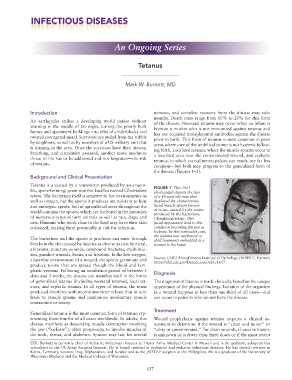
                                                                 the disease (Figures 1–3).
              Background and Clinical Presentation
              Tetanus is a caused by a neurotoxin produced by an anaero-
              bic, spore-forming, gram-positive bacillus named Clostridium   FIGURE 1  This 1965
                                                                 photograph depicts the face
              tetani. The bacterium itself is sensitive to hot environments as   of a 46-year-old man that
              well as oxygen, but the spores it produces are resistant to heat   displayed the characteristic
              and antiseptic agents. Soil of agricultural areas throughout the   facial muscle spasm known
              world contains the spores, which are harbored in the intestines   as rictus, caused by the toxins
                                                                 produced by the bacterium,
              of numerous types of farm animals as well as rats, dogs, and   Clostridium tetani. This
              cats. Humans who work close to the land may have their skin   facial appearance lead to this
              colonized, making them potentially at risk for infection.  condition becoming known as
                                                                 lockjaw. In this particular case,
                                                                 the tetanus was attributed to
              The bacterium and the spores it produces can enter through   shell fragments embedded in a
              breaks in the skin caused by injuries as diverse as cuts by metal,   wound to his hand.
              abrasions, puncture wounds, compound fractures, crush inju-
              ries, gunshot wounds, burns, and frostbite. In the low-oxygen,
              anaerobic environment of a wound, the spores germinate and   Source: CDC/ Armed Forces Institute of Pathology (AFIP)/ C. Farmer;
                                                                 https://phil.cdc.gov/Details.aspx?pid=1657
              produce toxins that are spread though the blood and lym-
              phatic systems. Following an incubation period of between 3   Diagnosis
              days and 3 weeks, the disease can manifest itself in the forms
              of generalized tetanus (including neonatal tetanus), local tet-  The diagnosis of tetanus is made clinically, based on the unique
              anus, and cephalic tetanus. In all types of tetanus, the toxin   appearance of the physical findings. Isolation of the organism
              produced interferes with neurotransmitter release that in turn   in a wound happens in less than one-third of all cases—and
              leads to muscle spasms and continuous involuntary muscle   can occur in patients who do not have the disease.
              contraction or tetany.
                                                                 Treatment
              Generalized tetanus is the most common form of tetanus, rep-
              resenting three-fourths of all cases worldwide. In adults, this   Wound prophylaxis against tetanus requires a clinical as-
              disease manifests as descending muscle contraction involving   sessment to determine if the wound is “clean and minor” or
              the jaw (“lockjaw”), often progressing to involve muscles of   “dirty or contaminated.” For clean wounds, if vaccine history
              the neck, throat, and abdomen. Spasms may last for several   is unknown or is fewer than three doses or if the most recent
              COL Burnett is currently chief of Pediatric Infectious Diseases at Tripler Army Medical Center in Hawaii and is the pediatric subspecialties
              consultant to the US Army Surgeon General. He is board certified in pediatrics and pediatric infectious diseases. He has served overseas in
              Korea, Germany, Kosovo, Iraq, Afghanistan, and Kuwait and as the JSOTF-P surgeon in the Philippines. He is a graduate of the University of
                Wisconsin-Madison and the Medical College of Wisconsin.

                                                              137

