


Page 40 - Journal of Special Operations Medicine - Winter 2016
P. 40
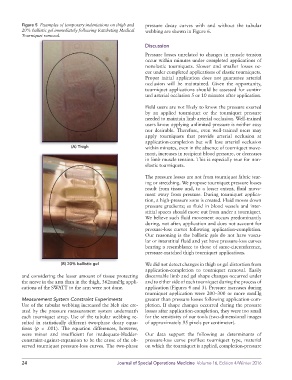
Figure 5  Examples of temporary indentations on thigh and   pressure decay curves with and without the tubular
          20% ballistic gel immediately following Ratcheting Medical   webbing are shown in Figure 6.
          Tourniquet removal.

                                                             Discussion
                                                             Pressure losses unrelated to changes in muscle tension
                                                             occur within minutes under completed applications of
                                                             nonelastic  tourniquets.  Slower  and  smaller  losses  oc-
                                                             cur under completed applications of elastic tourniquets.
                                                             Proper  initial  application  does  not  guarantee  arterial
                                                             occlusion will be maintained. Given the opportunity,
                                                             tourniquet applications should be assessed for contin-
                                                             ued arterial occlusion 5 or 10 minutes after application.

                                                             Field users are not likely to know the pressure exerted
                                                             by an applied tourniquet or the tourniquet pressure
                                                             needed to maintain limb arterial occlusion. Well-trained
                                                             users know applying unlimited pressure is neither easy
                                                             nor desirable. Therefore, even well-trained users may
                                                             apply tourniquets that provide arterial occlusion at
                                                             application-completion but will lose arterial occlusion
                              (A) Thigh                      within minutes, even in the absence of tourniquet move-
                                                             ment, increases in recipient blood pressure, or decreases
                                                             in limb muscle tension. This is especially true for non-
                                                             elastic tourniquets.

                                                             The pressure losses are not from tourniquet fabric tear-
                                                             ing or stretching. We propose tourniquet pressure losses
                                                             result from tissue and, to a lesser extent, fluid move-
                                                             ment away from pressure. During tourniquet applica-
                                                             tion, a high-pressure zone is created. Fluid moves down
                                                             pressure gradients; so fluid in blood vessels and inter-
                                                             stitial spaces should move out from under a tourniquet.
                                                             We believe such fluid movement occurs predominantly
                                                             during, not after, application and does not account for
                                                             pressure-loss curves following application-completion.
                                                             Our reasoning is the ballistic gels do not have vascu-
                                                             lar or interstitial fluid and yet have pressure-loss curves
                                                             bearing a resemblance to those of same-circumference,
                                                             pressure-matched thigh tourniquet applications.

                          (B) 20% ballistic gel              We did not detect changes in thigh or gel distortion from
                                                             application-completion to tourniquet removal. Easily
          and considering the lesser amount of tissue protecting   discernable limb and gel shape changes occurred under
          the nerve in the arm than in the thigh, 362mmHg appli-  and to either side of each tourniquet during the process of
          cations of the SWATT to the arm were not done.     application (Figures 4 and 3). Pressure increases during
                                                             tourniquet application were 200–300 or more mmHg
          Measurement System Constraint Experiments          greater than pressure losses following application-com-
          Use of the tubular webbing increased the bleb size cre-  pletion. If shape changes occurred during the pressure
          ated by the pressure measurement system underneath   losses after application-completion, they were too small
          each tourniquet strap. Use of the tubular webbing re-  for the sensitivity of our tools (two-dimensional images
          sulted in statistically different two-phase decay equa-  of approximately 95 pixels per centimeter).
          tions (p < .001). The equation differences, however,
          were minor and insufficient  for inadequate-bladder-   Our data support the following as determinants of
          constraint-against-expansion to be the cause of the ob-  pressure-loss curve profiles: tourniquet type, material
          served tourniquet pressure-loss curves. The two-phase   on which the tourniquet is applied, completion-pressure


          24                                     Journal of Special Operations Medicine  Volume 16, Edition 4/Winter 2016

