


Page 38 - Journal of Special Operations Medicine - Winter 2016
P. 38
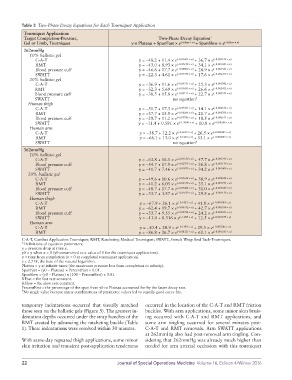
Table 3  Two-Phase Decay Equations for Each Tourniquet Application
           Tourniquet Application:
           Target Completion-Pressure,                            Two-Phase Decay Equation *
           Gel or Limb, Tourniquet                     y = Plateau + SpanFast × e (−KFast × x)  + SpanSlow × e (−KSlow × x)
           262mmHg
             10% ballistic gel
                C-A-T                                     y = −48.2 + 11.4 × e (−0.02602 × x)  + 36.7 × e (−0.002195 × x)
                RMT                                       y = −43.0 + 8.93 × e (−0.05258 × x)  + 34.1 × e (−0.001843 × x)
                Blood pressure cuff                       y = −46.6 + 17.7 × e (−0.04800 × x)  + 28.9 × e (−0.003585 × x)
                SWATT                                     y = −22.3 + 4.61 × e (−0.04758 × x)  + 17.6 × e (−0.002339 × x)
             20% ballistic gel
                C-A-T                                     y = −36.9 + 11.6 × e (−0.04735 × x)  + 25.3 × e (−0.003082 × x)
               RMT                                        y = −32.3 + 5.69 × e (−0.03433 × x)  + 26.6 × e (−0.002412 × x)
               Blood pressure cuff                        y = −38.5 + 15.8 × e (−0.05111 × x)  + 22.7 × e (−0.003253 × x)
               SWATT                                                     no equation †
             Human thigh
                C-A-T                                     y = −31.7 + 17.5 × e (−0.09503 × x)  + 14.1 × e (−0.006532 × x)
                RMT                                       y = −37.7 + 15.9 × e (−0.08286 × x)  + 21.7 × e (−0.008788 × x)
                Blood pressure cuff                       y = −29.7 + 11.2 × e (−0.07786 × x)  + 18.5 × e (−0.006611 × x)
                SWATT                                     y = −11.4 + 0.581 × e (−1.5000 × x)  + 10.8 × e (−0.002461 × x)
             Human arm
                C-A-T                                      y = −38.7 + 12.2 × e (−0.1659 × x)  + 26.5 × e (−0.008205 × x)
                RMT                                        y = −66.1 + 13.0 × e (−0.1468 × x)  + 53.1 × e (−0.008805 × x)
                SWATT                                                    no equation †
           362mmHg
             10% ballistic gel
                C-A-T                                     y = −63.8 + 16.1 × e (−0.01550 × x)  + 47.7 × e (−0.002245 × x)
                Blood pressure cuff                       y = −54.7 + 17.9 × e (−0.02797 × x)  + 36.8 × e (−0.003179 × x)
                SWATT                                     y = −41.7 + 7.46 × e (−0.01879 × x)  + 34.2 × e (−0.001409 × x)
             20% ballistic gel
                C-A-T                                     y = −49.6 + 10.6 × e (−0.03634 × x)  + 38.9 × e (−0.002242 × x)
                RMT                                       y = −41.2 + 6.05 × e (−0.03318 × x)  + 35.1 × e (−0.001754 × x)
                Blood pressure cuff                       y = −48.7 + 17.7 × e (−0.05404 × x)  + 31.0 × e (−0.003649 × x)
                SWATT                                     y = −33.7 + 3.87 × e (−0.01639 × x)  + 29.8 × e (−0.001138 × x)
             Human thigh
                C-A-T                                      y = −67.9 + 26.1 × e (−0.1425 × x)  + 41.8 × e (−0.007609 × x)
                RMT                                       y = −62.4 + 19.7 × e (−0.06742 × x)  + 42.7 × e (−0.005958 × x)
                Blood pressure cuff                       y = −33.7 + 9.55 × e (−0.09724 × x)  + 24.2 × e (−0.005283 × x)
                SWATT                                     y = −13.0 + 0.516 × e (−1.009 × x)  + 12.5 × e (−0.002379 × x)
             Human arm
                C-A-T                                      y = −50.4 + 20.9 × e (−0.1399 × x)  + 29.5 × e (−0.007206 × x)
                RMT                                       y = −86.8 + 26.7 × e (−0.08723 × x)  + 60.1 × e (−0.005583 × x)
          C-A-T, Combat Application Tourniquet; RMT, Ratcheting Medical Tourniquet; SWATT, Stretch Wrap And Tuck-Tourniquet.
          *Definitions of equation parameters:
          y = pressure drop at time x.
          y0 = y when x = 0 (y0 constrained to a value of 0 for the tourniquet applications).
          x = time from completion (x = 0 at completed tourniquet application).
          e = 2.718, the base of the natural logarithm.
          Plateau = y at infinite times (the maximum pressure loss from completion to infinity).
          SpanFast = (y0 − Plateau) × PercentFast × 0.01.
          SpanSlow = (y0 − Plateau) × (100 − PercentFast) × 0.01.
          KFast = the fast rate constant.
          KSlow = the slow rate constant.
          PercentFast = the percentage of the span from y0 to Plateau accounted for by the faster decay rate.
          † No single value because many combinations of parameter values led to equally good curve fits.


          temporary  indentations  occurred  that  visually  matched   occurred in the location of the C-A-T and RMT friction
          those seen on the ballistic gels (Figure 5). The greatest in-  buckles. With arm applications, some minor skin bruis-
          dentation depths occurred under the strap bunches of the   ing occurred with C-A-T and RMT applications, and
          RMT created by advancing the ratcheting buckle (Table   some arm tingling occurred  for several minutes  post-
          1). These indentations were resolved within 30 minutes.  C-A-T and RMT removals. Arm SWATT applications
                                                             at 262mmHg also had post-removal arm tingling. Con-
          With same-day repeated thigh applications, some minor   sidering that 262mmHg was already much higher than
          skin irritation and transient post-application tenderness   needed for arm arterial occlusion with this tourniquet


          22                                     Journal of Special Operations Medicine  Volume 16, Edition 4/Winter 2016

