


Page 34 - Journal of Special Operations Medicine - Winter 2016
P. 34
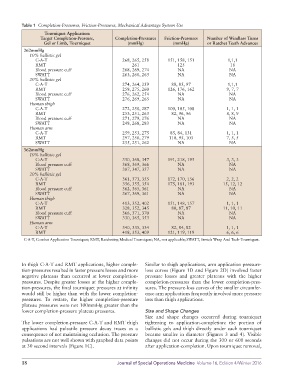
Table 1  Completion-Pressures, Friction-Pressures, Mechanical Advantage System Use
                   Tourniquet Application:
                  Target Completion-Pressure,    Completion-Pressures   Friction-Pressures   Number of Windlass Turns
                   Gel or Limb, Tourniquet            (mmHg)             (mmHg)        or Ratchet Teeth Advances
           262mmHg
             10% ballistic gel
                C-A-T                               268, 265, 258     151, 158, 151            1,1,1
                RMT                                     261               125                   18
                Blood pressure cuff                 268, 269, 274         NA                    NA
                SWATT                               263, 260, 263         NA                    NA
             20% ballistic gel
                C-A-T                               274, 264, 259       88, 85, 97             1,1,1
                RMT                                 258, 275, 260     126, 176, 162            9, 7, 7
                Blood pressure cuff                 276, 262, 254         NA                    NA
                SWATT                               276, 269, 265         NA                    NA
             Human thigh
                C-A-T                               272, 250, 287     100, 105, 108            1, 1, 1
                RMT                                 253, 251, 263       82, 96, 96             8, 8, 9
                Blood pressure cuff                 271, 279, 276         NA                    NA
                SWATT                               248, 268, 283         NA                    NA
             Human arm
                C-A-T                               259, 253, 275      85, 84, 131             1, 1, 1
                RMT                                 297, 250, 279      110, 95, 103            7, 5, 5
                SWATT                               255, 251, 262         NA                    NA
           362mmHg
             10% ballistic gel
                C-A-T                               350, 368, 347     191, 218, 195            3, 3, 3
                Blood pressure cuff                 368, 369, 366         NA                    NA
                SWATT                               387, 347, 357         NA                    NA
             20% ballistic gel
                C-A-T                               361, 373, 355     172, 170, 156            2, 2, 2
                RMT                                 356, 355, 354     175, 181, 193          15, 12, 12
                Blood pressure cuff                 362, 365, 361         NA                    NA
                SWATT                               367, 369, 361         NA                    NA
             Human thigh
                C-A-T                               413, 352, 402     151, 148, 157            1, 1, 1
                RMT                                 328, 352, 345       80, 87, 87           11, 10, 11
                Blood pressure cuff                 366, 371, 370         NA                    NA
                SWATT                               330, 365, 353         NA                    NA
             Human arm
                C-A-T                               340, 335, 334       82, 84, 82             1, 1, 1
                RMT                                 418, 353, 409     121, 119, 119            6, 6, 6
           C-A-T, Combat Application Tourniquet; RMT, Ratcheting Medical Tourniquet; NA, not applicable; SWATT, Stretch Wrap And Tuck-Tourniquet.


          In thigh C-A-T and RMT applications, higher comple-  Similar to thigh applications, arm application pressure-
          tion-pressures resulted in faster pressure losses and more   loss curves (Figure 1D and Figure 2D) involved faster
          negative plateaus than occurred at lower completion-  pressure losses and greater plateaus with the higher
          pressures. Despite greater losses at the higher comple-  completion-pressures than the lower completion-pres-
          tion-pressures, the final tourniquet pressures at infinity   sures. The pressure-loss curves of the smaller circumfer-
          would still be higher than with the lower completion-  ence arm applications frequently involved more pressure
          pressures. To restate, the higher completion-pressure   loss than thigh applications.
          plateau pressures were not 100mmHg greater than the
          lower completion-pressure plateau pressures.       Size and Shape Changes
                                                             Size and shape changes occurred during tourniquet
          The lower completion-pressure C-A-T and RMT thigh   tightening to application-completion: the portion of
          applications  had  pulsatile  pressure  decay  traces  as  a   ballistic gels and thigh directly under each tourniquet
          consequence of not maintaining occlusion. The pressure   became smaller in diameter (Figures 3 and 4). Visible
          pulsations are not well shown with graphed data points   changes did not occur during the 300 or 600 seconds
          at 30 second intervals (Figure 1C).                after application-completion. Upon tourniquet removal,


          18                                     Journal of Special Operations Medicine  Volume 16, Edition 4/Winter 2016

