


Page 41 - Journal of Special Operations Medicine - Winter 2016
P. 41
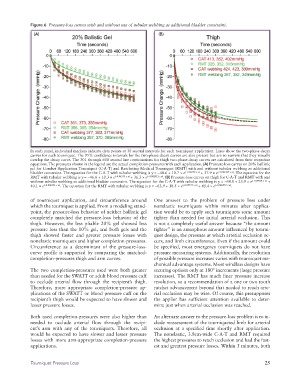
Figure 6  Pressure-loss curves with and without use of tubular webbing as additional bladder constraint.
               (A)                                                 (B)


              In each panel, individual markers indicate data points at 30 second intervals for each tourniquet application. Lines show the two-phase decay
              curves for each tourniquet. The 95% confidence intervals for the two-phase decay curves are also present but are so narrow that they visually
              overlap the decay curve. The 301 through 600 second line continuations for thigh two-phase decay curves are calculated from their respective
              equations. The pressures shown in the legend are the actual completion-pressures with each application. (A) Pressure-loss curves on 20% ballistic
              gel for Combat Application Tourniquet (C-A-T) and Ratcheting Medical Tourniquet (RMT) with and without tubular webbing as additional
              bladder constraint. The equation for the C-A-T with tubular webbing is y = −48.6 + 10.7 × e (−0.04578 × x)  + 37.9 × e (−0.002389 × x) . The equation for the
              RMT with tubular webbing is y = −46.6 + 10.3 × e (−0.04539 × x)  + 36.3 × e (−0.002912 × x) . (B) Pressure-loss curves on thigh for C-A-T and RMT with and
              without tubular webbing as additional bladder constraint. The equation for the C-A-T with tubular webbing is y = −64.0 + 23.9 × e (−0.08928 × x)  +
              40.1 × e (−0.006954 × x) . The equation for the RMT with tubular webbing is y = −63.9 + 18.5 × e (−0.07527 × x)  + 45.4 × e (−0.006729 × x) .


              of tourniquet application, and circumference around   One answer to the problem of pressure loss under
              which the tourniquet is applied. From a modeling stand-  nonelastic tourniquets within minutes after applica-
              point, the pressure-loss behavior of neither ballistic gel   tion would be to apply such tourniquets some amount
              completely  matched  the  pressure-loss  behavior  of the   tighter than needed for initial arterial occlusion. This
              thigh. However, the less pliable 20% gel showed less   is not a completely useful answer because “the amount
              pressure loss than the 10% gel, and both gels and the   tighter” is an amorphous amount influenced by tourni-
              thigh showed faster  and greater  pressure losses  with   quet design, the pressure at which arterial occlusion oc-
              nonelastic tourniquets and higher completion-pressures.   curs, and limb circumference. Even if the amount could
              Circumference as a determinant of the pressure-loss-  be specified, most emergency tourniquets do not have
              curve profile is supported by comparing the matched-  pressure measuring systems. Additionally, the resolution
              completion-pressures thigh and arm curves.         of possible pressure increases varies with tourniquet me-
                                                                 chanical advantage systems. Most windlass designs have
              The two completion-pressures used were both greater   securing options only at 180° increments (large pressure
              than needed for the SWATT or adult blood pressure cuff   increases). The RMT has much finer pressure increase
              to occlude  arterial flow through the  recipient’s thigh.   resolution, so a recommendation of a one or two tooth
              Therefore, more appropriate completion-pressure ap-  ratchet advancement beyond that needed to reach arte-
              plications of the SWATT or blood pressure cuff on the   rial occlusion may be wise. Of course, this presupposes
              recipient’s thigh would be expected to have slower and   the applier has sufficient attention available to deter-
              lesser pressure losses.                            mine just when arterial occlusion was reached.

              Both used completion-pressures were also higher than   An alternate answer to the pressure-loss problem is to in-
              needed to occlude arterial flow through the recipi-  clude reassessment of the tourniqueted limb for arterial
              ent’s arm with any of the tourniquets. Therefore, all   occlusion at a specified time shortly after application.
              would be expected to have slower and lesser pressure   The nonelastic, 3.8cm-wide C-A-T and RMT required
              losses with more arm-appropriate completion-pressure   the highest pressures to reach occlusion and had the fast-
              applications.                                      est and greatest pressure losses. Within 5 minutes, both


              Tourniquet Pressure Loss                                                                        25

