


Page 76 - Journal of Special Operations Medicine - Winter 2015
P. 76
suicidal thoughts, disinhibition, and mood alteration.   The current treatments that are now available (or
          Combining more than two psychoactive medications   quickly becoming available) are slowly being accepted
          (unless monitored very closely by a physician) can lead   by the medical community. No single therapy will be
          to unexpected side effects and behaviors.          able to completely undo, reverse, or repair the damage
                                                             that has been done to the brain or mind. It will require
                                                             a combined approach to heal the damage.
          What Can Be Done
          The training a physician receives has a deep and long-  Our experience as clinicians and medical researchers
          lasting effect on how one makes diagnoses. Subtle  biases   has shown us treatments like hyperbaric oxygen therapy
          may affect the diagnostic outcome. The diagnosis of   (HBOT), eye movement desensitization and reprocess-
          PTSD can be made with little hesitation and then the   ing (EMDR), and low-intensity infrared light therapy
          workup stops without having the possibility of TBI or   (LILT) can have measurable improvements in TBI and
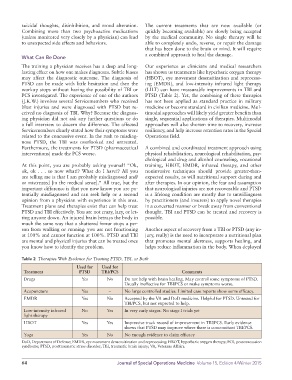
          PCS investigated. The experience of one of the authors   PTSD (Table 2). Yet, the combining of these therapies
          (J.K.W.) involves several Servicemembers who received   has not been applied as standard practice in military
          blast injuries and were diagnosed with PTSD but re-  medicine or become standard in civilian medicine. Mul-
          ceived no diagnosis of TBI. Why? Because the diagnos-  timodal approaches will likely yield greater benefits than
          ing physician did not ask any further questions or do   single, sequential applications of therapies. Multimodal
          a full interview to discern the difference. The affected   approaches will also shorten time to recovery, increase
          Servicemembers clearly stated how their symptoms were   resiliency, and help increase retention rates in the Special
          related to the concussive event. In the rush to misdiag-  Operations field.
          nose  PTSD,  the  TBI  was  overlooked  and  untreated.
          Furthermore, the treatments for PTSD (pharmaceutical   A combined and coordinated treatment approach using
          interventions) made the PCS worse.                 physical rehabilitation, neurological rehabilitation, psy-
                                                             chological and drug and alcohol counseling, vocational
          At this point, you are probably asking yourself “Ok,   training,  HBOT,  EMDR,  infrared  therapy,  and  other
          ok, ok . . . so now what!? What do I have!? All you   noninvasive  techniques  should  provide  greater-than-
          are telling me is that I am probably misdiagnosed and/  expected results, as will nutritional support during and
          or mistreated [in the medical sense].” All true, but the   after therapies. In our opinion, the fear and assumption
          important difference is that you now know you are po-  that neurological injuries are not recoverable and PTSD
          tentially misdiagnosed and can seek help or a second   is a lifelong condition are mostly due to unwillingness
          opinion from a physician with experience in this area.   by practitioners (and insurers) to apply novel therapies
          Treatment plans and therapies exist that can help treat   in a concerted manner or break away from conventional
          PTSD and TBI effectively. You are not crazy, lazy, or let-  thought. TBI and PTSD can be treated and recovery is
          ting anyone down. An injured brain betrays the body in   possible.
          much the same way that a shattered femur stops a per-
          son from walking or running: you are not functioning   Another aspect of recovery from a TBI or PTSD (any in-
          at 100% and cannot function at 100%. PTSD and TBI   jury, really) is the need to incorporate a nutritional plan
          are mental and physical injuries that can be treated once   that promotes mental alertness, supports healing, and
          you know how to identify the problem.              helps reduce inflammation in the body. When  deployed

          Table 2  Therapies With Evidence for Treating PTSD, TBI, or Both
                                 Used for   Used for
           Treatment              PTSD     TBI/PCS                          Comments
           Drugs                   Yes       No     Do not help with brain healing. May control some symptoms of PTSD.
                                                    Usually ineffective for TBI/PCS or make symptoms worse.
           Acupuncture             Yes        –     No large controlled studies. Limited case reports show some efficacy.
           EMDR                    Yes       No     Accepted by the VA and DoD medicine. Helpful for PTSD. Untested for
                                                    TBI/PCS, but not expected to help.
           Low-intensity infrared   No       Yes    In very early stages. No stage I trials yet
           light therapy
           HBOT                    Yes       Yes    Impressive track record of improvement in TBI/PCS. Early evidence
                                                    shows that PTSD may improve where there is concomitant TBI/PCS.
           Yoga                    Yes       No     No enough evidence to claim efficacy
          DoD, Department of Defense; EMDR, eye movement densensitization and reprocessing; HBOT, hyperbaric oxygen therapy; PCS, postconcussion
          syndrome; PTSD, posttraumatic stress disorder; TBI, traumatic brain injury; VA, Veterans Affairs.


          64                                     Journal of Special Operations Medicine  Volume 15, Edition 4/Winter 2015

