


Page 71 - Journal of Special Operations Medicine - Winter 2015
P. 71
OK, Doc . . . What Do I Really Have?
                   Posttraumatic Stress Disorder Versus Traumatic Brain Injury


                                      Xavier A. Figueroa, PhD; James K. Wright, MD


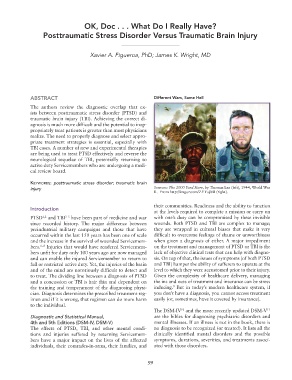
              ABSTRACT                                           Different Wars, Same Hell

              The authors review the diagnostic overlap that ex-
              ists between posttraumatic stress disorder (PTSD) and
              traumatic brain injury (TBI). Achieving the correct di-
              agnosis is much more difficult and the potential to inap-
              propriately treat patients is greater than most physicians
              realize. The need to properly diagnose and select appro-
              priate treatment strategies is essential, especially with
              TBI cases. A number of new and experimental therapies
              are being used to treat PTSD effectively and reverse the
              neurological sequelae of TBI, potentially returning to
              active duty Servicemembers who are undergoing a medi-
              cal review board.

              Keywords: posttraumatic stress disorder; traumatic brain
              injury                                             Sources: The 2000 Yard Stare, by Thomas Lea (left), 1944, World War
                                                                 II.  From http://imgur.com/ZYYujMI (right).

                                                                 their  communities. Readiness and the ability to function
              Introduction
                                                                 at the levels required to complete a mission or carry on
              PTSD  and TBI  have been part of medicine and war   with one’s duty can be compromised by these invisible
                            3–5
                   1,2
              since recorded history. The major difference between   wounds. Both PTSD and TBI are complex to manage;
              preindustrial  military  campaigns  and  those  that  have   they are wrapped in cultural biases that make it very
              occurred within the last 150 years has been one of scale   difficult to overcome feelings of shame or unworthiness
              and the increase in the survival of wounded Servicemem-  when given a diagnosis of either. A major impediment
              bers.  Injuries that would have rendered Servicemem-  on the treatment and management of PTSD or TBI is the
                  6–8
              bers unfit for duty only 100 years ago are now managed   lack of objective clinical tests that can help with diagno-
              and can enable the injured Servicemember to return to   sis. On top of that, the issues of symptoms (of both PTSD
              full or restricted active duty. Yet, the injuries of the brain   and TBI) hamper the ability of sufferers to operate at the
              and of the mind are notoriously difficult to detect and   level to which they were accustomed prior to their injury.
              to treat. The dividing line between a diagnosis of PTSD   Given the complexity of healthcare delivery, managing
              and a concussion or TBI is hair thin and dependent on   the ins and outs of treatment and insurance can be stress
              the training and temperament of the diagnosing physi-  inducing.  But in today’s modern healthcare system, if
                                                                         9
              cian. Diagnosis determines the prescribed treatment reg-  you don’t have a diagnosis, you cannot access treatment
              imen and if it is wrong, that regimen can do more harm   easily (or, sometimes, have it covered by insurance).
              to the individual.
                                                                            10
                                                                 The DSM-IV  and the more recently updated DSM-V
                                                                                                               11
              Diagnostic and Statistical Manual,                 are the bibles for diagnosing psychiatric disorders and
              4th and 5th Editions (DSM-IV, DSM-V)               mental illnesses. If an illness is not in the book, there is
              The effects of PTSD, TBI, and other mental condi-  no diagnosis to be recognized (or treated). It lists all the
              tions and injuries suffered by returning Servicemem-  clinically identified mental disorders and the possible
              bers have a major impact on the lives of the affected   symptoms, durations, severities, and treatments associ-
              individuals, their comrades-in-arms, their families, and   ated with those disorders.


                                                              59

