


Page 74 - Journal of Special Operations Medicine - Winter 2015
P. 74
Although at least some of the current symptoms listed   Symptoms of a TBI overlap with other neurological in-
          above are required for a diagnosis of mTBI, the Na-  juries, just like PTSD.
          tional Institute of Neurological Disease and Stroke has
          compiled a list of symptoms commonly associated with   So, Which Is It?
          a TBI (Table 1). 24
                                                             How much overlap is there between TBI and PTSD? The
          The severity of TBI is normally defined by the acute in-  overlap is substantial and difficult to separate out unless
          jury characteristics and not by the severity of symptoms   a complete history (medical, deployment, and incident
          at random points after trauma.  Severe TBIs are hard to   history) is available. We will go into some detail to high-
                                    25
          miss. The mild to moderate TBIs, which make up 80%   light how TBI and PTSD overlap, and Figure 3 sum-
          to 90% of TBI cases, are less obvious, making identifi-  marizes the diagnostic overlap of symptoms and criteria
          cation of affected individuals difficult. The problem is   between PTSD and TBI/PCS.
          twofold. (1) Many times the individual who suffers a
          TBI does not know what happened. One wakes up with-
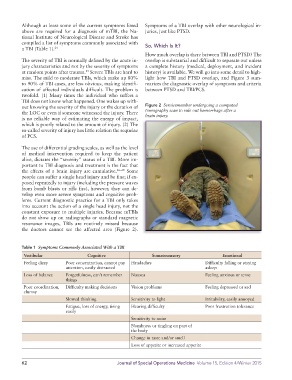
          out knowing the severity of the injury or the duration of   Figure 2  Servicemember undergoing a computed
          the LOC or even if someone witnessed the injury. There   tomography scan to rule out hemorrhage after a
                                                             brain injury.
          is no reliable way of estimating the energy of impact,
          which is poorly related to the amount of injury. (2) The
          so-called severity of injury has little relation the sequelae
          of PCS.

          The use of differential grading scales, as well as the level
          of medical intervention required to keep the patient
          alive, dictates the “severity” status of a TBI. More im-
          portant to TBI diagnosis and treatment is the fact that
          the effects of a brain injury are cumulative. 26–28  Some
          people can suffer a single head injury and be fine; if ex-
          posed repeatedly to injury (including the pressure waves
          from bomb blasts or rifle fire), however, they can de-
          velop even more severe symptoms and cognitive prob-
          lems. Current diagnostic practice for a TBI only takes
          into account the action of a single head injury, not the
          constant exposure to multiple injuries. Because mTBIs
          do not show up on radiographs or standard magnetic
          resonance images, TBIs are routinely missed because
          the doctors cannot see the affected  area (Figure 2).


          Table 1  Symptoms Commonly Associated With a TBI
           Vestibular                Cognitive                  Somatosensory                Emotional
           Feeling dizzy    Poor concentration, cannot pay   Headaches                Difficulty falling or staying
                            attention, easily distracted                              asleep
           Loss of balance  Forgetfulness, can’t remember   Nausea                    Feeling anxious or tense
                            things
           Poor coordination,   Difficulty making decisions  Vision problems          Feeling depressed or sad
           clumsy
                            Slowed thinking            Sensitivity to light           Irritability, easily annoyed
                            Fatigue, loss of energy, tiring   Hearing difficulty      Poor frustration tolerance
                            easily
                                                       Sensitivity to noise
                                                       Numbness or tingling on part of
                                                       the body
                                                       Change in taste and/or smell
                                                       Loss of appetite or increased appetite


          62                                     Journal of Special Operations Medicine  Volume 15, Edition 4/Winter 2015

