


Page 75 - Journal of Special Operations Medicine - Winter 2015
P. 75
“The essential feature of post traumatic stress disorder   of a TBI. Depending on how the physician interprets
              (PTSD) is the development of characteristic symptoms   the symptoms, memories, and findings of a patient, the
              following exposure to one or more traumatic events.”    memory of the trauma may be interpreted as intrusive.
                                                             4
              The requirement for a traumatic event for PTSD is im-  The remainder of the criteria required for a diagnosis of
              portant, but vague. “Traumatic event” is a ubiquitous   PTSD are listed in the PTSD section of this article.
              definition for a broad set of conditions. A wide variety
              of traumatic events can cause stress and produce PTSD   Finally, duration and functional significance are direct
              symptoms: car accidents, exposure to combat, seeing   overlaps between PTSD and TBI. It takes an involved
              someone hurt, even being confronted with a phobia-  and observant physician to discern the subtle differences
              linked situation can be called a traumatic event and im-  between PTSD and TBI. It also requires that the phy-
              plicated as a cause of PTSD. Therefore, when applying   sician be aware of her/his bias with regard to making
              the term traumatic event to PTSD, having a bomb ex-  diagnoses and to learn to ask the patient a simple ques-
              plode nearby, being hit in the head with debris or getting   tion: have you ever experienced one or more injuries
              T-boned at an intersection can count toward PTSD.  to your head or injuries to yourself that altered your
                                                                 perception?
              Unfortunately, all the conditions just described can also
              result in a brain injury. Bomb blasts (with no direct head   Currently,  an  ongoing  debate  within  the  psychiatric
              injury), direct head hits, or getting thrown around a car   community rests on the assumption that PTSD and TBI
              (acceleration-deceleration injuries) produce concussive   are two distinct conditions. The problem comes in sepa-
              damage to the brain. Differentiating between PTSD and   rating the physical damage portion from the behavioral
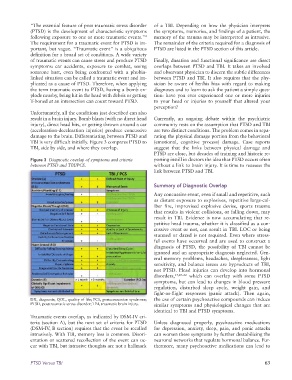
              TBI is very difficult initially. Figure 3 compares PTSD to   (emotional, cognitive process) damage. Case reports
              TBI, side by side, and where they overlap.         suggest that the  links between physical damage and
                                                                 PTSD are close, but decades of training and historic re-
              Figure 3  Diagnostic overlap of symptoms and criteria   porting instill in doctors the idea that PTSD occurs often
              between PTSD and TBI/PCS.                          without a link to brain injury. It is time to reassess the
                                                                 link between PTSD and TBI.


                                                                 Summary of Diagnostic Overlap
                                                                 Any concussive event, even if small and repetitive, such
                                                                 as distant exposure to explosives, repetitive large-cal-
                                                                 iber fire, improvised explosive devise, sports trauma
                                                                 that results in violent collisions, or falling down, may
                                                                 result in TBI. Evidence is now accumulating that re-
                                                                 petitive head trauma, whether it is classified as a con-
                                                                 cussive event or not, can result in TBI. LOC or being
                                                                 stunned or dazed is not required. Even where stress-
                                                                 ful events have occurred and are used to construct a
                                                                 diagnosis of PTSD, the possibility of TBI cannot be
                                                                 ignored and an appropriate diagnosis neglected. Gen-
                                                                 eral memory problems, headaches, sleeplessness, light
                                                                 sensitivity, and balance issues are byproducts of TBI,
                                                                 not PTSD. Head injuries can develop into hormonal
                                                                 disorders, 17,29–32  which can overlap with some PTSD
                                                                 symptoms, but can lead to changes in blood pressure
                                                                 regulation, disturbed  sleep cycle, weight  gain,  and
                                                                 fight-or-flight responses (panic attack). Then again,
              DX, diagnosis; QOL, quality of life; PCS, postconcussion syndrome;   the use of certain psychoactive compounds can induce
              PTSD, posttraumatic stress disorder; TBI, traumatic brain injury.  similar symptoms and physiological changes that are
                                                                 identical to TBI and PTSD symptoms.
              Traumatic events overlap, as indicated by DSM-IV cri-
              teria (section A), but the next set of criteria for PTSD   Unless diagnosed properly, psychoactive medications
              (DSM-IV, B section) requires that the event be recalled   for depression, anxiety, sleep, pain, and panic attacks
              intrusively. With TBI, memory loss is common. Disori-  can worsen these symptoms by further destabilizing the
              entation or scattered recollection of the event can oc-  neuronal networks that regulate hormonal balance. Fur-
              cur with TBI, but intrusive thoughts are not a hallmark   thermore, many psychoactive medications can lead to


              PTSD Versus TBI                                                                                 63

