


Page 80 - Journal of Special Operations Medicine - Winter 2015
P. 80
study. A waiver of consent was obtained, since the sur-  1 year or less experience as a staff EP. The mean to-
          veys were anonymous, and the procedural volume data   tal deployment time was 10.9 months, with 11 (23%)
          were obtained in a deidentified manner. A letter of ap-  reporting  zero  months  deployed.  Table  1  outlines  the
          proval was obtained from SRMC Command because      demographics  of those surveyed; Table  2 outlines the
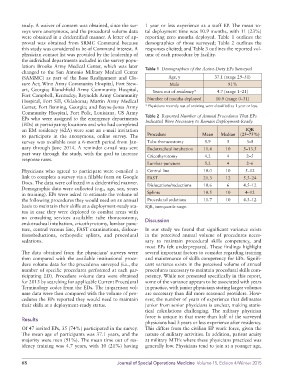
          this study was considered to be of Command interest. A   responses elicited; and Table 3 outlines the reported vol-
          physician contact list was provided by the leadership of   ume of each procedure by facility.
          the individual departments included in the survey popu-
          lation: Brooke Army Medical Center, which was later   Table 1  Demographics of the Active-Duty EPs Surveyed
          changed to the San Antonio Military Medical Center
          (SAMMC) as part of the Base Realignment and Clo-             Age, y             37.1 (range 29–51)
          sure Act; Winn Army Community Hospital, Fort Stew-           Male                    91%
          art, Georgia; Blanchfield Army Community Hospital,    Years out of residency*    4.7 (range 1–21)
          Fort Campbell, Kentucky; Reynolds Army Community
          Hospital, Fort Sill, Oklahoma; Martin Army Medical   Number of months deployed  10.9 (range 0–31)
          Center, Fort Benning, Georgia; and Bayne-Jones Army   *Physicians recently out of training were classified as 1 year or less.
          Community Hospital, Fort Polk, Louisiana. US Army
          EPs who were assigned to the emergency departments   Table 2  Reported Number of Annual Procedures That EPs
                                                             Indicated Were Necessary to Remain Deployment-Ready
          (EDs) at participating locations and who had completed
          an EM residency (62A) were sent an e-mail invitation                                         IQR
          to participate  in  the anonymous,  online survey. The   Procedure         Mean   Median  (25–75%)
          survey was available over a 6-month period from Jan-  Tube thoracostomy     5.9      5       3–8
          uary through June 2014. A reminder e-mail was sent   Endotracheal intubation  11.4  10      5–13.5
          part way through the study, with the goal to increase   Cricothyrotomy      4.2      4       2–5
          response rates.
                                                              Lumbar puncture         5.2      4       2–6
          Physicians who agreed to participate were e-mailed a   Central line        10.0     10      5–12
          link to complete a survey via a fillable form on Google   FAST             21.3     12      5.5–24
          Docs. The data were collected in a deidentified manner.   Dislocations/reductions  10.6  6  4.5–12
          Demographic data were collected (e.g., age, sex, years
          in training). EPs were asked to estimate the volume of   Splints           10.5     10      4–12
          the following procedures they would need on an annual   Procedural sedations  11.7  10      4.5–12
          basis to maintain their skills at a deployment-ready sta-  IQR, interquartile range.
          tus in case they were deployed to combat areas with
          no consulting services available: tube thoracostomy,   Discussion
          endotracheal intubation, cricothyrotomy, lumbar punc-
          ture, central venous line, FAST examinations, disloca-  In our study we found that significant variance exists
          tions/reductions, orthopedic splints, and procedural   in the perceived annual volume of procedures neces-
          sedations.                                         sary to maintain procedural skills competency, and
                                                             most EPs felt underprepared. These findings highlight
          The data obtained from the physicians’ surveys were   several important factors to consider regarding training
          then compared with the available institutional proce-  and maintenance of skills competency for EPs. Signifi-
          dure volume data for the procedures surveyed (i.e., the   cant variance exists in the perceived volume of annual
          number of specific procedures performed at each par-  procedures necessary to maintain procedural skills com-
          ticipating  ED).  Procedure  volume  data were  obtained   petency. While not presented specifically in this report,
          for 2013 by searching for applicable Current Procedural   some of the variance appears to be associated with years
          Terminology codes from the EDs. The in-garrison vol-  in practice, with junior physicians stating larger volumes
          ume data were then compared with the volume of pro-  are necessary than did more seasoned providers. How-
          cedures the EPs reported they would need to maintain   ever, the number of years of experience that delineates
          their skills at a deployment-ready status.         junior from senior physicians is unclear, making statis-
                                                             tical calculations challenging. The military physician
                                                             force is unique in that more than half of the surveyed
          Results
                                                             physicians had 3 years or less experience after residency.
          Of 47 invited EPs, 35 (74%) participated in the survey.   This differs from the civilian EP work force, given the
          The mean age of participants was 37.1 years, and the   nature of military activities. In addition, patient acuity
          majority were men (91%). The mean time out of res-  at military MTFs where these physicians practiced was
          idency training was 4.7 years, with 10 (21%)   having   generally low. Physicians tend to join at a younger age,


          68                                     Journal of Special Operations Medicine  Volume 15, Edition 4/Winter 2015

