


Page 84 - Journal of Special Operations Medicine - Winter 2015
P. 84
wound was created by an open surgical dissection to   Figure 2  Screen shot of remote mentoring surgeon’s
          the common femoral artery proximal to the bifurcation   computer.
          into the superficial and profunda branches and creation
          of a near transsection with only the arterial back wall
          left intact to prevent retraction of the ends. Thereafter, a
          firefighter with paramedical training but no previous ul-
          trasound experience was guided by a remote ultrasound
          expert to image the groin and especially the arteriotomy
          site before and after application of a single iTClamp.

          The firefighter, located in the Memphis, Tennessee, lab-
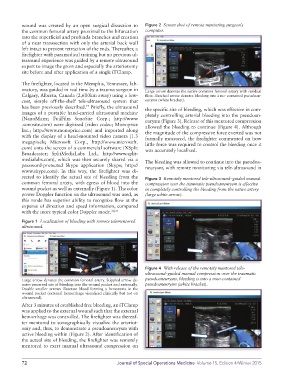
          oratory, was guided in real time by a trauma surgeon in   Large arrow denotes the native common femoral artery with residual
          Calgary, Alberta, Canada (2,600km away) using a low-  flow. Hatched arrow denotes bleeding into a no- contained pseudoan-
          cost,  simple  off-the-shelf  tele-ultrasound  system  that   eurysm (white bracket).
          has been previously described.  Briefly, the ultrasound   the specific site of bleeding, which was effective in com-
                                     19
          images of a portable hand-carried ultrasound machine   pletely controlling arterial bleeding into the pseudoan-
          (NanoMaxx;  FujiFilm  SonoSite  Corp.; http://www   eurysm (Figure 3). Release of this mentored compression
          .sonosite.com) were digitized (video codec; Monoprice   allowed the bleeding to continue (Figure 4). Although
          Inc.; http://www.monoprice.com) and imported along   the magnitude of the compressive force exerted was not
          with the display of a head-mounted video camera (1.3   formally measured, the firefighter commented on how
          megapixels; Microsoft Corp., http://www.microsoft.  little force was required to control the bleeding once it
          com) onto the screen of a commercial software (XSplit   was accurately localized.
          Broadcaster; SplitMediaLabs Ltd., http://www.split-
          medialabs.com), which was then securely shared via a   The bleeding was allowed to continue into the pseudoa-
          password-protected Skype application (Skype; http://  neurysm, with remote monitoring via tele-ultrasound in
          www.skype.com).  In  this  way, the  firefighter  was  di-
          rected to identify the actual site of bleeding from the   Figure 3  Remotely mentored tele-ultrasound–guided manual
          common femoral artery, with egress of blood into the   compression over the traumatic pseudoaneurysm is effective
          wound pocket as well as externally (Figure 1). The color   in completely controlling the bleeding from the native artery
          power Doppler function on the ultrasound was used, as   (large white arrow).
          this mode has superior ability to recognize flow at the
          expense of direction and speed information, compared
          with the more typical color Doppler mode. 20,21
          Figure 1  Localization of bleeding with remote telementored
          ultrasound.


                                                             Figure 4  With release of the remotely mentored tele-
                                                             ultrasound–guided manual compression over the traumatic
          Large arrow denotes the common femoral artery. Stippled arrow de-  pseudoaneurysm, bleeding is into a now-contained
          notes perceived site of bleeding into the wound pocket and externally.   pseudoaneurysm (white bracket).
          Double smaller arrows illustrate blood forming a hematoma in the
          wound pocket (external hemorrhage visualized clinically but not on
          ultrasound).
          After 3 minutes of established free bleeding, an iTClamp
          was applied to the external wound such that the external
          hemorrhage was controlled. The firefighter was thereaf-
          ter mentored to sonographically visualize the arteriot-
          omy and, thus, to demonstrate a pseudoaneurysm with
          active bleeding within (Figure 2). After identification of
          the actual site of bleeding, the firefighter was remotely
          mentored to exert manual ultrasound compression on


          72                                     Journal of Special Operations Medicine  Volume 15, Edition 4/Winter 2015

