


Page 89 - Journal of Special Operations Medicine - Winter 2015
P. 89
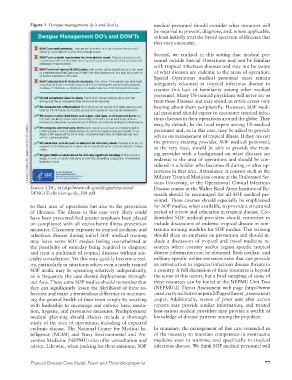
Figure 1  Dengue management do’s and don’ts.       medical personnel should consider what resources will
                                                                 be required to prevent, diagnose, and, where applicable,
                                                                 at least initially treat the broad spectrum of illnesses that
                                                                 they may encounter.

                                                                 Second, we realized in this setting that medical per-
                                                                 sonnel outside Special Operations may not be familiar
                                                                 with tropical infectious diseases and may not be aware
                                                                 of what diseases are endemic to the areas of operation.
                                                                 Special  Operations  medical  personnel  must  remain
                                                                 adequately educated in tropical infectious disease to
                                                                 counter this lack of familiarity among other medical
                                                                 personnel. Many US-trained physicians will never see or
                                                                 treat these illnesses and may spend an entire career only
                                                                 hearing about them peripherally. However, SOF medi-
                                                                 cal personnel should expect to encounter tropical infec-
                                                                 tious diseases in their operations around the globe. They
                                                                 may, by default, be the local expert among US medical
             Courtesy of Centers for Disease Control and Prevention.  advice on management of tropical illness. If they are not
                                                                 personnel and, as in this case, may be asked to provide

                                                                 the primary treating provider, SOF medical personnel,
                                                                 at the very least, should be able to provide the treat-
                                                                 ing provider with a background on what illnesses are
                                                                 endemic to the area of operations and should be con-
                                                                 sidered in a Soldier who becomes ill during or after op-

                                                                 Military Tropical Medicine course at the Uniformed Ser-
                                                                 vices University, or the Operational Clinical Infectious
              Source: CDC, at http://www.cdc.gov/dengue/resources/  erations in that area. Attendance at courses such as the
                                                                 Disease course at the Walter Reed Army Institute of Re-
              DENGUE-clinician-guide_508.pdf.                    search should be encouraged for all SOF medical per-
                                                                 sonnel. These courses should especially be emphasized
              to their area of operations but also to the prevention   for SOF medics, when available, to provide a structured
              of illnesses. The illness in this case very likely could   period of review and education in tropical disease. Cre-
              have been prevented had greater emphasis been placed   dentialed SOF medical providers should remember to
              on compliance with all vector-borne illness prevention   include discussions of endemic tropical disease in non-
              measures. Classroom exposure to tropical medicine and   trauma training modules for SOF medics. This training
              infectious disease during initial SOF medical training   should place an emphasis on prevention and should in-
              may leave some SOF medics feeling overwhelmed at   clude a discussion of tropical and travel medicine re-
              the possibility of someday being required to diagnose   sources where country and/or region specific tropical
              and treat a multitude of tropical diseases without spe-  disease information can be obtained. Both civilian- and
              cialty consultation. Yet this may quickly become a real-  military-specific online resources exist that can provide
              ity, particularly in situations where even a newly trained   an introduction to expected infectious disease threats in
              SOF medic may be operating relatively independently,   a country. A full discussion of these resources is beyond
              as is frequently the case during deployments through-  the scope of this report, but a brief sampling of some of
              out Asia. These same SOF medics should remember that   these resources can be found at the NEPMU Unit Two
              they can significantly lessen the likelihood of these in-  (NEPMU-2) Threat Assessment web page (http://www
              fections and make a tremendous difference in maintain-  .med.navy.mil/sites/nepmu2/Pages/threat_assessment
              ing the general health of their team simply by working   .aspx). Additionally, review of prior unit after action
              with leadership to encourage and enforce basic sanita-  reports may provide similar information, and trusted
              tion, hygiene, and preventive measures. Predeployment   host-nation medical providers may provide a wealth of
              medical planning should always include a thorough   knowledge of disease patterns among the populace.
              study of the area of operations, including of expected
              endemic disease. The National Center for Medical In-  In summary, the management of this case reminded us
              telligence (NCMI) and Navy Environmental and Pre-  of the necessity to maintain competence in nontrauma
              ventive Medicine (NEPMU) also offer consultation and   medicine  even in wartime, and specifically in  tropical
              advice. Likewise, when packing for these missions, SOF   infectious disease. We think SOF medical personnel will


              Tropical Disease Case Study: Fever and Thrombocytopenia                                         77

