


Page 69 - Journal of Special Operations Medicine - Winter 2015
P. 69
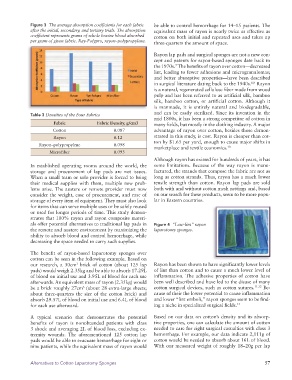
Figure 3  The average absorption coefficients for each fabric   be able to control hemorrhage for 14–15 patients. The
              after the initial, secondary, and tertiary trials. The absorption   equivalent mass of rayon is nearly twice as effective as
              coefficient represents grams of whole bovine blood absorbed   cotton on both initial and repeated uses and takes up
              per gram of given fabric. Ray-Polypro, rayon–polypropylene.  three-quarters the amount of space.

                                                                 Rayon lap pads and surgical sponges are not a new con-
                                                                 cept and patents for rayon-based sponges date back to
                                                                 the 1970s.  The benefits of rayon over cotton—decreased
                                                                         7
                                                                 lint, leading to fewer adhesions and microgranulomas;
                                                                 and better absorptive properties—have been described
                                                                 in surgical literature dating back to the 1940s.  Rayon
                                                                                                         8,9
                                                                 is a natural, regenerated cellulose fiber made from wood
                                                                 pulp and has been referred to as artificial silk, bamboo
                                                                 silk, bamboo cotton, or artificial cotton. Although it
                                                                 is manmade, it is entirely natural and biodegradable,
              Table 3 Densities of the Four Fabrics              and can be easily sterilized. Since its invention in the
                                                                 mid 1800s, it has been a strong competitor of cotton in
                       Fabric            Fabric Density, g/cm3   many fields, but mostly in the clothing industry. A major
                       Cotton                   0.087            advantage of rayon over cotton, besides those demon-
                       Rayon                    0.12             strated in this study, is cost. Rayon is cheaper than cot-
                                                                 ton by $1.65 per yard, enough to cause major shifts in
                 Rayon–polypropylene            0.098
                                                                 marketplace and textile economics. 10
                     Microfiber                  0.093
                                                                 Although rayon has existed for hundreds of years, it has
              In established operating rooms around the world, the   some limitations. Because of the way rayon is manu-
              storage and procurement of lap pads are not issues.   factured, the strands that compose the fabric are not as
              When a small team or solo provider is forced to bring   long as cotton strands. Thus, rayon has a much lower
              their  medical  supplies  with  them,  multiple  new  prob-  tensile strength than cotton. Rayon lap pads are sold
              lems arise. The austere or remote provider must now   both with and without cotton mesh nettings and, based
              consider the weight, ease of procurement, and ease of   on our search for these products, seem to be more popu-
              storage of every item of equipment. They must also look   lar in Eastern countries.
              for items that can serve multiple uses or be safely reused
              or used for longer periods of time. This study demon-
              strates that 100% rayon and rayon composite materi-
              als offer potential alternatives to traditional lap pads in   Figure 4  “Low-lint” rayon
              the remote and austere environment by maximizing the   laparotomy sponges.
              ability to absorb blood and control hemorrhage, while
              decreasing the space needed to carry such supplies.

              The  benefit  of  rayon-based  laparotomy  sponges  over
              cotton can be seen in the following example. Based on
              our research, a 30cm  brick of cotton (about 125 lap   Rayon has been shown to have significantly lower levels
                                 3
              pads) would weigh 2.35kg and be able to absorb 17.29L   of lint than cotton and to cause a much lower level of
              of blood on initial use and 3.95L of blood for each use   inflammation. The adhesive properties of cotton have
              afterwards. An equivalent mass of rayon (2.35kg) would   been well described and have led to the disuse of many
              be a brick roughly 27cm  (about 28 extra-large sheets;   cotton surgical devices, such as cotton sutures. 11,12  Be-
                                   3
              about three-quarters the size of the cotton brick) and   cause of their the lower potential to cause inflammation
              absorb 29.57L of blood on initial use and 6.4L of blood   and lower “lint emboli,” rayon sponges seem to be find-
              for each use afterward.                            ing a niche in specialized surgical fields. 13

              A typical scenario that demonstrates the potential   Based on our data on cotton’s density and its absorp-
              benefits of rayon is nonobtunded patients with class   tive properties, one can calculate the amount of cotton
              3 shock and averaging 2L of blood loss, excluding ex-  needed to care for eight surgical casualties with class 3
              tremity wounds. The aforementioned 125 cotton lap   hemorrhage. For example, our data indicate 2,111g of
              pads would be able to evacuate hemorrhage for eight or   cotton would be needed to absorb about 16L of blood.
              nine patients, while the equivalent mass of rayon would   With our measured weight of roughly 18–20g per lap


              Alternatives to Cotton Laparotomy Sponges                                                       57

