


Page 67 - Journal of Special Operations Medicine - Winter 2015
P. 67
the large amount of liquid and clotted blood is removed.
              Laparotomy pads are bulky and the amount needed to
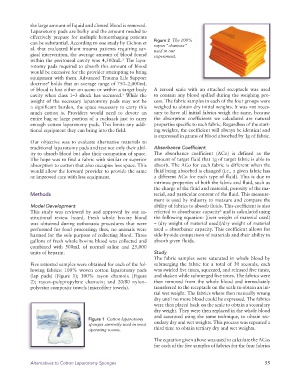
              effectively prepare for multiple hemorrhaging patients   Figure 2  The 100%
              can be substantial. According to one study by Cichon et   rayon “chamoix”
              al. that evaluated blunt trauma patients requiring sur-  used in our
              gical intervention, the average amount of blood found   experiment.
              within the peritoneal cavity was 4,500mL.  The lapa-
                                                    3
              rotomy pads required to absorb this amount of blood
              would be excessive for the provider attempting to bring
              equipment with them. Advanced Trauma Life Support
              doctrine  holds that an average range of 750–2,000mL
                     4
              of blood is lost either on scene or within a target body   A  zeroed  scale  with an  attached  receptacle  was  used
              cavity when class 1–3 shock has occurred.  While the   to contain any blood spilled during the weighing pro-
                                                    5
              weight  of  the  necessary  laparotomy  pads  may  not  be   cess. The fabric samples in each of the four groups were
              a significant burden, the space necessary to carry this   weighed to obtain dry initial weights. It was not neces-
              much cotton is. Providers would need to devote an   sary to have all initial fabrics weigh the same, because
              entire bag or large portion of a rucksack just to carry   the absorption coefficients we calculated are natural
              enough cotton laparotomy pads. This limits any addi-  properties specific to each fabric. Regardless of the start-
              tional equipment they can bring into the field.    ing weights, the coefficient will always be identical and
                                                                 is expressed in grams of blood absorbed by 1g of fabric.
              Our objective was to evaluate alternative materials to
              traditional laparotomy pads and test not only their abil-  Absorbance Coefficient
              ity to absorb blood but also their occupation of space.   The  absorbance  coefficient  (ACo)  is  defined  as  the
              The hope was to find a fabric with similar or superior   amount of target fluid that 1g of target fabric is able to
              absorption to cotton that also occupies less space. This   absorb. The ACo for each fabric is different when the
              would allow the forward provider to provide the same   fluid being absorbed is changed (i.e., a given fabric has
              or improved care with less equipment.              a different ACo for each type of fluid). This is due to
                                                                 intrinsic properties of both the fabric and fluid, such as
                                                                 the charge of the fluid and material, porosity of the ma-
              Methods                                            terial, and particular content of the fluid. This measure-
                                                                 ment is used by industry to measure and compare the
              Model Development                                  ability of fabrics to absorb fluids. This coefficient is also
              This study was reviewed by and approved by our in-  referred to absorbance capacity  and is calculated using
                                                                                            6
              stitutional  review  board.  Fresh  whole  bovine  blood   the following equation: [(wet weight of material used)
              was  obtained  during euthanasia  procedures  that  were   − (dry weight of material used)]/dry weight of material
              performed for food processing; thus, no animals were   used = absorbance capacity. This coefficient allows for
              harmed for the sole purpose of collecting blood. Three   side-by-side comparison of materials and their ability to
              gallons of fresh whole bovine blood was collected and   absorb given fluids.
              combined with 500mL of normal saline and 25,000
              units of heparin.                                  Study
                                                                 The fabric samples were saturated in whole blood by
              Five untested samples were obtained for each of the fol-  submerging the fabric for a total of 30 seconds; each
              lowing fabrics: 100% woven cotton laparotomy pads   was swirled five times, squeezed, and released five times,
              (lap pads) (Figure 1); 100% rayon chamoix (Figure   and shaken while submerged five times. The fabrics were
              2); rayon–polypropylene chamoix; and 20/80 nylon–   then removed from the whole blood and immediately
              polyester composite towels (microfiber towels).    transferred to the receptacle on the scale to obtain an ini-
                                                                 tial wet weight. The fabrics where then manually wrung
                                                                 dry until no more blood could be expressed. The fabrics
                                                                 were then placed back on the scale to obtain a secondary
                                                                 dry weight. They were then replaced in the whole blood
                                                                 and saturated using the same technique, to obtain sec-
                                      Figure 1  Cotton laparotomy
                                      sponges currently used in most   ondary dry and wet weights. This process was repeated a
                                      operating rooms.           third time to obtain tertiary dry and wet weights.

                                                                 The equation given above was used to calculate the ACos
                                                                 for each of the five samples of fabrics for the four fabrics


              Alternatives to Cotton Laparotomy Sponges                                                       55

